
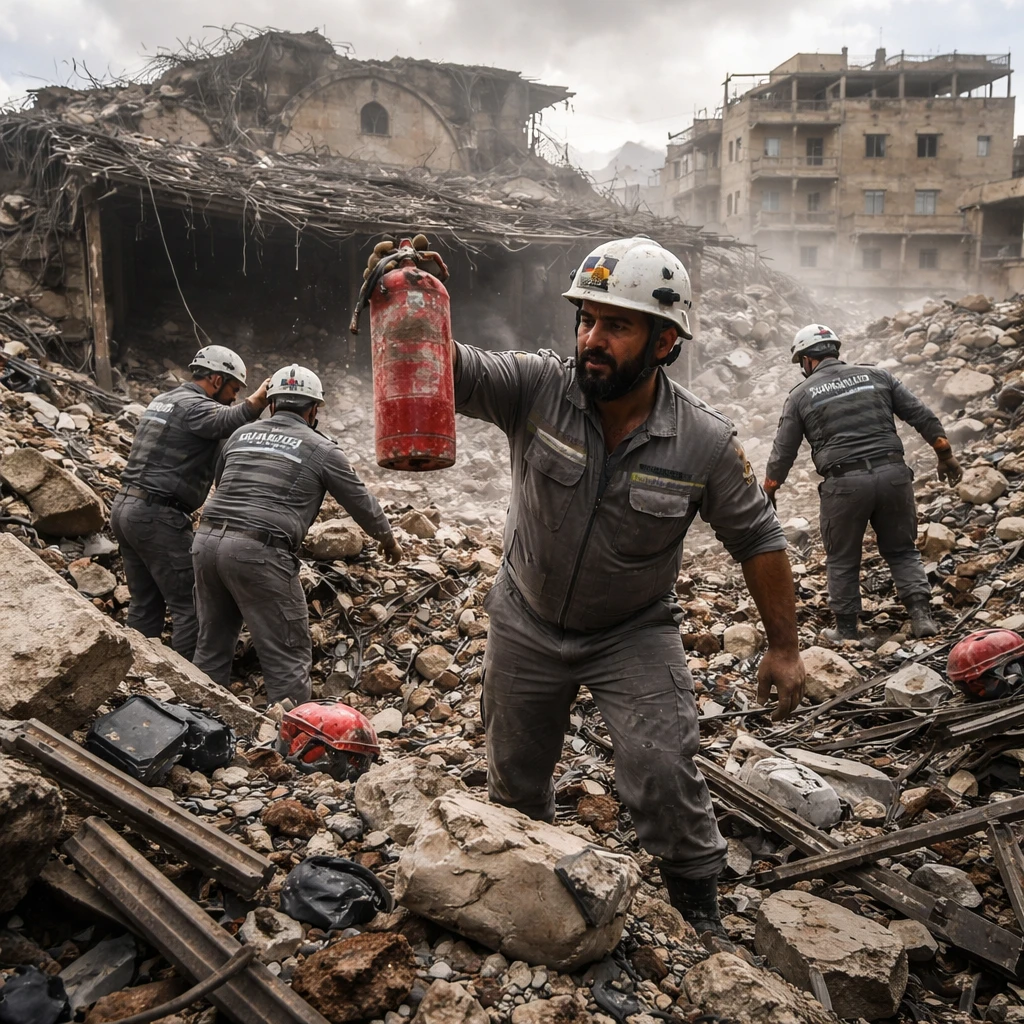
Nabatieh, Lebanon - June 18: Rescue workers in the southern city of Nabatieh are salvaging belongings and archives from the ruins of their civil defence headquarters after it was destroyed in an airstrike last month. Those on site said they had believed the marked civil defence centre would be spared, but the building was hit and reduced to rubble.
Clad in grey civil defence overalls, Hussein Daqdouq described the emotional toll as men and women sifted through debris looking for any item that could be retrieved. "We used to spend more time at this centre than we did in our homes. We lost everything here," he said, while colleagues hauled items from the wreckage. One rescuer pulled a fire extinguisher free from the collapsed structure.
Volunteers and staff have returned daily to comb through what remains of the building. "We’re coming here every day, we’re searching and looking around to see if we can find any memories, if we find any of our belongings ... our memories, archives," Daqdouq said as workers continued to clear the site.
Nabatieh, a provincial capital roughly 15 km (10 miles) from the Israeli border, has endured heavy bombardment over three months of conflict between Israel and Iran-backed Hezbollah. The city also suffered severe damage in the conflict two years ago and now faces renewed destruction in the current hostilities.
Hussein Fakih, the regional head of the civil defence service, said nine members of the Nabatieh civil defence have been killed in this war and another 15 wounded. He added that two of those killed died in a drone strike in front of the centre on May 12, an attack that led the civil defence to relocate operations away from the building.
On May 23 the centre itself was struck directly and completely destroyed, Fakih said. He told Reuters that members of the civil defence had been targeted while carrying out firefighting, ambulance and rescue operations.
Malek Zineddine, a member of the Nabatieh civil defence, said the attack came without prior warning and that the civil defence symbol - a blue triangle set within an orange circle - had been displayed on the roof. "That’s what made us so surprised because we always respected the Civil Defence emblem," Zineddine said. "We ruled out the possibility of the Israeli enemy targeting us."
Lebanon’s health ministry reported on May 24 that the civil defence centre in Nabatieh had been destroyed in an airstrike the previous day and that the building had been vacated at the time.
Human toll and displacement
Lebanese authorities say Israeli strikes have killed nearly 4,000 people in Lebanon since March 2, including 746 women, children and healthcare workers. The health ministry also reports that about 1.2 million people have been displaced across the country.
Municipal council member Khodr Kodeih said residents had started to return this week, encouraged by an interim U.S.-Iranian agreement intended to end the regional conflict immediately and permanently on all fronts, including Lebanon. However, he added that renewed bombardment prompted another wave of departure and the city has emptied out again at times.
Kodeih said the scale of destruction in Nabatieh in this round of fighting is greater than in 2024. "There may be more than 1,500 or 2,000 residential or commercial units affected," he said.
Lebanon has not completed a full assessment of damage in the south, but a study by the National Council for Scientific Research found more than 9,970 housing units in the Nabatieh area were destroyed or damaged between March 2 and May 17, the highest level of destruction recorded among Lebanese districts during that period.
Security situation around Nabatieh
While Israeli airstrikes have struck Nabatieh heavily, Israeli ground forces had not entered the city, according to a foreign security official and Lebanese security sources. The foreign security official said Israeli troops had been attempting to encircle Nabatieh but encountered strong resistance from Hezbollah fighters in surrounding villages and on nearby hilltops.
The combination of direct hits on emergency infrastructure and ongoing bombardment of surrounding towns has complicated rescue and relief efforts and heightened the strain on services and residents alike.
What remains
At the destroyed civil defence compound, workers continue to salvage what they can while acknowledging that much has been lost. Personal items, equipment and archives that once supported emergency response have been consumed by the strike and its aftermath. The loss has deprived local responders of their primary coordination hub at a time when demand for firefighting, ambulance and rescue operations has surged.
As Nabatieh confronts large-scale damage and displacement, authorities and residents face the immediate tasks of documenting losses, locating survivors, and attending to the wounded and displaced, even as hostilities continue to shape access and safety.