
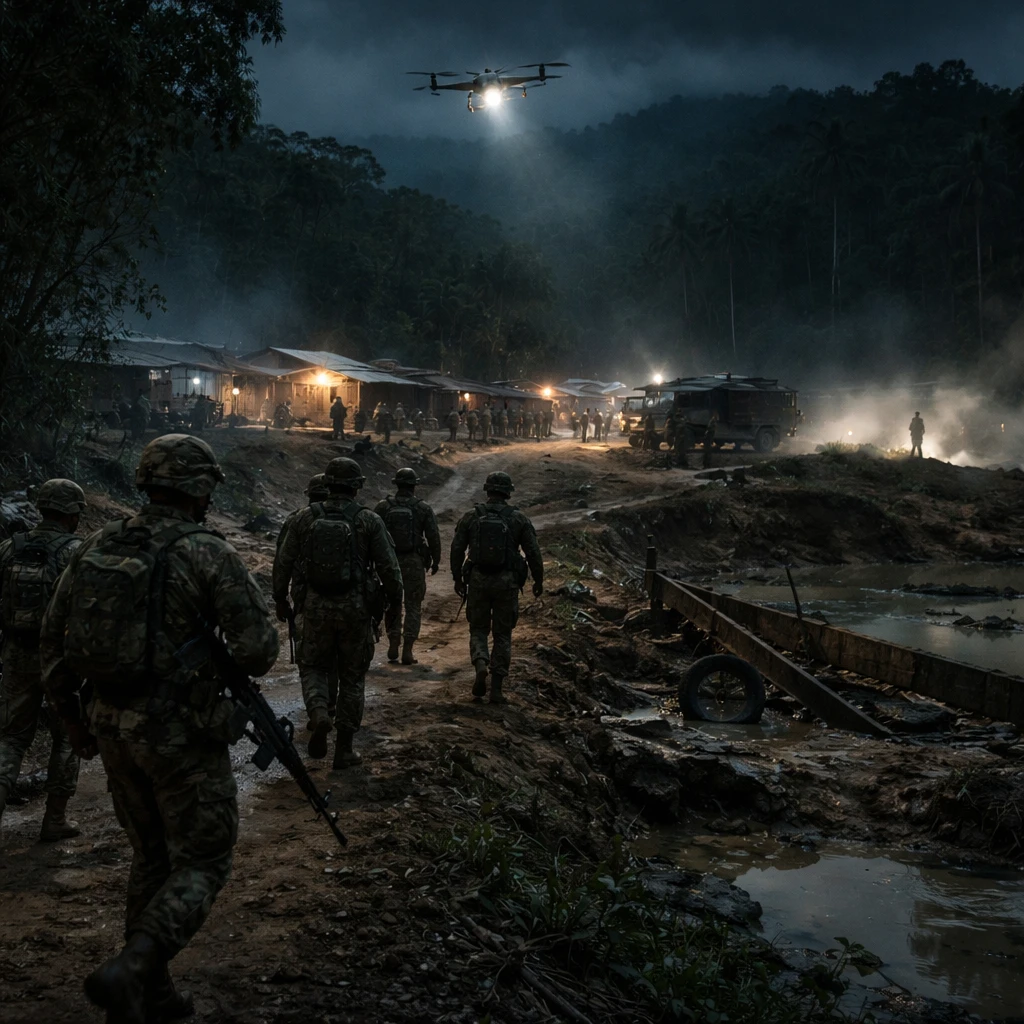
Venezuela has moved military forces into a key portion of its gold-producing region to confront groups accused of controlling illegal mining operations, local residents and human rights groups said.
Sources who monitor the area reported troops operating near Las Claritas in southern Bolivar state. Las Claritas is identified by observers as one of the principal hubs for illicit gold extraction within the Orinoco Mining Arc, a mineral-rich zone that stretches close to Venezuela's frontiers with Guyana and Brazil.
The Venezuelan Communications Ministry had not returned requests for comment and the government has not publicly acknowledged the campaign, according to the same sources.
Five residents told Reuters they heard explosions and gunfire in the area. Those accounts described scenes that kept people indoors and prompted businesses to close.
"Bombs and gunfire could be heard in the jungle," a 45-year-old resident said. "There are mines in those areas. This is bad; you can’t go out." A shopkeeper in Las Claritas said drones circled low over the town for hours overnight. All of the residents who spoke declined to be named out of concern for their safety.
Non-governmental organizations and investigators backed by the United Nations have described much of the activity in the Orinoco Mining Arc as being under the control of organized criminal groups and armed factions.
"The Venezuelan Army is deploying a massive operation in Las Cristinas and at Km 88 in Bolivar state," rights group Provea said in a post on X. "We warn of the risk of extrajudicial executions and arbitrary detentions against the civilian population in the area."
The reported operation comes as Venezuela's new government seeks to reopen sectors that have been largely closed to foreign capital. In January, U.S. forces captured Venezuelan President Nicolas Maduro, leaving Delcy Rodriguez to take up the post on an interim basis. Since that time, Washington and Caracas have held talks on steps to revive investment in oil and mining.
In April, Venezuela enacted a new mining law intended to make the sector more attractive to foreign companies. U.S. Interior Secretary Doug Burgum said the Venezuelan government had pledged security guarantees for incoming firms.
Canadian miner Crystallex had earlier planned to develop the Las Cristinas gold deposit until then-President Hugo Chavez halted the project in 2008 as part of a broad nationalization program affecting electricity, telecommunications, cement, steel and oil. Those takeovers left foreign investment in mining largely curtailed.
Some industry observers, referenced in the original reporting, see potential for a short-term rebound in exports, particularly gold. However, they caution that any recovery will require substantial capital injection and renewed exploration activity to restore production at scale.
Context and immediate implications
The deployment near Las Claritas underscores the intersection of security and commercial objectives in Venezuela's strategy for its mining sector. The presence of armed groups in the Orinoco Mining Arc has been well-documented by rights organizations and U.N.-affiliated investigators, and the government's move to project military control appears linked to efforts to make the region accessible to outside investors under new legal and security frameworks.
Observers quoted in the reporting indicate that re-establishing formal mining activity - particularly involving foreign partners - will require not only legal reforms but also significant investment and renewed geological exploration.