
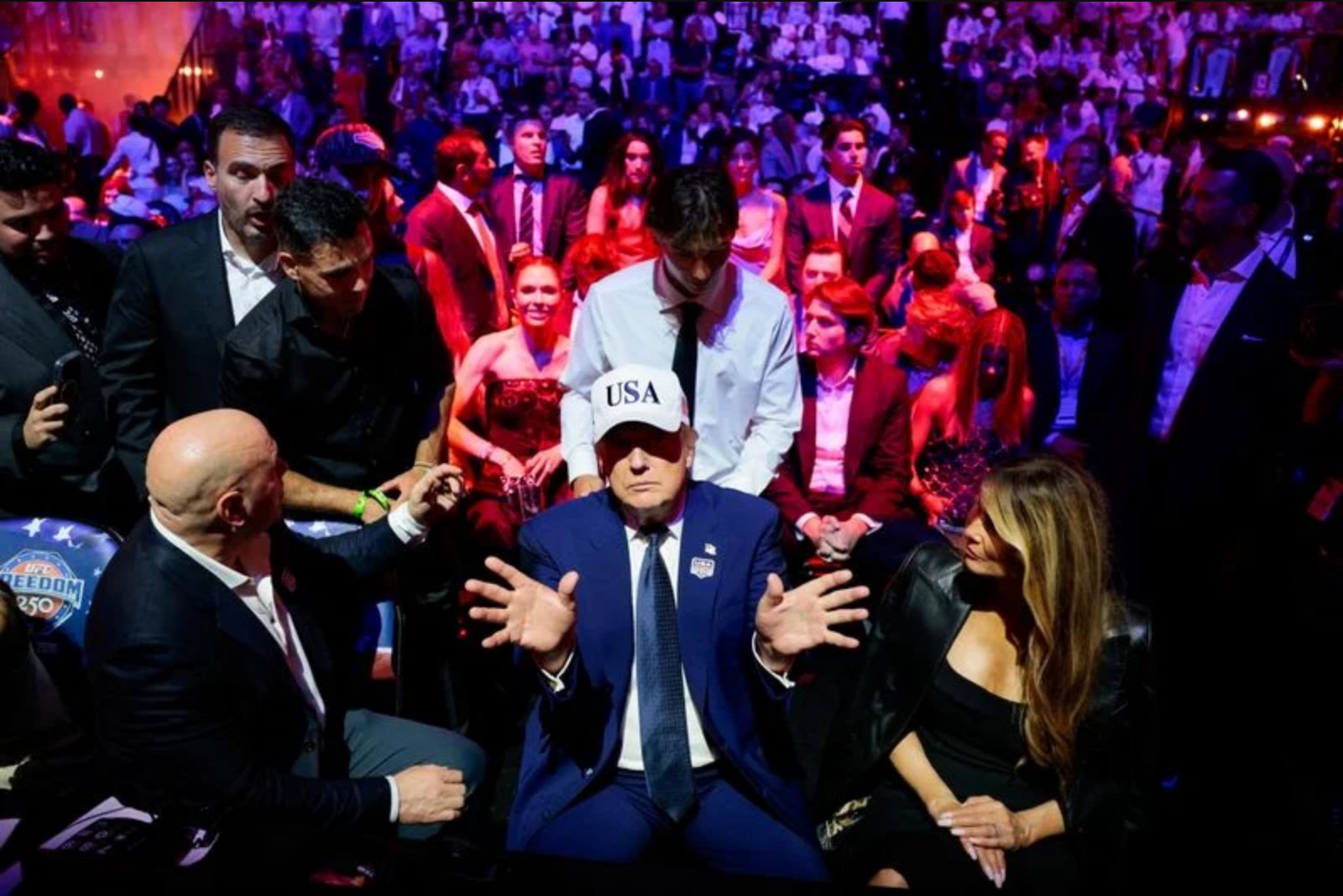
President Donald Trump staged a seven-fight Ultimate Fighting Championship card on the White House lawn on Sunday, marking the first time a professional sporting event has been held on the presidential grounds. The spectacle, timed as part of the nation’s 250th anniversary activities and occurring on the president’s 80th birthday, mixed entertainment, corporate branding and personal ties to the administration.
The card began hours after an announcement that Trump and Iranian officials had reached a peace agreement to end a four-month-old war between their countries, a conflict the article says had pushed consumer prices to a three-year high. Within minutes of taking his ringside seat - while the Marine Corps band played a live rendition of AC/DC’s "Thunderstruck" - the president posted details of the Iran deal to social media and took calls from journalists.
Inside the eight-sided cage, sponsorship and branding were prominent. The canvas carried logos from several large U.S. corporations and organizations described as political allies, including video-streaming platform Rumble, shipping technology company EasyPost and conservative advocacy group Turning Point USA. Closed captioning on the Paramount+ stream was sponsored by Trump Coin, the gold and silver tokens featuring the president’s profile sold by his family. A cryptocurrency firm referred to as World Liberty Financial, which is backed by two of the president’s sons and the son of his top diplomatic negotiator, contributed to a pool of bonus money awarded to fighters chosen by UFC officials.
The main event ended with heavy underdog Justin Gaethje defeating Ilia Topuria to claim the lightweight championship. Several fighters were ushered to meet the president after their victories. American fighter Bo Nickal climbed the cage fence following his knockout win to shake the president’s hand. Heavyweight Josh Hokit, after winning his bout, presented an item to the president which Trump wore around his neck before Hokit delivered an expletive-laced speech that included praise for the president and concluded with a misogynistic jab at former first lady Michelle Obama.
The fighting circuit said it would spend $60 million to cover the cost of staging the event, though neither the company nor the White House disclosed detailed financial arrangements. In March, Trump reported purchases of up to $50,000 in shares of TKO Group Holdings, the UFC’s publicly traded parent company. The event’s prominence had visible market references, with coverage noting short-term stock movements tied to TKO.
UFC chief executive Dana White, a long-time friend of the president, told attendees that the event was not meant to be interpreted as a political statement. "On America’s 250th birthday, hopefully tonight created some unity," White said. "Like even for the people that thought this was going to be some big political statement or something. This wasn’t. This was Americans, all Americans, celebrating the birthday." Early on Monday morning, White informed media that the temporary venue, nicknamed "The Claw" because its supporting structures rose above the White House roofline, would be taken down quickly.
Access to the roughly 4,000 seats inside the temporary arena was tightly managed. The White House recruited military personnel to occupy some seats, retained control over other tickets and, according to a person familiar with arrangements, UFC made some seats available to guests who paid more than $1 million. Tickets were not sold to the general public.
The event drew legal and public scrutiny. A judge declined to block the card in a lawsuit alleging the administration exceeded its authority in staging the event. An online poll of 4,531 U.S. adults conducted June 3-8 found that just 16% of respondents thought it was appropriate for the president to hold this type of event on the White House grounds. Polling referenced in the report also indicated that about a fifth of Americans identify as fans of mixed martial arts, but that fight fans did not have a particularly favorable view of the president’s overall job performance.
Commenting on the private nature of the celebration, independent streaming analyst Dan Rayburn observed that most Americans were not marking the country’s 250th anniversary by watching a UFC card. "The vast majority of Americans are not celebrating 250 years of America by watching a UFC fight," he said. "This is really a private event."
Despite suggestions by the president that the octagonal structure could remain permanently on the grounds, White told reporters that the UFC would remove the temporary venue promptly. The event also produced diplomatic scheduling consequences: France delayed the start of the Group of Seven summit, which was due to begin on Monday, in order to accommodate the president’s attendance at the UFC card.
Organizers and the White House have rejected claims of conflicts of interest, stating that the president’s family manages his private business matters. Beyond the immediate spectacle, the event illustrated several intersections of sport, commerce and politics. Sponsorship by corporate partners and companies connected to the president and his family, the involvement of military personnel as seated guests, large sums committed to staging the show and constrained ticket distribution combined to make the event a unique blend of the public and the private.
In the wake of the show, the UFC’s chief executive emphasized unity and a nonpolitical framing while many observers and a substantial portion of the public voiced discomfort with the blending of presidential authority, family business ties and partisan-aligned sponsors in a White House celebration. The legal challenge to the event failed to halt it and the temporary arena is slated for quick removal as organizers wind down the production.
Key points
- For the first time, a professional sporting event was held on the White House grounds - a seven-fight UFC card staged as part of 250th anniversary activities and coinciding with the president’s 80th birthday.
- Corporate sponsors and firms tied to the president’s family and allies were prominently visible, with the UFC saying it would cover $60 million of event costs and closed captioning sponsored by Trump Coin; the president reported owning up to $50,000 in TKO Group Holdings stock in March.
- Access to seats was tightly controlled - the White House filled some seats with military personnel and UFC reportedly offered seats to guests paying more than $1 million - and a judge declined to block the event in a legal challenge.
Risks and uncertainties
- Conflict of interest concerns - The layering of personal business ties, sponsorships and presidential duties raises legal and ethical questions for the sectors linking politics, media and corporate sponsors.
- Public and political backlash - Low public approval for the event’s appropriateness and vocal criticism could reverberate across political networks and media companies associated with the production and distribution.
- Operational and reputational risks for sponsors - Corporations whose brands were prominent at the event may face reputational fallout or customer pushback, affecting marketing and digital media partners.
Conclusion
The White House lawn UFC card was an unprecedented melding of presidential theater, private commercial interests and athletic spectacle. It proceeded in the face of legal challenges and public skepticism, while occurring alongside a major diplomatic announcement and prompting adjustments to international scheduling. Organizers and senior figures framed the event as a unifying celebration, but the combination of corporate sponsorship, family-linked contributors and managed access kept scrutiny and debate alive as the temporary venue is dismantled.