
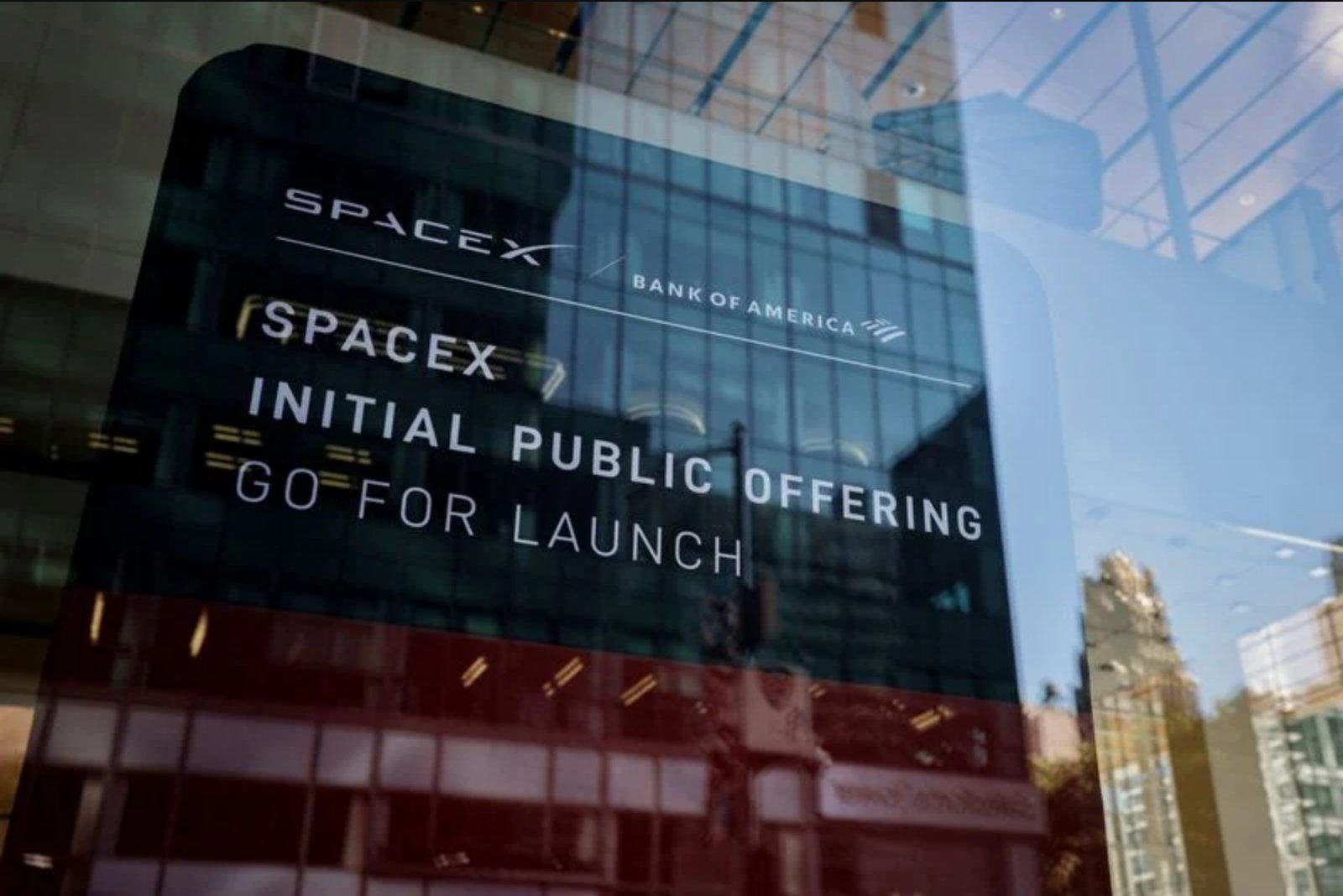
SpaceX has priced what will become the largest initial public offering in U.S. history, setting the sale at $135 per share on Thursday and selling 555.56 million shares for proceeds of $75 billion. The price implies a total equity value of $1.77 trillion based on 13.08 billion shares outstanding, a level that would place the company among the largest U.S.-listed firms once trading begins on the Nasdaq on Friday.
The offering marks the culmination of a protracted effort to take Elon Musk’s aerospace and satellite operator public at an unprecedented scale. Under the terms disclosed, SpaceX reserved 30% of the IPO allocation for retail investors - an unusually large portion - and the company and its bankers agreed on the offer price prior to conducting the customary roadshow with investors. The structure of the deal preserves concentrated founder control: following the offering, Musk will retain approximately 82% of SpaceX.
While the IPO produces a headline valuation that exceeds many household names, the company reported a loss in the prior year and its revenue base remains far smaller than those of several mega-cap peers. SpaceX’s management and backers have framed the company’s market opportunity as vast, citing a $28.5 trillion total addressable market that the company described as the largest in human history. That opportunity spans launches, satellite services, cloud and artificial intelligence infrastructure, among other businesses.
Starlink, SpaceX’s satellite internet division, currently accounts for the majority of the company’s revenue. According to the company, the Starlink network connects millions of consumer, enterprise and government customers across 164 countries, territories and other markets. The firm also says its launch operations have been dominant in recent years, accounting for more than four-fifths of the mass launched into orbit over the past three years.
SpaceX further disclosed a multiyear cloud services agreement with Alphabet’s Google that secures computing capacity to support growing demands for its services. The company also promotes a suite of AI-related initiatives, including xAI, which it positions as benefiting from access to SpaceX’s computing infrastructure and real-time data from the social platform X. The company noted that the combination of infrastructure, model and data provides a strategic advantage, even as external observers widely view xAI as trailing leaders in the segment.
The $1.77 trillion valuation sits above the prior largest IPO by proceeds and implied size. The biggest offering before this was Saudi Aramco’s December 2019 sale, which generated $25.6 billion at an initial valuation of $1.71 trillion; when adjusted for inflation, that Aramco offering equated to about $33.2 billion in proceeds and a $2.21 trillion valuation. The SpaceX valuation could rise if underwriters exercise their option to sell additional shares, a decision that typically must be made within 30 days after the offering.
Market participants and analysts have reacted to several unconventional features of the deal. Pricing was set ahead of the roadshow, a departure from standard practice where investor feedback during the marketing period influences offer terms. The substantial retail allocation will enlarge the base of individual shareholders from the outset. There was also a push from the company for early inclusion in major indexes, an outcome that would broaden potential passive buying demand once shares start trading.
At the same time, observers note a number of issues that temper immediate enthusiasm. The company incurred a loss in the most recent year, and some analysts have questioned whether the lofty valuation can be supported by current revenue trends. Competition among private space operators is intensifying, with rivals aiming to accelerate commercial deployments and pursue government contracts that could erode market share or pressure pricing.
Goldman Sachs, Morgan Stanley, BofA Securities, Citigroup and J.P. Morgan are the joint book-running managers on the deal. Investment banks and the company will complete the mechanics of the offering in the weeks that follow, including any decision on additional shares that underwriters are permitted to sell as part of a standard overallotment option.
SpaceX’s public prospectus frames the company’s mission around building systems and technologies to enable multiplanetary life and expanded human understanding of the universe, and it details an addressable market dominated in dollar terms by applications tied to AI and related infrastructure. While xAI and related AI efforts are described internally as complementary to SpaceX’s infrastructure and data access, external views broadly see those projects as behind category leaders.
As shares prepare to begin trading on Nasdaq, SpaceX will be listed among companies with vastly larger revenue bases in some sectors, yet the IPO itself represents a major milestone for the U.S. public markets and for Musk’s long-standing ambitions to scale a private aerospace enterprise into a public market titan.
Summary
SpaceX priced its IPO at $135 per share, selling 555.56 million shares and raising $75 billion. The implied equity valuation is $1.77 trillion on 13.08 billion shares outstanding. The deal reserves 30% of shares for retail buyers, was priced before the traditional roadshow, and keeps Elon Musk in control of roughly 82% of the company. Starlink is the main revenue driver, and the firm has a multiyear cloud pact with Google. Observers cite recent losses, competitive pressures and governance concentration as uncertainties.
Key points
- Record-sized U.S. IPO: 555.56 million shares sold at $135 each, raising $75 billion and valuing SpaceX at $1.77 trillion.
- Retail and governance features: 30% of shares set aside for retail investors and founder control maintained at an estimated 82% for Elon Musk.
- Revenue concentration and partnerships: Starlink supplies most revenue; the company has a multiyear cloud services agreement with Google and promotes AI initiatives tied to its infrastructure and data.
Risks and uncertainties
- Valuation scrutiny - The IPO’s $1.77 trillion valuation is subject to debate given SpaceX’s recent loss and revenue scale compared with other mega-cap firms.
- Competitive pressures - Rival space operators seeking commercial opportunities and government contracts could affect market dynamics and profitability.
- Revenue concentration - A significant portion of revenue currently derives from Starlink, exposing the company to risks tied to satellite internet market conditions.