
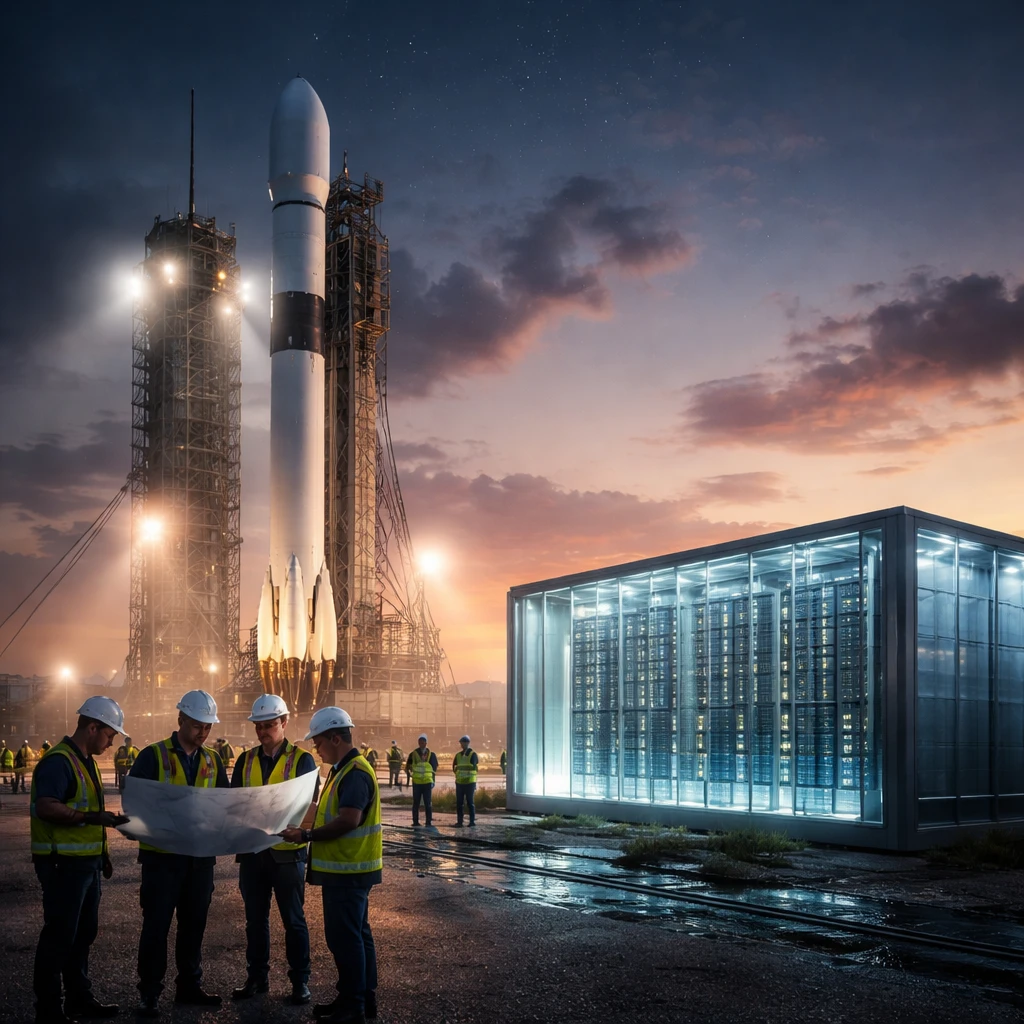
SpaceX's long-anticipated public listing, slated with shares set at $135 each and implying a market capitalization close to $1.75 trillion, is widely expected to have ripple effects across the space exploration industry and the broader deep-tech sector. The offering, projected to raise around $75 billion, dwarfs prior landmark flotations and could serve as a central test of investor demand for very large, capital-intensive technology companies.
Industry participants point to SpaceX's scale and ambition as a key reason the IPO may lift other space-focused businesses. As the largest firm operating in the sector, SpaceX's market debut may function as a litmus test of whether public investors are prepared to back companies that combine heavy engineering spend with multiyear product and capacity buildouts.
At the positioned price of $135 per share, the size of the flotation would outstrip the previous record IPO results by a substantial margin. The planned fundraising of approximately $75 billion far exceeds the roughly $25.6 billion raised by Saudi Aramco in 2019 and the $21.8 billion Alibaba achieved in 2014. Observers noted that the intended proceeds from SpaceX would exceed the total of U.S. IPO fundraising across the prior two-year period, underscoring the unprecedented scale on offer.
Analysts and market strategists have flagged the listing as a moment that could either validate or challenge recent optimism surrounding the technology sector. In particular, the reception of SpaceX's shares will be watched alongside the potential public offerings from high-profile artificial intelligence companies. Market participants have speculated that a series of mega-flotations, if successful, might channel substantial capital into the tech ecosystem and accelerate the formation of new, large-scale technology players.
The company's public profile is high. A Reuters/Ipsos poll conducted prior to the listing found that roughly 84% of Americans said they were familiar with SpaceX. The firm's visibility has risen in recent years due to the consumer-facing Starlink satellite internet service and headline-grabbing demonstrations of reusable rocket technology, developments that have also made SpaceX a significant contractor to U.S. government space programs.
SpaceX's business footprint has expanded beyond launch services. The group absorbed xAI, Elon Musk's artificial intelligence venture known for the Grok chatbot, and operates a major data center project under the Colossus name. The company's SEC prospectus indicates that it is renting capacity inside Colossus to external AI firms, including Anthropic and Google, which is owned by Alphabet. SpaceX has even proposed the concept of placing data centers in orbit as a potential response to high terrestrial energy costs.
Those new ventures, however, have contributed to ongoing negative net income. The company's financials show a 2025 net loss of $4.94 billion against revenue of $18.7 billion. Company backers and experienced founders note that sizable losses are often a feature of enterprises that are 'swinging for the home run' - investing aggressively in long-term scale and capabilities.
Elon Musk, who founded the company in 2002 and retains about a 50% ownership stake, stands to gain significant personal wealth if the shares appreciate after trading commences - to the extent that some observers say he could reach cumulative wealth levels not previously seen. Market watchers will also be attentive to corporate governance, shareholder structure and how newly public capital is allocated across SpaceX's portfolio of initiatives.
Additional strategic links among Musk-run businesses were highlighted by commentators as part of the company's potential future trajectory. Tesla, which holds a stake in SpaceX, is cited in filings and commentary as a potential partner for shared projects - most notably around a proposed semiconductor fabrication plant that has been envisioned for joint operation between the two companies. Observers point out that Musk has in the past encouraged intellectual property sharing across his ventures, making a closer operational alignment between Tesla and SpaceX a plausible pathway should leadership pursue that option.
For markets and industry sectors, the listing raises multiple themes to monitor. Aerospace and defense contractors, satellite operators, and suppliers to launch and spacecraft programs could see investor interest recalibrated if SpaceX's performance in the public markets is received favorably. Simultaneously, the intersection with AI infrastructure - through data center partnerships and xAI integration - highlights potential implications for cloud-service providers, hyperscale data center operators and the semiconductor supply chain, particularly in the context of proposed fab activity tied to Musk's businesses.
In sum, SpaceX's entry into the public markets is expected to be more than a single-company event: its scale, financial profile and strategic connections position it as a potential catalyst for investor sentiment across multiple technology and industrial arenas. How the offering is received by public markets will be closely observed as an indicator of appetite for large, ambitious deep-tech companies and as a stress test of the current optimism around future mega-IPOs in AI and related fields.
Summary - SpaceX's record-sized IPO, priced at $135 per share and expected to value the company at about $1.75 trillion while raising roughly $75 billion, may materially lift other companies in the space and deep-tech sectors. The listing also serves as a gauge of investor appetite for capital-intensive technology firms and will be watched alongside possible large AI company flotations.