
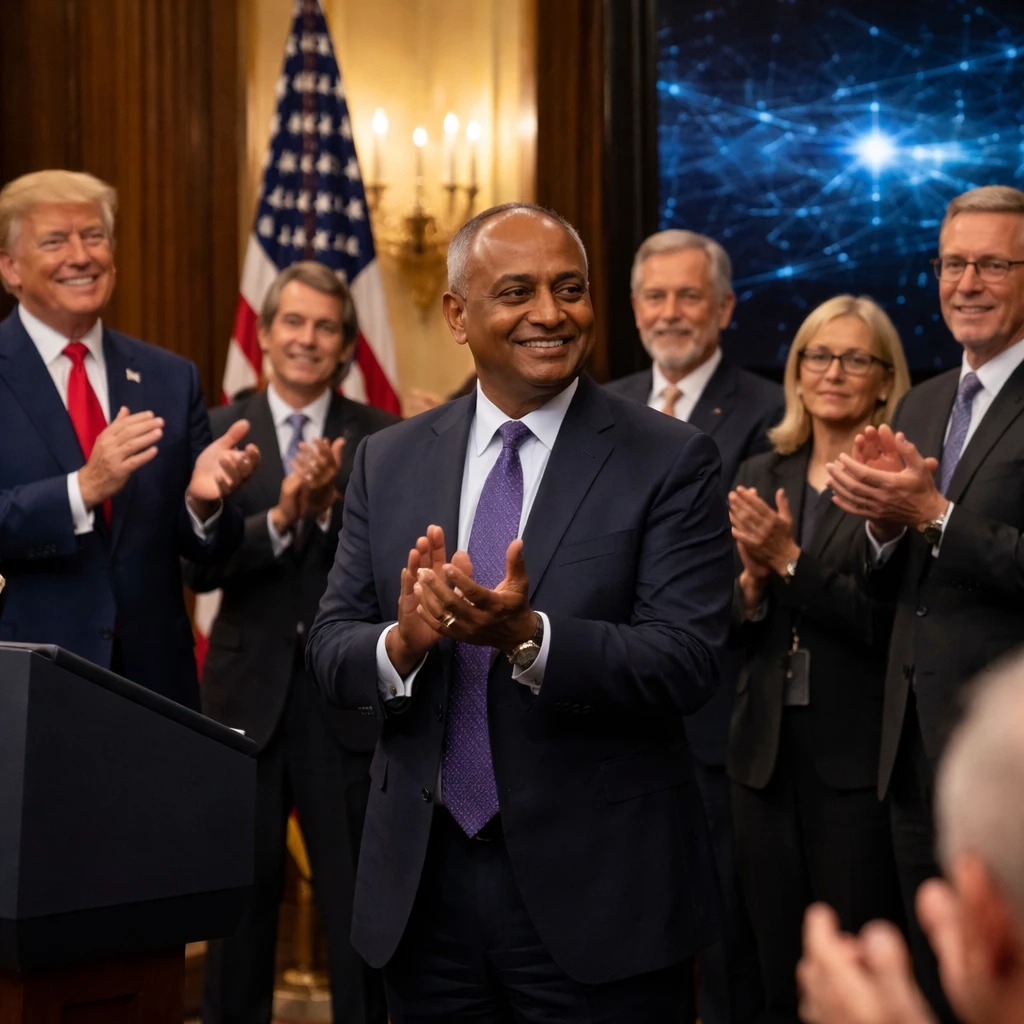
Shares of IBM climbed 3.75% in after-hours trading on Monday after President Donald Trump singled out the company and its chief executive during a White House event devoted to the future of quantum technologies.
Addressing a room of industry leaders, the president praised IBM CEO Arvind Krishna by name. He told the assembled executives:
"IBM CEO Arvind Krishna, who’s a great man, who’s [doing] a really great job. What a job you’ve done,"
In a lighter moment, the president reflected on his personal experience with IBM stock since entering public office, saying:
"I used to have that stock when it was much, much lower. I brilliantly sold it when I became president. That was not a good move."
While the presidential commendation attracted immediate market attention, the gathering’s substantive outcome centered on two executive orders intended to accelerate U.S. capabilities in next-generation computing, sensing, and networking.
The White House characterized the measures as aggressive steps to entrench American leadership in quantum technologies. The first order establishes a government-backed, concentrated effort to deliver a fully operational quantum computer capable of advanced scientific calculations, along with quantum-enabled networks and sensors, within the next five years.
The second executive order sets a firm cybersecurity deadline for federal systems. Under this directive, all federal agencies must complete a transition of their computer systems to post-quantum cryptography by 2031, with the goal of protecting government data against potential future quantum decryption.
The event brought together a roster of scientific and technology figures. Present alongside Krishna were Google President Ruth Porat, Inflection CEO Matthew Kinsella, and Nobel Prize-winning quantum physicist John Martinez Goldman.
Before signing the new mandates, the president noted previous legislative groundwork in the field, referencing the National Quantum Initiative Act of 2018. The White House framed that 2018 legislation as the driver behind a doubling of federal investment in domestic quantum research and development, positioning the new orders as a continuation and acceleration of that effort.
Market reaction was immediate but concentrated: IBM’s after-hours gain followed the public recognition and the administration’s strategic push. The announcements combine technology policy, national security considerations, and corporate visibility around a suite of emerging technologies that include quantum computing, sensing, networking, and related cybersecurity requirements.
Investors and industry participants will likely watch implementation details closely, particularly the five-year development timeline and the 2031 cryptography deadline for federal systems. Those mandates set specific targets but leave open the operational and budgetary steps necessary to meet the goals.