
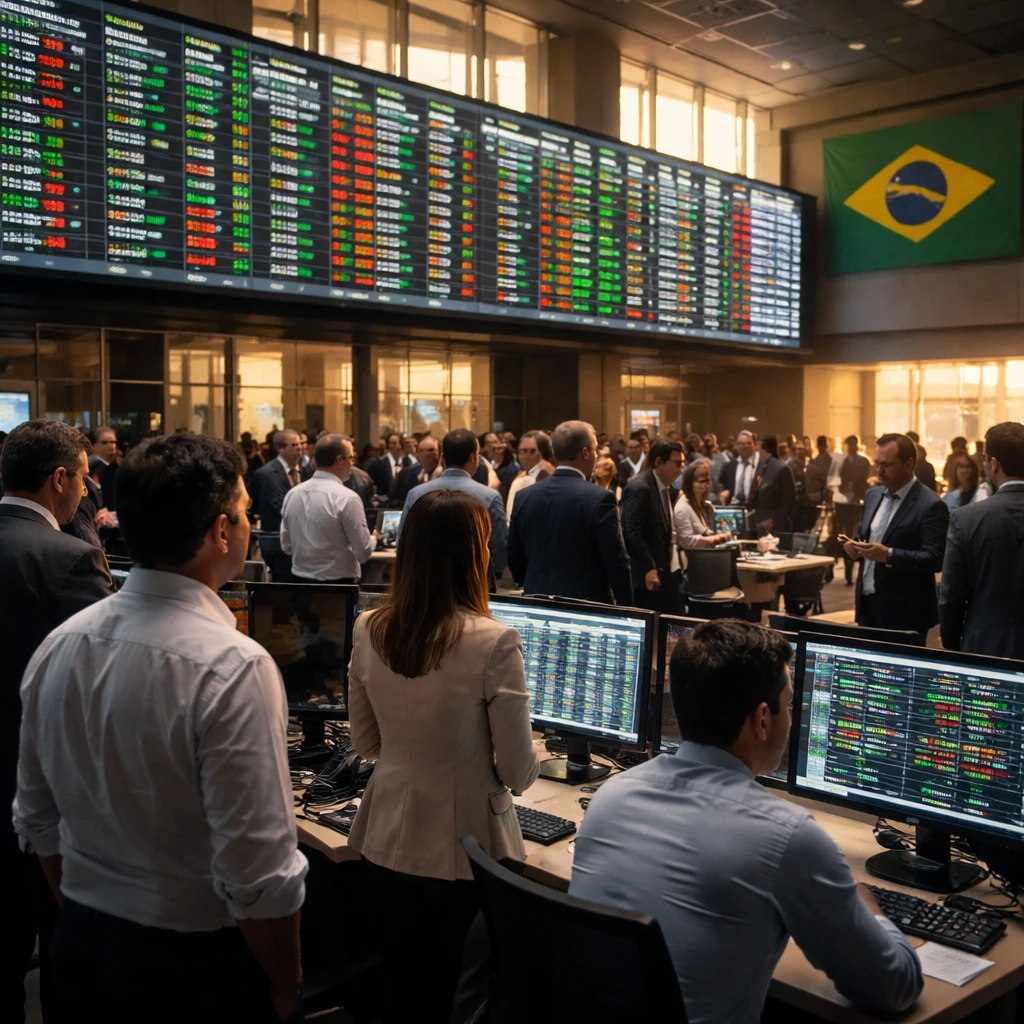
Stocks in Brazil ended Monday's session higher, with the Bovespa advancing 1.21% at the close in Sao Paulo. Gains concentrated in the Public Utilities, Financials and Electric Power sectors provided the principal upward thrust for the benchmark.
Among individual names, Azzas 2154 SA (BVMF:AZZA3) recorded the largest jump, climbing 10.48% or 1.84 points to finish at 19.40. YDUQS Participacoes SA (BVMF:YDUQ3) added 5.23% or 0.42 points to end the day at 8.45, and Tim Participacoes SA (BVMF:TIMS3) rose 5.08% or 1.07 points to close at 22.14.
On the downside, Suzano Papel e Celulose SA (BVMF:SUZB3) led losses, dropping 2.75% or 1.19 points to close at 42.19. Marcopolo SA (BVMF:POMO4) slipped 1.34% or 0.08 points to 5.92, while SLC Agricola SA (BVMF:SLCE3) fell 1.32% or 0.18 points, ending at 13.44.
Market breadth at the B3 Stock Exchange showed 512 names declining versus 446 advancing, and 51 issues finishing unchanged. That divergence between the headline index move and the number of individual decliners highlights a mixed intra-market picture despite the overall rise in the Bovespa.
Volatility and macro-related instruments moved modestly alongside equities. The CBOE Brazil Etf Volatility measure, which reflects implied volatility for Bovespa options, increased 0.54% to 29.71. The US Dollar Index Futures was up 0.16% at 100.78.
Commodities saw declines during the session. Gold futures for August delivery fell 0.88% or 37.31 to $4,208.59 a troy ounce. Crude oil for August delivery dropped 2.41% or 1.83 to $74.02 a barrel. The September US coffee C contract lost 0.50% or 1.35 to trade at 266.45.
In currency pairs relevant to Brazil, the USD/BRL exchange rate eased 0.12% to 5.14, while EUR/BRL moved lower by 0.21% to 5.90. These currency moves came alongside the equity and commodity price shifts recorded during the day.
Overall, the trading session combined sector-driven strength in utilities, financials and power with selective weakness among several large names and a modest uptick in implied volatility. Investors watching market breadth, commodity prices and currency dynamics may view these mixed signals as factors to monitor in subsequent sessions.