
Overview
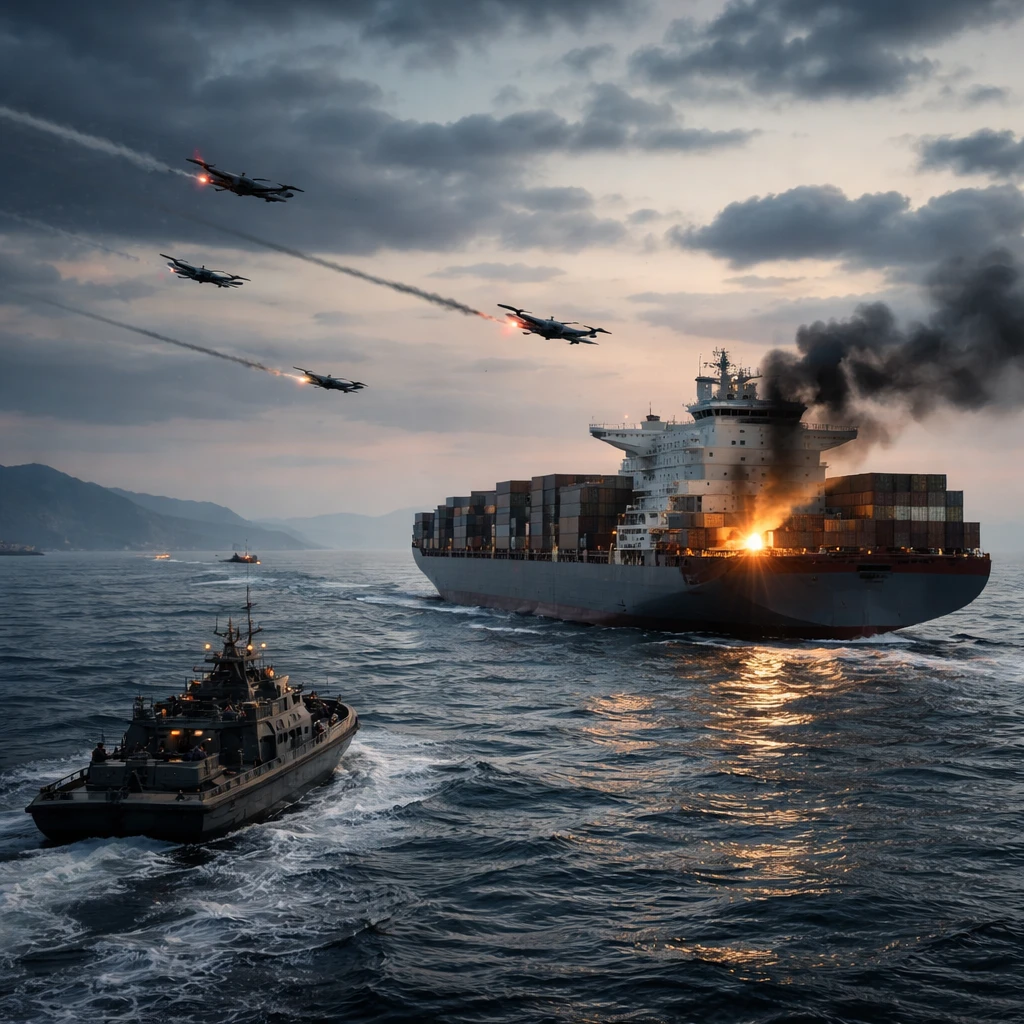
President Donald Trump said on Friday that Iran fired a minimum of four One Way Attack Drones at ships moving through the strategically important Strait of Hormuz, and that one of those drones struck the upper deck of a large cargo ship. In a post on his Truth Social service, the president described the action as a "foolish violation" of the ceasefire agreement between Washington and Tehran.
In his post the president added: "The Islamic Republic of Iran shot at least four One Way Attack Drones at Ships transversing the Strait of Hormuz. One of the Drones solidly hit the upper deck of a large and very expensive Cargo Carrying Ship. Damage was done, but the Ship was able to proceed on its way. We knocked down three other Drones." He did not provide additional operational details or name the vessel involved.
Reports and confirmations
Separate maritime reporting noted an earlier report from the United Kingdom Maritime Trade Operations that a cargo vessel had been attacked in the Strait of Hormuz near Oman. That report said an unknown projectile caused damage to the vessel's bridge but that there were no casualties. Later reporting indicated that two senior U.S. officials had confirmed the ship was a Singapore-flagged cargo vessel named the Ever Lovely and that Iran's Islamic Revolutionary Guard Corps was responsible for the strike. The vessel was navigating near the coast of Oman when it was hit.
Context for the attack
The reported strike occurred hours after Iran's paramilitary navy issued a strong warning against commercial ships using routes it considered unauthorized through the strait. Those warnings and the subsequent strike prompted the suspension of a planned maritime evacuation in the waterway overseen by the International Maritime Organization.
Evacuation plan paused
Earlier in the week the United Nations' maritime agency had announced plans to coordinate a large-scale evacuation of seafarers stranded aboard ships in the Strait of Hormuz, a program intended to move more than 11,000 seafarers. The IMO said it would undertake the effort in close cooperation with Iran, Oman, coastal Gulf states, and the United States. Following the attack near Oman, the IMO announced on Thursday that it had halted the evacuation plan. The IMO also said the vessel struck had not transited under the UN body's evacuation framework.
Security warnings
Reporting attributed a warning from Iran's Islamic Revolutionary Guard Corps that any attempt to cross the Strait of Hormuz along the route designated by the IMO would be "unacceptable and completely dangerous."
Market and shipping reaction
The incident did not halt traffic through the Strait of Hormuz. Data from Kpler cited in reporting showed 54 verified crossings through the chokepoint on Thursday, described as a "broad mix" of commercial and energy-linked vessels. Nonetheless, oil markets reacted to the news: Brent crude futures expiring in September were last reported down about 4% at $72.51 a barrel.
Key points
- President Trump said Iran fired at least four one-way attack drones at ships in the Strait of Hormuz and that one drone hit a cargo vessel while three others were shot down.
- Maritime authorities reported a cargo vessel sustained bridge damage near Oman but suffered no casualties; later reporting identified the ship as the Singapore-flagged Ever Lovely and attributed the strike to Iran's IRGC.
- The attack prompted the International Maritime Organization to pause a coordinated evacuation plan for more than 11,000 stranded seafarers and coincided with a decline in Brent crude prices.
Risks and uncertainties
- Security risk to commercial shipping and offshore operations in the Strait of Hormuz, which could affect the maritime and insurance sectors given the reported drone strikes and warnings from Iran's paramilitary forces.
- Operational uncertainty for a planned IMO-coordinated evacuation of seafarers, which was suspended after the attack and could complicate coordination among coastal states and shipping firms.
- Market volatility for energy prices, evidenced by a fall in Brent crude futures following the incident, reflecting sensitivity in oil markets to disruptions or perceived threats in the chokepoint.
Note: The president's public statement did not include further details on the identity of the ship beyond later confirmations reported by officials, and the IMO stated the struck vessel did not transit under its evacuation framework.