
Overview
Markets begin the week navigating a complex mix of political risk, firming interest rates, and evolving leadership under the surface. Headlines around potential U.S.–E.U. tariff escalation and ongoing debates over Federal Reserve independence frame the macro backdrop, while recent flow data and sector rotations continue to reward cyclicals—particularly industrials—over some of last year’s mega-cap growth winners. At the same time, safe-haven dynamics are less one-way than they appeared just days ago: gold is off recent highs, silver is consolidating after a historic run, and the euro is a touch stronger against the dollar.
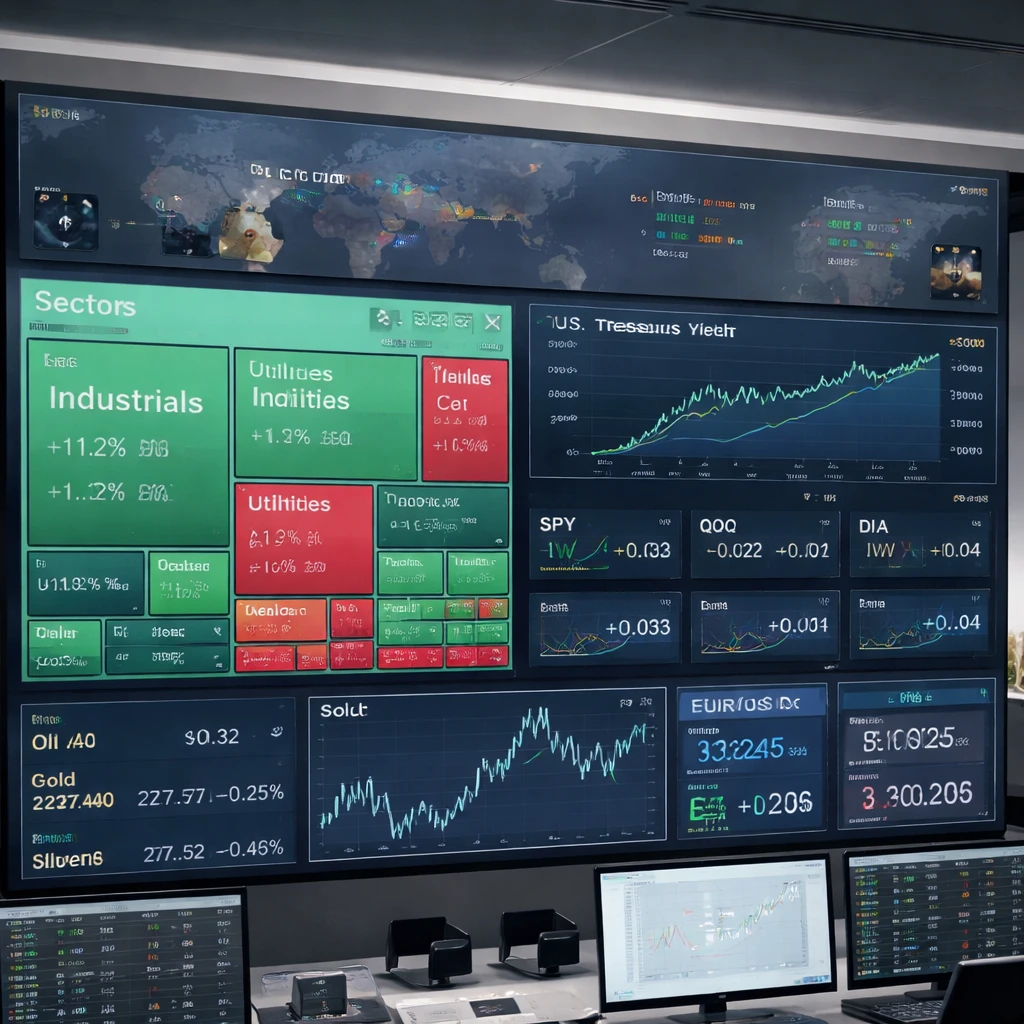
At the index level, U.S. equity proxies are little changed versus their prior closes. SPY last traded near 691.6, modestly below its previous close of 692.24, while QQQ sits around 621.0 versus a 621.78 prior close. The Dow proxy DIA is similarly softer, whereas small caps (IWM) hold a slight gain versus their Thursday mark. Sector dispersion is more pronounced: industrials are leading and utilities lag, with health care and consumer staples also under pressure. In fixed income, long-duration Treasuries (TLT) and intermediates (IEF) are below their prior closes, consistent with the mild back-up in yields observed late last week. Commodities are mixed as oil edges higher and precious metals cool. Crypto starts the week with a steadier tone.
Macro backdrop: rates, inflation and expectations
Treasury yields ended last week a bit higher along the curve, with the 10-year at roughly 4.17% (Jan 15), the 2-year near 3.56%, the 5-year around 3.77%, and the 30-year at 4.79%. Versus the prior day’s marks, the short and belly maturities firmed slightly more than the long end, leaving the curve a touch flatter. That shift aligns with this morning’s price action in duration-heavy bond ETFs, where TLT is below its last close and IEF is modestly lower, while front-end SHY is essentially unchanged.
On inflation, the latest readings (December) show headline CPI at about 326.03 (index level) and core CPI at 331.86. Forward-looking expectations from January models suggest inflation is seen settling in the mid-2% range over the medium term: roughly 2.60% for the next year, about 2.33% over five years, and near 2.32% over ten years. Those levels are consistent with an economy that is neither overheating nor falling into disinflationary stress, but policy path uncertainty remains in focus given the high-stakes political backdrop and turnover questions at the Fed highlighted in recent reporting.
Equities: indices and leadership
- Large caps: SPY’s last trade around 691.58 is a hair below its previous close (692.24), indicating a cautious early tone. DIA sits near 493.42 versus a 494.48 prior close, also slightly softer.
- Growth/tech: QQQ at 621.04 is just under its previous 621.78, echoing a weekslong narrative of mixed mega-cap participation. Several recent articles point to Big Tech fatigue and renewed interest in other areas, even as AI demand remains a core driver for semiconductors.
- Small caps: IWM at 265.74 is fractionally above its prior 265.51, suggesting continued attention to domestic cyclicals.
Sectors: industrials lead; defensives lag
Recent flows continue to favor industrials. XLI’s last trade near 166.89 compares to a 165.78 prior close, an outperformance supported by coverage noting the biggest hedge fund overweighting in a decade amid improved global growth forecasts and European rearmament themes. In contrast, defensives are under pressure: XLU (utilities) around 43.40 is below its prior 43.61, and XLV (health care) at 155.76 sits below 156.96. Consumer staples (XLP) are a touch lower (82.14 vs. 82.37), while consumer discretionary (XLY) is also softer (122.31 vs. 122.70), hinting at a more selective consumer backdrop.
Technology (XLK) is up slightly at 145.61 versus 145.46, reflecting a nuanced balance of factors: on the supportive side, commentary around Taiwan Semiconductor’s record quarter helped renew confidence in AI infrastructure spending; on the cautious side, software sentiment has been dented by discussion of new AI tools encroaching on traditional software workflows and the announcement of ads on a major AI platform, which raises questions about monetization models and competitive dynamics. Financials (XLF) are modestly higher (54.43 vs. 54.37), consistent with a backdrop of firmer yields and a resilient credit environment.
Energy (XLE) edges up (47.70 vs. 47.61) as oil holds firmer and geopolitical attention remains elevated. The recent focus on power pricing and policy risk also ripples into utilities and independent power producers; coverage suggests some names most exposed to mandated price reductions have underperformed, aligning with XLU’s underperformance today.
Bonds: duration softens as yields consolidate higher
Bond ETFs align with the modest rise in rates at the end of last week. TLT last near 87.81 is below its previous close (88.31), IEF near 95.95 is below 96.30, and SHY is essentially flat (82.80 vs. 82.81). The mix implies heavier pressure on duration than on the front end. Articles also point to global corporate bond risk premia falling to their lowest since 2007, reflecting robust demand for credit against the prospect of eventual policy easing. That technical strength in credit, alongside slightly higher government yields, helps explain why financials can firm even as growth sectors trade more selectively.
Commodities: oil firmer; precious metals cool; complex mixed
Oil is slightly higher: USO last around 71.66 versus 71.13 prior, consistent with continued geopolitical vigilance across key producing regions. The broader commodity basket is mixed to slightly softer, with DBC near 23.16 versus 23.20.
Gold and silver are both off recent highs. GLD is around 421.23 versus 423.33 prior, while SLV near 80.99 compares to 83.32. That cooling follows reports of a fresh gold record late last week amid tariff headlines, and a series of features describing a historic silver rally driven by both speculative and industrial demand. The drawdown in silver today fits a consolidation phase after outsized gains; on gold, views remain divided in the cross-asset debate, with at least one strategist reportedly rotating out of bitcoin into gold on concerns about future technological disruptions. Today’s print, however, favors a modest pullback rather than decisive safe-haven follow-through.
Natural gas (UNG) is a touch firmer (10.34 vs. 10.30), reflecting the usual seasonal and supply sensitivities without a dominant headline driver in the last day’s coverage.
FX and crypto: euro firms; crypto steadies
The euro is modestly stronger against the dollar, with EURUSD marked near 1.1643 versus an open around 1.1621 over the same data window. That move is directionally consistent with tariff-related uncertainty and articles discussing potential shifts away from “buy America” trades amid policy risk. In digital assets, bitcoin (BTCUSD) trades near 93,012, slightly above its referenced open (~92,628), within a narrow intraday range (roughly 92,342 to 93,384). Ether (ETHUSD) is similarly steady around 3,215, a touch above its open (~3,212). The crypto complex appears to be consolidating recent gains in a tight range, even as policy and regulatory news flow continues to ebb and flow.
Policy, politics, and the Fed
The weekend and early-morning narrative is heavy on policy risk. Reports indicate fresh U.S. tariff threats toward Europe, including detailed discussions of a 10% tariff plan and the potential for retaliatory measures. These headlines contributed to Friday’s defensive futures tone and continue to inform the cautious bias in early trading today. Within the monetary policy sphere, coverage highlights debate over Fed leadership and independence. While one report notes the increased odds of a potential appointment shift, another points to Chair Powell’s likely ability to remain on the Board even as his term as Chair ends later this year, and a separate item notes Powell’s planned attendance at a Supreme Court hearing concerning a fellow Fed official—an unusual moment that underscores the political scrutiny around the institution. Markets will parse these developments primarily through the lens of their effects on policy credibility, rate expectations, and risk premia.
Notable movers and themes from recent coverage
- Industrials: The sector has benefited from the biggest hedge fund buying in a decade, according to reporting, driving relative strength that is visible in XLI’s outperformance versus defensive sectors.
- Energy and power pricing: Commentary suggests that efforts to direct large technology firms to help lower electricity prices spooked investors in certain power producers; XLU’s underperformance fits that narrative.
- AI and semiconductors: A standout quarter from a leading foundry has renewed confidence in AI infrastructure, while memory producers continue to attract incremental enthusiasm; separate notes flag that one high-profile GPU name has lagged memory peers this year. The crosscurrents help explain today’s modest, rather than broad-based, tech strength (XLK slightly higher; QQQ slightly softer).
- Software and AI tools: A new AI coworking product was flagged as a drag for software sentiment late last week, and the introduction of ads by a major AI platform adds a twist to monetization debates. These items have stoked rotation within tech rather than wholesale de-risking.
- Metals: Silver’s exceptional rally has been a focal point, with today’s giveback aligning with consolidation after outsized gains. Gold remains a barometer for policy and geopolitical risk; it’s down today but remains in focus after hitting a fresh record late last week per reporting.
- Credit: Global corporate bond risk premia are described as the lowest since 2007, supporting financials and risk assets more broadly, even as Treasury yields have edged higher.
Risks
- Trade policy escalation: The tariff narrative between the U.S. and Europe remains fluid. The path and magnitude of any measures—and potential retaliation—pose a clear risk to global growth proxies and the dollar’s trajectory.
- Central bank independence and leadership: Uncertainty around Fed leadership and political pressure on policy decisions could widen risk premia if credibility is questioned.
- AI ecosystem fragility: Supply chains, power constraints, and rapidly evolving competitive dynamics are cited as key risks for tech valuations and capex plans.
- Commodity volatility: Geopolitics and supply risks can quickly reprice oil and metals, with spillovers to inflation expectations and rates.
What to watch next
- Earnings: Upcoming results and guidance from large tech hardware and semis, select software names, and major financials should help refine the leadership narrative flagged by recent sector rotation.
- Policy headlines: Any concrete details on tariff proposals or energy pricing initiatives could catalyze sector-level volatility.
- Rates and the curve: Watch whether the modest late-week bear-flattening persists; sustained pressure on duration would weigh on TLT/IEF while supporting value and financials.
- Metals follow-through: Does silver’s consolidation attract dip buyers, and does gold reassert safe-haven bid if policy uncertainty rises?
Data note: Index, sector, bond, commodity, FX, and crypto levels cited reflect the latest prints provided in the accompanying dataset and may reference last regular-session trades from late last week.