
Overview
U.S. markets are closed for Martin Luther King Jr. Day, leaving investors to digest a heavy mix of macro signals, policy headlines, and cross-asset moves that accumulated into the long weekend. Equity benchmarks finished last week little changed, with modest softness in the large-cap complex and a slight bid for small caps. Sector rotations remained orderly: cyclicals, led by industrials and financials, showed resilience, while defensives and portions of health care lagged. Bond proxies softened as Treasury yields pushed a touch higher along the intermediate curve. In commodities, oil held a bid while precious metals eased, even as news coverage noted new records earlier in the global session. In the 24/7 markets, crypto trades near recent ranges, while the euro-dollar cross holds steady as investors weigh tariff rhetoric and monetary-policy expectations.
Macro backdrop: Yields, inflation, and expectations
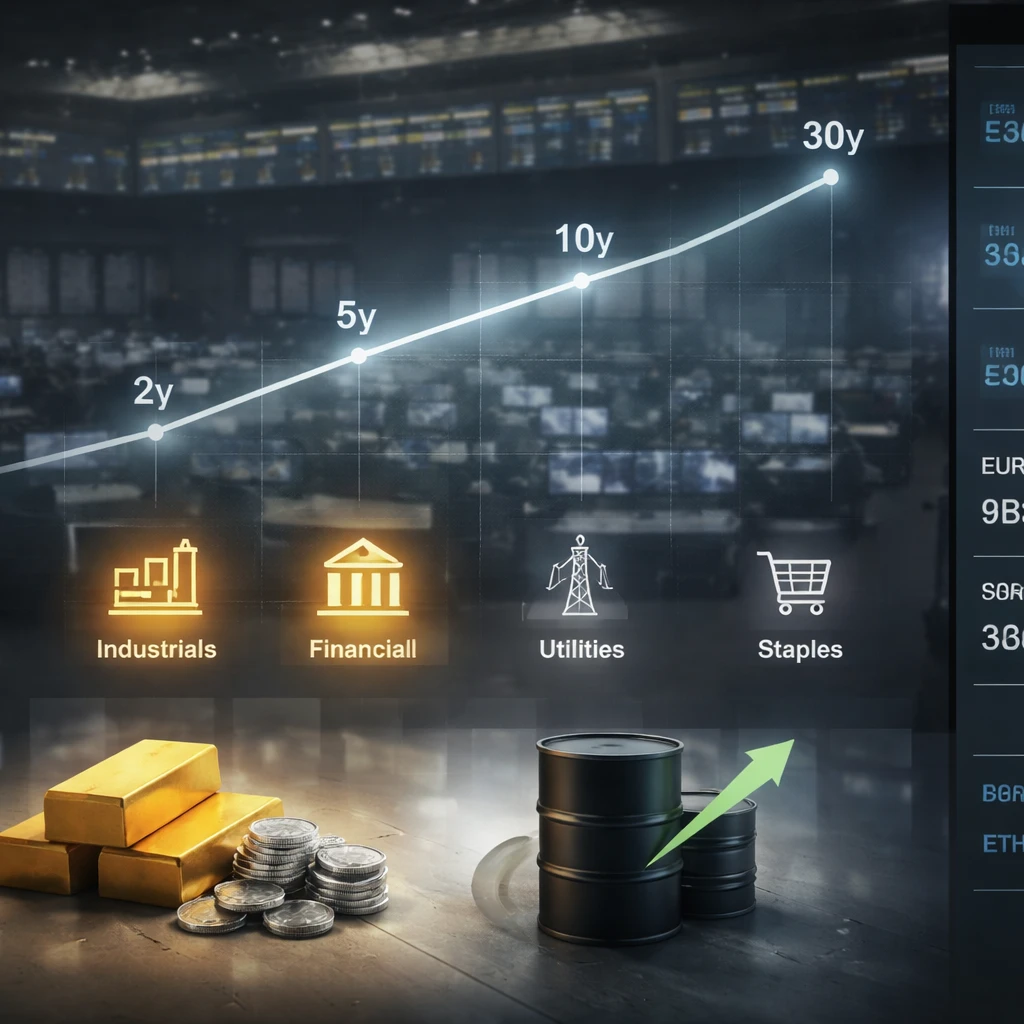
The latest Treasury curve levels as of January 15 show a gentle back-up in yields compared with the day prior. The 2-year sits at 3.56%, the 5-year at 3.77%, the 10-year at 4.17%, and the 30-year at 4.79%. The move was incremental—most notable across the 2s to 10s segment—consistent with a market still repricing a “higher-for-longer” path while maintaining confidence that inflation pressures can continue to moderate.
Inflation data through December (headline CPI index at 326.03 and core CPI at 331.86) indicate price levels ticked higher into year-end. While the index levels alone don’t speak to month-on-month rates here, the direction remains consistent with a glide path that the Federal Reserve has sought to engineer—cooling without abrupt deterioration in growth-sensitive data. Expectations remain well-anchored: model-implied 1-year inflation expectations are 2.60%, with 5-year at 2.33% and 10-year at 2.32% (January readings). That term structure suggests markets are comfortable with inflation converging toward the Fed’s target zone over the medium term.
Policy headlines also hover over the macro debate. Reporting notes the Fed Chair will attend a Supreme Court hearing related to a fellow policymaker, and separate coverage points to speculation about future Fed leadership changes. While these are institutionally significant stories, the rates market’s modest reaction last week indicates investors are prioritizing realized inflation, growth prints, and earnings over speculative personnel shifts for now.
Equities: Indices steady into the holiday
With cash markets closed today, the most recent reference point is Friday’s close:
- SPY last traded at 691.58 versus a previous close of 692.24, a marginal decline that underscores a balanced risk tone.
- QQQ finished at 621.04 versus 621.78 previously, similarly fractionally lower, reflecting a quiet session for mega-cap growth.
- DIA ended at 493.42 versus an adjusted prior close of 494.30, a slight downtick in the Dow complex.
- IWM printed 265.74 versus 265.51 previously, a small gain that keeps small caps’ recent stabilization narrative intact.
Under the surface, sector leadership favored a cyclical tilt. Industrials (XLI 166.89 vs. 165.78 prior) continued to firm—echoing reporting that hedge funds have been adding to global industrials as growth forecasts improve and capital expenditures accelerate. Financials (XLF 54.43 vs. 54.37) also edged up, consistent with commentary that banks remain well-positioned as the rate repression era ends and capital markets activity normalizes. Technology (XLK 145.61 vs. 145.46) was a touch higher, but dispersion remains evident: software sentiment has been choppy amid competitive AI-product headlines, even as positive read-throughs from select semis offset pockets of weakness.
Defensives lagged into the weekend: health care (XLV 155.76 vs. 156.96), consumer staples (XLP 82.14 vs. 82.37), and utilities (XLU 43.40 vs. 43.61) all eased. Consumer discretionary (XLY 122.31 vs. 122.70) slipped modestly, reflecting consolidation after a strong multi-month run.
Bonds: Long duration softens as yields firm
Rate-sensitive ETFs eased Friday in step with the uptick in intermediate and long-end yields. TLT closed at 87.81 versus 88.31, while IEF finished at 95.95 versus 96.30. Short duration was nearly unchanged (SHY 82.80 vs. 82.81), consistent with a curve that nudged higher more at the belly than the very front end. The configuration fits the backdrop of anchored medium-term inflation expectations and a data-dependent Fed: modest growth resilience can pressure term premiums without unmooring the longer-run inflation view.
Commodities: Energy firmer, precious metals cool
Energy held up into the long weekend. USO printed 71.66 versus 71.13 previously, while natural gas (UNG 10.34 vs. 10.30) edged higher. Reporting highlighted that oil traders remain vigilant around geopolitical catalysts spanning multiple regions—an ongoing support for crude’s risk premium. Broad commodities (DBC 23.16 vs. 23.20) were little changed.
Precious metals eased despite earlier headlines noting fresh records for gold in global trade. GLD settled at 421.23 versus 423.33, while SLV fell to 80.99 from 83.32. News flow emphasized robust speculative and industrial demand for silver this year and, separately, a recent dip as U.S. tariff moves paused—context that helps explain the volatility. The day’s softness in metals is also coherent with the modest firming in Treasury yields late last week.
FX and crypto: Sideways tone with headline sensitivity
On the currency front, EURUSD marked around 1.1640 as of midday. Without a direct prior-day comparator here, the cross appears steady, though press coverage suggests tariff-related rhetoric could influence flows between U.S. and European assets in the sessions ahead. For now, interest-rate differentials and growth expectations remain the key anchors.
Crypto remains rangebound intraday. BTCUSD trades near 93,000 and ETHUSD near 3,217, close to their respective opens. Several pieces of coverage frame a mixed setup: one strategist reportedly rotated from bitcoin toward gold citing long-run technological risks, while other reporting notes that recent bitcoin rallies have struggled to break through round-number thresholds. On the policy side, a key crypto legislative vote was canceled at the last minute but could be rescheduled, keeping regulatory path dependency squarely in focus for digital-asset risk premia.
Notable movers and themes from recent coverage
- Policy and the Fed: Reports indicate Fed Chair Jerome Powell will attend a Supreme Court hearing concerning a fellow board member—an unusual show of institutional solidarity. Another piece suggests Powell is likely to remain a Fed governor beyond his chair term, while speculation about potential successors surfaces in separate coverage. Markets, however, took these developments in stride as of last week’s close; the rate complex appears more tethered to realized inflation and growth data than to personnel speculation.
- Trade and tariffs: Multiple stories highlighted new tariff threats aimed at Europe, including a proposed broad-brush tariff framework. One analysis noted potential investor rotation dynamics—possibly away from the dollar and toward select European exposures—should rhetoric translate into policy. That remains a watch item for FX and globally levered sectors.
- AI and software: Headlines around advertising within a major AI platform and a new collaboration tool from another AI firm stoked debate about software monetization and competitive risk. While XLK finished modestly higher on Friday, dispersion within the group remains elevated as investors separate infrastructure beneficiaries from potential application-layer margin pressures.
- Semiconductors and memory: Coverage pointed to a blockbuster quarter at a key foundry player and rapid market-cap milestones for a leading memory manufacturer, reinforcing the theme that AI compute intensity continues to favor select subsectors even as leadership rotates within tech.
- Banks and capital markets: Commentary remained constructive on large-caps in the space, even as individual bank earnings showed mixed revenue outcomes. With rate repression behind us and deal-making on the mend, the sector’s cyclical sensitives—reflected in XLF—have a plausible fundamental underpinning.
- Energy transition and infrastructure: A court decision cleared the way for an offshore wind project to resume construction, while separate reporting highlighted a sizable acquisition of U.S. natural gas assets by a Japanese conglomerate. Both underscore that the energy landscape remains a mosaic: decarbonization efforts proceed in fits and starts alongside ongoing investment in conventional fuels—factors that can keep USO supported while policy-sensitive utilities (XLU) lag.
Putting it together
Across assets, the message is one of measured equilibrium. A modest rise in Treasury yields weighed on duration-sensitive trades (TLT, IEF) and on classic defensives (XLU, XLP), while cyclicals (XLI, XLF) found support from stable growth expectations, incremental signs of corporate investment, and improving risk appetite. Precious metals cooled after an energetic run, while energy maintained a bid amid geopolitical vigilance. Crypto trades neutrally, awaiting clearer policy signals.
What to watch next
- Rates and inflation: With expectations anchored around 2.3%–2.6% across horizons, incremental CPI/PCE readings will determine whether the curve’s gentle steepening continues. Watch the 10-year near 4.17% as a barometer for equity multiples and duration-sensitive sectors.
- Earnings: Corporate results and guidance should clarify whether capex and productivity tailwinds are broadening beyond semiconductors into industrials and services. Sector dispersion within tech and health care remains a swing factor for index-level performance.
- Tariffs and geopolitics: Any escalation or clarification of U.S.–Europe tariff proposals could influence FX, global industrials, and multinational consumer names. Oil remains headline-sensitive over the weekend-to-week cadence.
- AI commercialization: Monetization models, infrastructure investment, and competitive dynamics across AI platforms and software tools will continue to drive intra-tech reallocations.
- Crypto policy: The timing and contours of rescheduled voting on crypto legislation may affect liquidity, custody, and on-ramps—core to the medium-term investability of the asset class.
Risks
- Upside inflation surprises that push medium-term expectations higher and force repricing of the policy path.
- Trade-policy shocks or retaliatory measures that unsettle FX and globally exposed sectors.
- AI ecosystem fragility—whether from infrastructure constraints (power, supply chain) or competitive disruption—leading to elevated tech volatility.
- Energy-price spikes tied to geopolitical events, challenging both inflation and growth simultaneously.
- Policy uncertainty around central-bank leadership that erodes confidence in the reaction function, even if temporarily.
Note: All ETF, commodity, FX, and crypto levels cited reflect the latest values provided in the accompanying dataset. U.S. cash equity markets are closed today for the MLK Day holiday.