
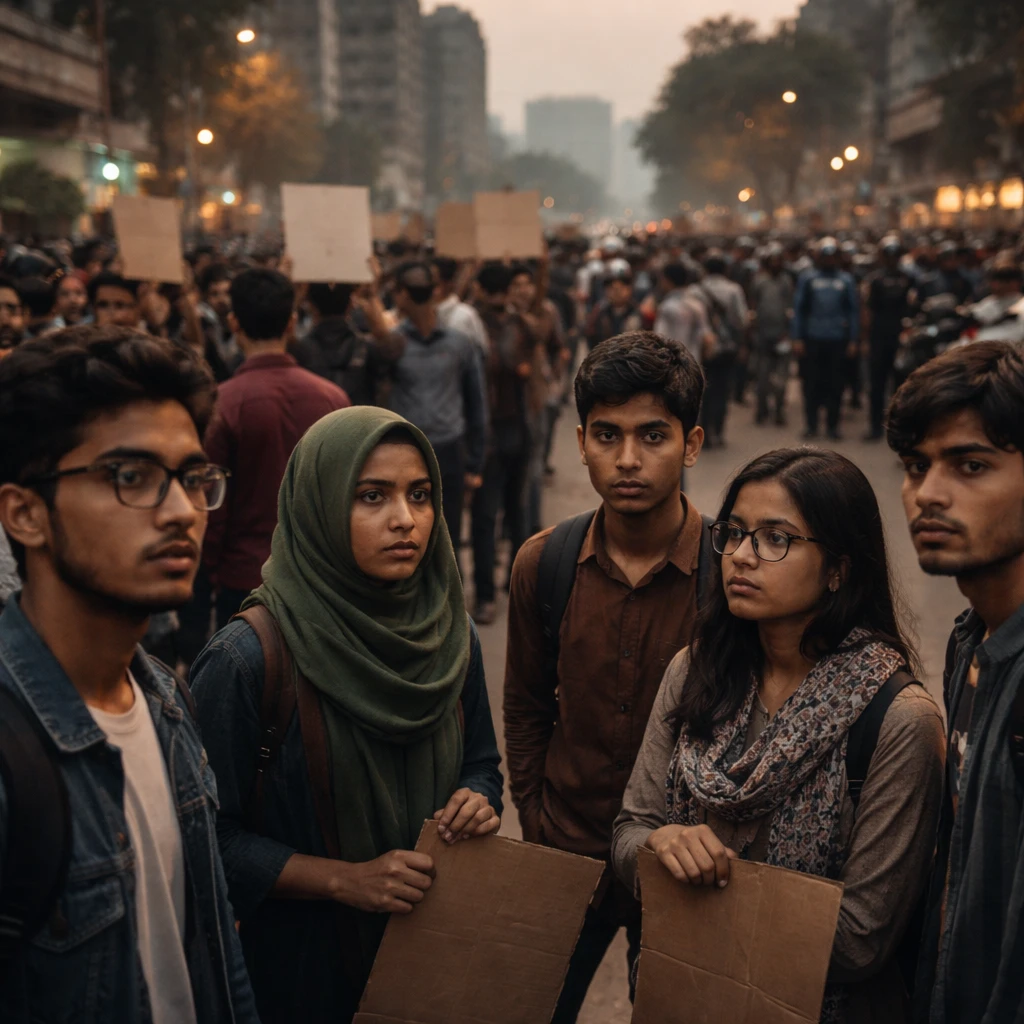
DHAKA, Jan 28 - Dhaka University student Sadman Mujtaba Rafid joined the mass demonstrations that helped force former Prime Minister Sheikh Hasina from power despite warnings from his family and confrontations with police. At 25, Rafid said he believed the rallies were necessary to place democratic norms above dynastic politics. Yet, as Bangladesh prepares for a parliamentary election on February 12 - the first since last year's upheaval - Rafid's optimism has cooled.
"We dreamt of a country where all people regardless of gender, race, religion would have equal opportunity," the 25-year-old said. "We expected policy changes and reforms, but it is far away from what we dreamt of."
Large numbers of young Bangladeshis poured into the streets in 2024, driven by frustration with repression and a lack of jobs and economic opportunity under Hasina's government. Their calls for a "New Bangladesh" briefly shifted the political landscape, but many of those same young activists now express disappointment that substantive reforms have not materialised and that a robust, new political party has not emerged to carry their agenda to power.
Instead, many observers and voters say the upcoming election looks set to return the contest to a familiar division - largely between the Bangladesh Nationalist Party (BNP) led by former Prime Minister Khaleda Zia and the Islamist Jamaat-e-Islami. That narrowing of options, they argue, risks undermining the original aspirations of the uprising.
Gen-Z at the centre but lacking choices
Those under 30 - commonly referred to as Gen-Z - were the backbone of the protests and constitute a significant share of the electorate, making up more than a quarter of Bangladesh's 128 million voters. Political analyst Asif Shahan, who teaches at Dhaka University, said the generation is politically engaged and likely to turn out to vote in numbers sufficient to influence the outcome.
Many young people initially rallied behind the newly formed National Citizens Party (NCP), a movement led by some of the uprising's figures. Yet the NCP has struggled to consolidate that support. Party officials acknowledge weaknesses: limited resources, scarce grassroots organisation and a lack of financial muscle, factors that have hindered the party's ability to mount a large-scale campaign ahead of the vote.
NCP spokesperson Asif Mahmud, 27, who gained prominence during the protests and later served in the interim government, said the party's youth and newness constrained it. He described the party's alliance with Jamaat-e-Islami as strategic rather than ideological and denied any intent to pursue sharia law, saying: "We will work to fulfill expectations of the youth in the present and also in the future as promised."
Disillusionment among protesters
For many activists, the calculus has shifted. Some say the NCP has forfeited its moral advantage by partnering with a hardline Islamist group. "They have lost the moral high ground," said Shudrul Amin, a 23-year-old archaeology student at Jahangirnagar University. "Voters who wanted a ‘New Bangladesh’ free from the baggage of the past now feel they are being forced to choose between the old guard and a student‑Islamist alliance."
Shama Debnath, a 24-year-old Hindu, described politics as trapped in "an ‘either this or that’ framework" with little in the way of fresh vision. Hema Chakma, a 23-year-old Buddhist student, said the interim government led by Nobel laureate Muhammad Yunus had disappointed many in Gen-Z, in part because it did not curb mob violence that targeted journalists and minorities. "After a year, I feel the spirit of the July revolution is completely lost," she said. "I am not saying the previous situation was good, but I feel the violence has increased a lot and the interim government is not taking any steps."
Economic grievances that helped spark the protests also persist. Interviews with more than 80 students under 30 - mostly in the capital Dhaka - revealed widespread unhappiness about job prospects and the state of the economy, both central motivations behind last year's demonstrations that ultimately led to Hasina's exile in India.
Voting intentions and referendum
Despite their reservations about the available choices, many young voters said they remained committed to participating in the election. There are 300 parliamentary seats at stake. Alongside the vote, a simultaneous referendum will ask citizens to approve reforms to state institutions, including proposals for term limits for prime ministers, stronger presidential powers and greater independence for the judiciary and election authorities.
A recent poll by the Bangladesh Youth Leadership Center, a platform focused on young leaders, found willingness to vote as high as 97% among those aged 18 to 35, with respondents showing an almost even split between support for the BNP and Jamaat. That potential turnout has prompted some former protest leaders and activists to reconsider their options in the ballot box.
"People are going to vote and that is enough," said 26-year-old student activist Umama Fatema, a prominent figure in the 2024 uprising, adding that only a democratically elected "stable government" could steer Bangladesh forward.
For some former supporters of the student movement, the BNP now represents the best chance for the country to be governed by an established organisation with sufficient ground presence. "Given that the new students’ party has shattered our hopes, I have decided to vote for BNP," said 25-year-old Maisha Maliha. "I believe the country needs a strong, united political party with enough people on the ground."
Others are prepared to back Jamaat as an alternative. "We have seen BNP before, so Jamaat seems like a new option," said 20-year-old Erisha Tabassum.
Independent bids and lingering hope
Not all who took part in the uprising have walked away from politics. Tasnim Jara, a 31-year-old doctor who returned from Britain to join the NCP but later quit because of its Islamist alliance, is running as an independent. She said the July uprising created hope that newcomers unconnected to the traditional political elite could enter politics and alter its practice. Jara spent two days collecting the 5,000 signatures required to validate her nomination, saying: "I do believe there is hope for a genuine political alternative in Bangladesh. But it will not emerge overnight."
Others remain steadfast in their aspirations for systemic change. H.M. Amirul Karim, a 25-year-old English literature student, said: "I continue to dream that even if not now, the desire for a new political structure will become a reality. I am not ready to give up."
As Bangladesh moves toward its first post-upheaval national ballot, the attitudes of the country's youth will be closely watched. Their high levels of potential participation could shape the next government's mandate even as the choices on offer reflect a reversion to long-established forces and an unresolved search for a credible, long-term political alternative.