
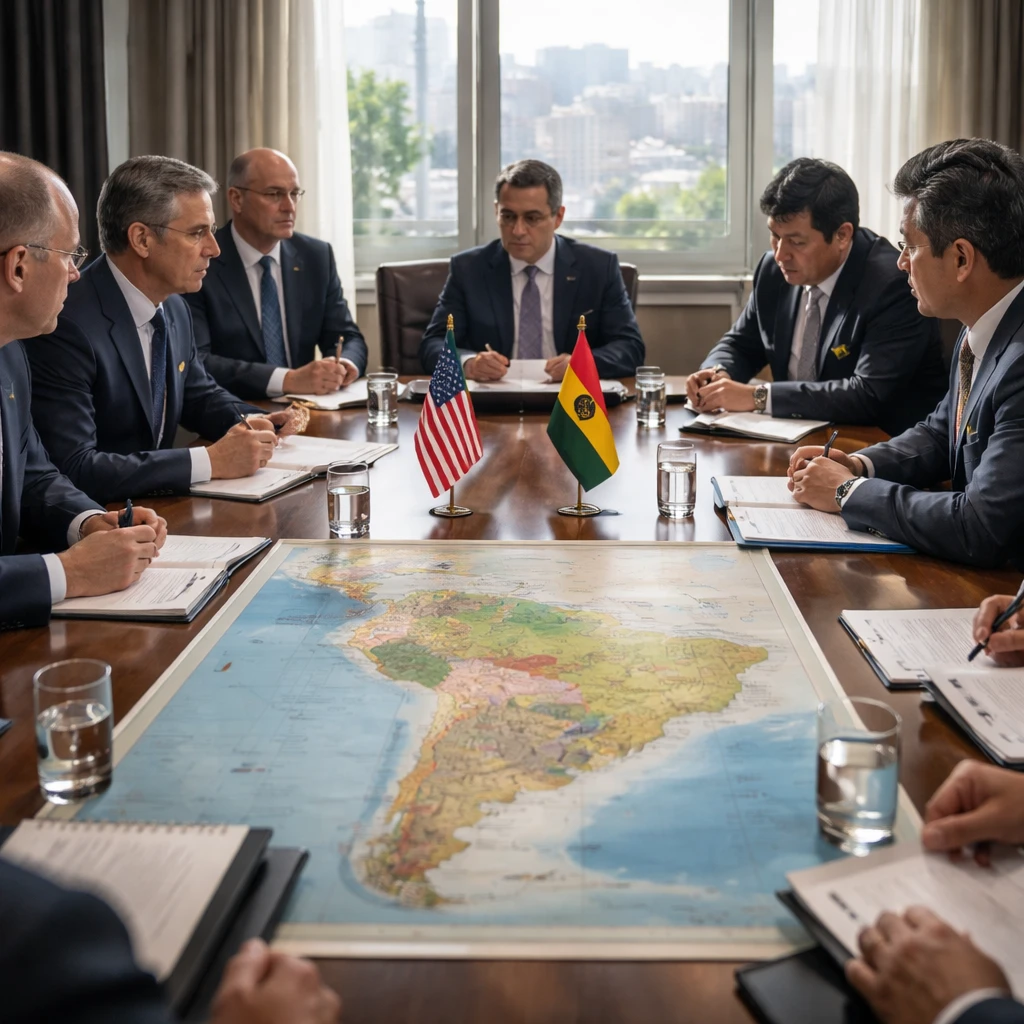
The United States has been pressing Bolivia to expel people it alleges are Iranian spies and to take official steps to classify Iran’s Islamic Revolutionary Guard Corps - the IRGC - as a terrorist organization, two sources with direct knowledge said on Jan. 24. The same sources, who asked for anonymity to discuss sensitive diplomacy, said Washington is also pushing La Paz to designate Lebanon’s Hezbollah and Palestinian group Hamas as terrorist groups, citing their ties to Tehran.
U.S. officials describe the outreach as part of a larger diplomatic push to increase American influence across Latin America while reducing the footprint of states and groups it views as adversaries. The effort in Bolivia follows other recent moves in the region, and officials say it is synchronized with broader U.S. measures to counter Tehran’s activities in the Western Hemisphere.
Bolivia’s foreign ministry responded to inquiries by saying that "there is still no completely defined position regarding this matter." The State Department did not reply to requests for comment, and the Iranian mission to the United Nations declined to comment, according to the sources.
Context and recent related actions
U.S. diplomats escalated their engagement with Bolivian counterparts this month. A delegation including State Department and intelligence officials traveled to La Paz, in part to discuss the possibility of terrorist designations, the sources said. The outreach comes amid a wider regional campaign: in September, Ecuador designated the IRGC, Hamas and Hezbollah as terrorist organizations, a move the sources said the U.S. advocated for. Last week, Argentina designated Iran’s Quds Force, the IRGC branch that handles overseas operations.
Officials also say Washington has been active in conversations with other governments in the region about similar steps. Chile, Peru and Panama have been raised as potential candidates for terrorist designations, though it is unclear if formal discussions have taken place in all of those capitals. The Panamanian foreign ministry said it had not discussed the issue with U.S. officials. Chile’s foreign ministry declined to comment, and Peru’s foreign ministry did not respond to requests for comment.
Why Bolivia matters, according to U.S. sources and former officials
Bolivia, a landlocked country of about 12 million people in the center of South America, might not at first appear to be a focal point in a geopolitical contest between major powers. But some current and former U.S. officials say the country has taken on importance for Iran’s diplomatic and intelligence reach in the region.
Those officials point to a permissive counterintelligence environment in Bolivia and the country’s central geography - bordering multiple nations - as factors that make it useful as a regional base. Rick de la Torre, a retired senior CIA officer and former Caracas chief of station, said that while Venezuela historically served as Iran’s principal Latin American hub, Bolivia and Nicaragua have acted as "secondary nodes" where Tehran can operate with less scrutiny.
"(Bolivia’s) value to Tehran was the permissive political climate, lighter scrutiny and central geography," de la Torre said. "In practice, the pattern you see across Latin America is Iran and Hezbollah using the most permissive jurisdictions as hubs, then projecting quietly into more capable or higher-value states nearby."
Political shifts in Bolivia opened a diplomatic window
Bolivia’s foreign policy toward Iran shifted alongside its political leadership. Under former president Evo Morales, who led from 2006 to 2019, Bolivia strengthened ties with Iran, including cooperation on defense and security matters. Morales and later leftist President Luis Arce, whose term ran from 2020 until late last year, were seen by U.S. officials as unlikely to distance Bolivia from Tehran.
That dynamic changed with the October election of Rodrigo Paz, a centrist whose victory ended nearly two decades of rule by the leftist MAS party. Paz’s government has faced substantial economic difficulties and a divided legislature, and it has sought to mend relations with Washington while encouraging private investment. U.S. officials publicly welcomed the election, and in December the United States made Bolivia eligible for grant funding administered by the Millennium Challenge Corporation, an independent U.S. agency.
U.S. officials view Paz’s administration as presenting a unique opportunity to press La Paz on issues related to Iran and its regional partners.
Allegations of Iran-linked activity across the region
U.S. officials point to a range of Iran-linked activity across Latin America in recent years. Among the incidents cited was an alleged assassination plot against the Israeli ambassador to Mexico that was uncovered and foiled last year by Mexican security forces. One source said the plot was orchestrated in part by an undercover Quds Force officer stationed in Caracas.
Hezbollah, which is closely allied with Tehran, has long been accused by U.S. officials of operating throughout Latin America. The group has been described as participating in smuggling and other illicit networks that generate revenue for its global activities, and on occasion has been linked to direct attacks.
However, the intelligence community is not unanimous on how organized Hezbollah’s presence in Latin America is. Some analysts characterize the group’s fundraising networks as hierarchical and well-managed. Others say that certain financial flows attributed to Hezbollah may instead be donations and remittances from Latin America’s sizable Lebanese diaspora that happen to end up in the hands of Hezbollah-linked individuals.
"In my view, Hezbollah leadership does not micromanage every criminal scheme," de la Torre said, "but it does authorize and benefit from a global facilitation architecture that includes Latin America."
Diplomatic sensitivity and remaining questions
The discussions between Washington and La Paz have been private, reflecting the sensitivity of urging a sovereign government to take steps that could alter its security relationships. Two anonymous sources provided details of the conversations to U.S. media. The Bolivian foreign ministry’s statement that there is no fully formed position underscores the deliberative and unresolved nature of the matter.
Outside of Bolivia, officials and diplomats have taken different approaches. Ecuador has already moved to label multiple Iran-linked entities as terrorist organizations, and Argentina recently designated the Quds Force. It remains unclear whether other governments contacted by U.S. officials will follow suit or how quickly they might act.
The U.S. campaign to press governments across Latin America on Tehran-linked groups signals a strategic push to reduce Iran’s latitude in the hemisphere. Whether it produces the formal designations or expulsions the U.S. seeks will depend on decisions by each country’s leadership and on how governments weigh the political, security and diplomatic implications.
Summary
The United States has quietly urged Bolivia to expel suspected Iranian spies and to designate Iran’s Islamic Revolutionary Guard Corps, Hezbollah and Hamas as terrorist organizations. The push is part of a coordinated regional effort that has seen recent moves in countries such as Ecuador and Argentina. Bolivian officials say they have not finalized their position, and U.S. delegations have held discussions in La Paz as officials evaluate the political and security consequences.