
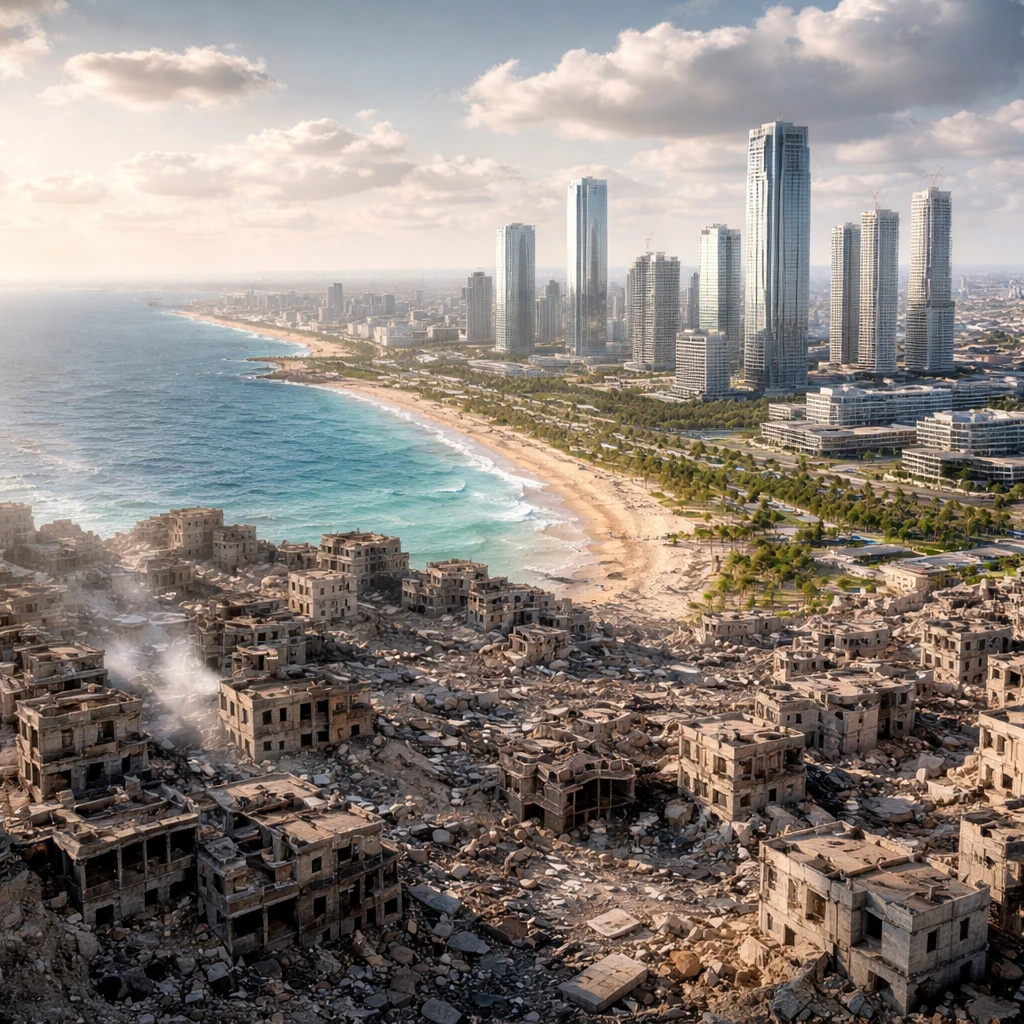
In a significant development aimed at reviving the Gaza Strip, the United States revealed Thursday a comprehensive reconstruction proposal intended to rebuild the territory from its current state of devastation. The project, which forms part of broader ceasefire efforts between Israel and Hamas, was presented by Jared Kushner in Davos, Switzerland, as a key component of the Trump administration’s global peace initiative.
The plan suggests erecting a modernized Gaza highlighted by residential towers, data centers, and resort facilities along its Mediterranean coastline, painting a vision of transformation inspired by urban centers such as Dubai and Singapore. Kushner described the approach as a "master plan" that prioritizes a bold vision for Gaza’s redevelopment, signaling a departure from earlier considerations that included creating free zones and sections controlled by Hamas.
Despite the promising images shared, specifics regarding crucial matters like ownership rights, compensation for those displaced, and interim housing arrangements for the millions affected remained unaddressed. Gaza, a densely populated enclave of nearly two million residents, faces severe disruption from two years of ongoing warfare, resulting in large-scale internal displacement and destruction.
The planned reconstruction is slated to start in Rafah, located in southern Gaza, which is currently under full Israeli military control. However, the logistics for funding this ambitious project remain vague, with Kushner mentioning an upcoming Washington conference to announce financial contributions, primarily from private sector participants, without detailing donors or commitments.
This unveiling of the Gaza redevelopment framework coincides with continued violence in the region. On Thursday, Gaza health officials reported that Israeli airstrikes resulted in the deaths of five Palestinians, including four in eastern Gaza City’s Zeitoun neighborhood and one in southern Khan Younis, further straining the tenuous ceasefire agreement reached in October.
Israeli military officials have not immediately commented on these recent hostilities. Earlier incidents included Israeli fire killing 11 individuals, among them two minors and three journalists, with the military alleging the journalists operated a drone threatening Israeli troops—claims that remain unverified publicly.
Moreover, the reopening of the Rafah border crossing, a critical gateway for the movement of people and goods, remains unresolved. Ali Shaath, backed by the U.S. to manage Gaza under a broader peace plan, announced via video link that the crossing will open next week, signaling a hopeful shift. However, Israel insists on the return of the remains of the last hostage held by Hamas as a precondition.
The proposed second phase of the plan anticipates Hamas’ disarmament and the deployment of international peacekeepers, facilitating further redeployment of Israeli forces. Meanwhile, the first phase has left Israel holding a majority of Gaza’s territory, maintaining military pressure on Hamas-controlled areas along the coast.
The broader conflict has wrought heavy casualties: health officials cite over 480 Palestinians killed in the Gaza Strip since the ceasefire, contrasted with three Israeli soldiers lost. The outbreak of hostilities followed a Hamas-initiated attack in October 2023 resulting in significant Israeli casualties, which precipitated a sustained military campaign by Israel that has reportedly caused tens of thousands of Palestinian deaths.