
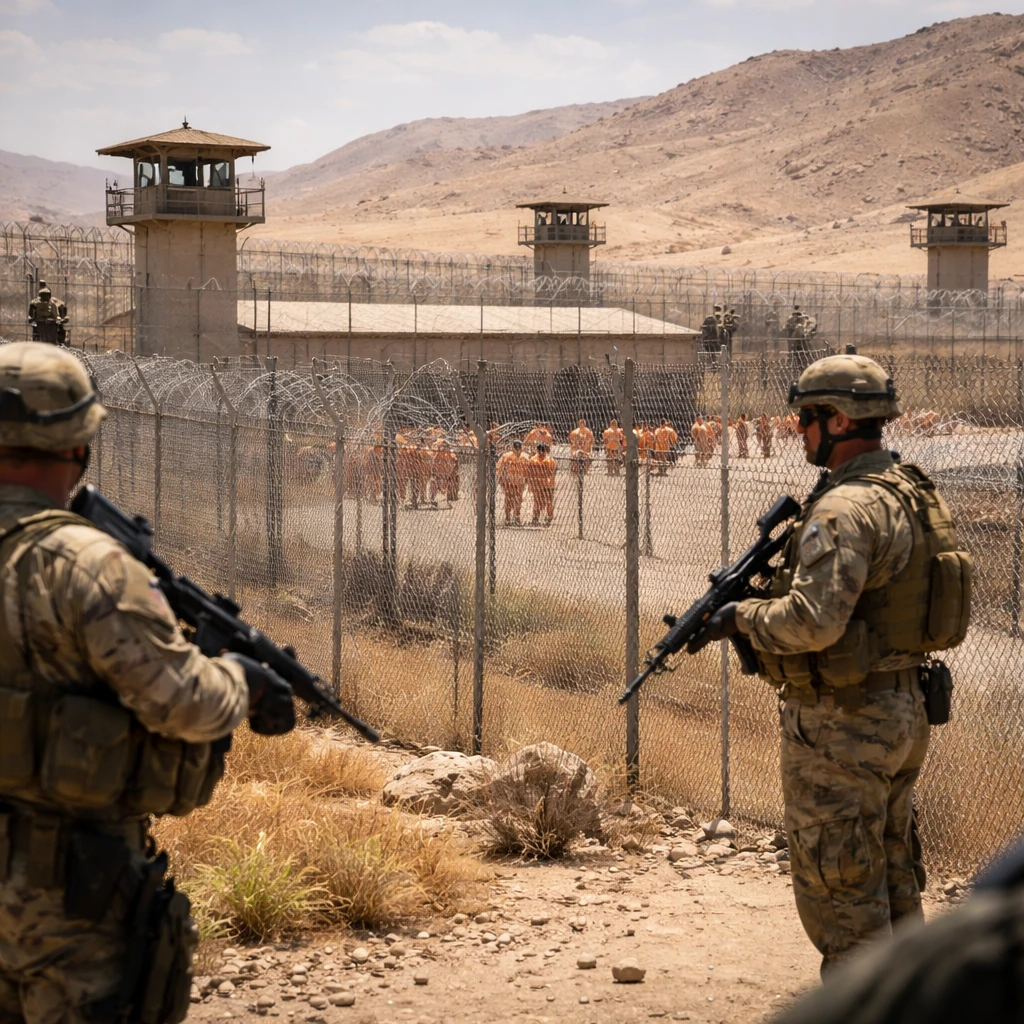
The United States military anticipates completing the transfer of as many as 7,000 detainees affiliated with the Islamic State from Syrian detention centers into Iraqi custody within the next several days. A U.S. official, speaking anonymously, informed Reuters on Thursday that this operation involves moving hundreds of detainees daily across the Syria-Iraq border.
On Wednesday, the U.S. Central Command confirmed that 150 detainees were transported from a prison complex in Syria's Hasaka province to Iraq. The transfer was prompted by concerns over the potential for prison breakouts, particularly in light of recent security instability.
This escalation in transfers coincides with the abrupt decline of Kurdish-led forces in northeast Syria. This situation has raised alarms about the safety and control of detention facilities. Notably, on Tuesday, approximately 200 low-level Islamic State combatants escaped from the Shaddadi prison in Syria, though many were subsequently recaptured by Syrian governmental troops.
The U.S. official clarified that the transfer efforts prioritize the relocation of the most dangerous detainees affiliated with Islamic State. These detainees are citizens from a variety of countries, including several European nations.
Iraqi legal authorities stated that the transported detainees consist of diverse nationalities. The largest contingent is Iraqi nationals, accompanied by fighters from other Arab countries and Europeans from Britain, Belgium, France, Germany, and Sweden.
U.S. Secretary of State Marco Rubio publicly commended Iraq's acceptance of these detainees on Thursday. Rubio emphasized that non-Iraqi terrorists are in Iraq temporarily and urged their home countries to assume responsibility by repatriating their citizens to face justice.
Islamic State emerged primarily within Iraq and Syria, controlling large territories between 2014 and 2017 and ruling millions of inhabitants during that period. Its self-declared "caliphate" was dismantled following coordinated military campaigns by regional powers and a coalition led by the United States.
The prisons from which these detainees are being moved are located in Hasaka province in northeast Syria, an area where the Syrian Democratic Forces (SDF) had maintained security in partnership with the U.S. for several years.
The SDF has been a U.S. ally since 2015 when the force was established with the objective of eradicating Islamic State presence in northeast Syria. Subsequently, the SDF founded an autonomous zone in the region, administrating separate civilian and military frameworks.
However, in late 2024, rebel factions led by President Ahmed al-Sharaa overtook Bashar al-Assad's government, claiming authority over all Syrian territory, including regions controlled by the SDF.
Recently, Syrian government forces have regained extensive control over northern and eastern Syria from Kurdish groups, effectively bringing nearly all of Syria under Damascus's official administration.
The United States currently maintains roughly 1,000 troops in Syria but has periodically considered withdrawal.
Following Al-Sharaa's rise, U.S. President Donald Trump has cultivated relations with the new Syrian leadership, easing sanctions and welcoming Syria's participation in an international coalition against Islamic State.
U.S. envoy Tom Barrack remarked on Tuesday that the original purpose of supporting the SDF has largely dissipated, indicating that the United States has no prolonged interest in maintaining its presence in Syria.