
World January 21, 2026

US Forces Relocate Islamic State Prisoners from Syria to Iraq Amid Regional Security Concerns

Transfer of 150 ISIS detainees highlights shifting control dynamics in northeast Syria

By Marcus Reed
US Forces Relocate Islamic State Prisoners from Syria to Iraq Amid Regional Security Concerns

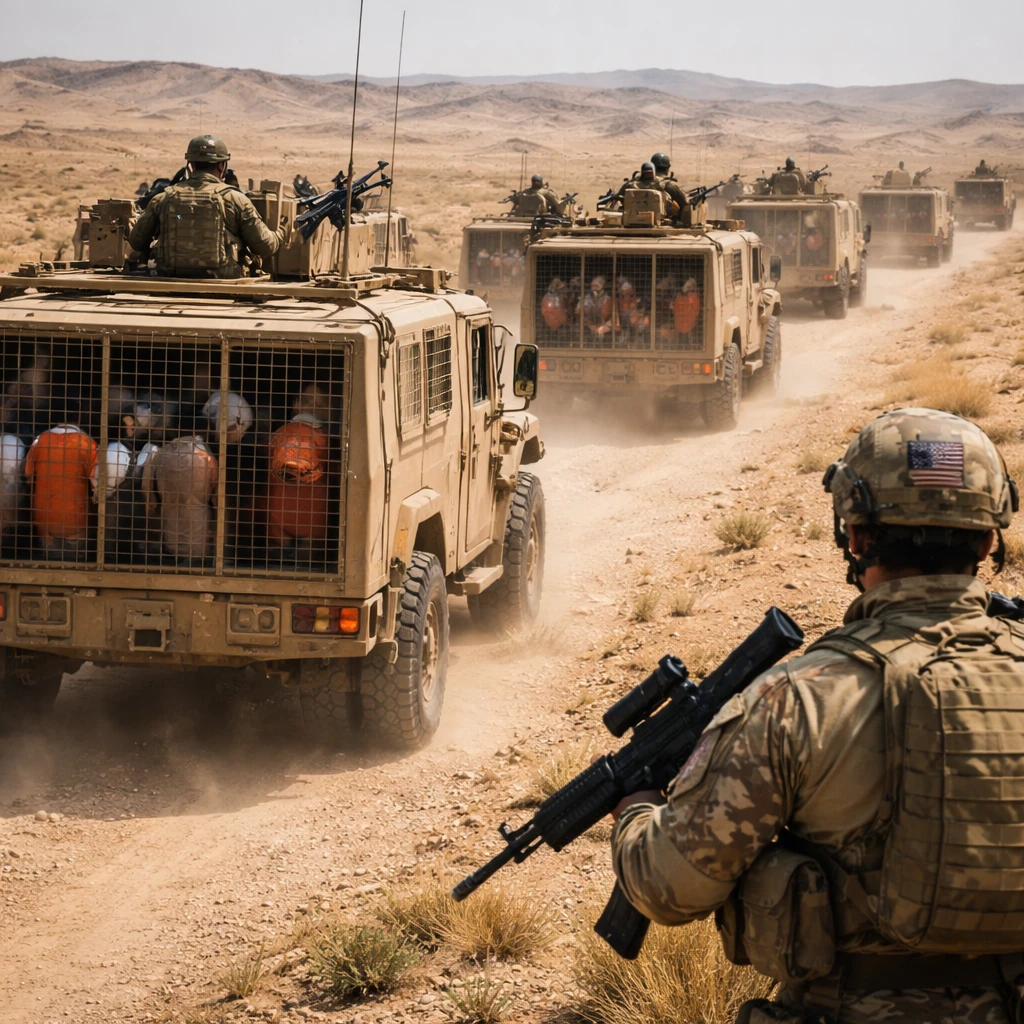
The United States military has moved 150 detained Islamic State fighters from Syria to Iraq due to security uncertainties following the Kurdish-led Syrian Democratic Forces' recent territorial losses. This relocation is part of a broader plan that may involve transferring thousands of ISIS detainees to Iraqi-controlled facilities, reflecting significant shifts in territorial control and ongoing coordination between the US and regional partners.

Key Points

  • The U.S. military transferred 150 Islamic State detainees from Syria to Iraq due to security concerns after Kurdish-led SDF's rapid territorial losses.
  • Up to 7,000 ISIS prisoners could potentially be relocated to Iraqi-controlled detention centers in a coordinated effort with regional partners, including Iraq.
  • A newly established Syrian government ceasefire with Kurdish forces and territorial gains underscore a significant shift in regional control and political dynamics.

The U.S. military announced on Wednesday the relocation of 150 Islamic State detainees from a detention center in Hasakah, Syria, to a secure site in Iraq. This operation follows rapid developments in northeast Syria, where the Kurdish-led Syrian Democratic Forces (SDF) have experienced significant territorial setbacks, raising concerns about the security of approximately a dozen prisons and detention camps previously under their control.

In an official statement, the military indicated that the transfer was facilitated in close coordination with regional allies, notably the Iraqi government. The plan envisions the potential movement of up to 7,000 ISIS detainees from Syrian to Iraqi custody, signaling a substantial shift in the handling of detainees linked to the Islamic State.

U.S. Admiral Brad Cooper, who commands U.S. forces in the Middle East, emphasized the importance of this collaboration and expressed gratitude for Iraq's role in ensuring the continued defeat of ISIS.

These developments coincide with a recently declared ceasefire between the Syrian government and Kurdish forces, wherein the Syrian regime has regained control over significant areas in the northeast. The Syrian government has challenged the Kurdish forces to integrate into the central state within a four-day period, a move the United States has urged the Kurdish-led forces to accept.

The swift advances by the Syrian government and the apparent withdrawal of U.S. backing for the SDF mark the most considerable territorial shifts since the initial rebel expulsion of Bashar al-Assad's forces over a year ago.

Risks

  • The security of detention facilities remains uncertain amid rapidly changing territorial control in northeast Syria, impacting regional stability and counterterrorism efforts.
  • The integration demands on Kurdish forces by the Syrian government could lead to further conflict or political instability, affecting local governance and security.
  • Shifts in U.S. military support dynamics for local forces may influence the effectiveness of ISIS detainment and the broader stability of the region.

More from World

Kremlin says Russia has long offered to process or store Iran’s enriched uranium Feb 2, 2026 Long-Awaited Rafah Reopening Prompts Hope and Anxiety Among Palestinians Stranded Across Border Feb 2, 2026 Rafah Reopens but Core Questions Persist Over Implementation of Trump’s Gaza Blueprint Feb 2, 2026 Rafah Crossing Reopens on Foot with Strict Limits as Gaza Remains Under Strain Feb 2, 2026 Medvedev Warns World Is Growing More Dangerous but Says Russia Does Not Seek Global War Feb 2, 2026