
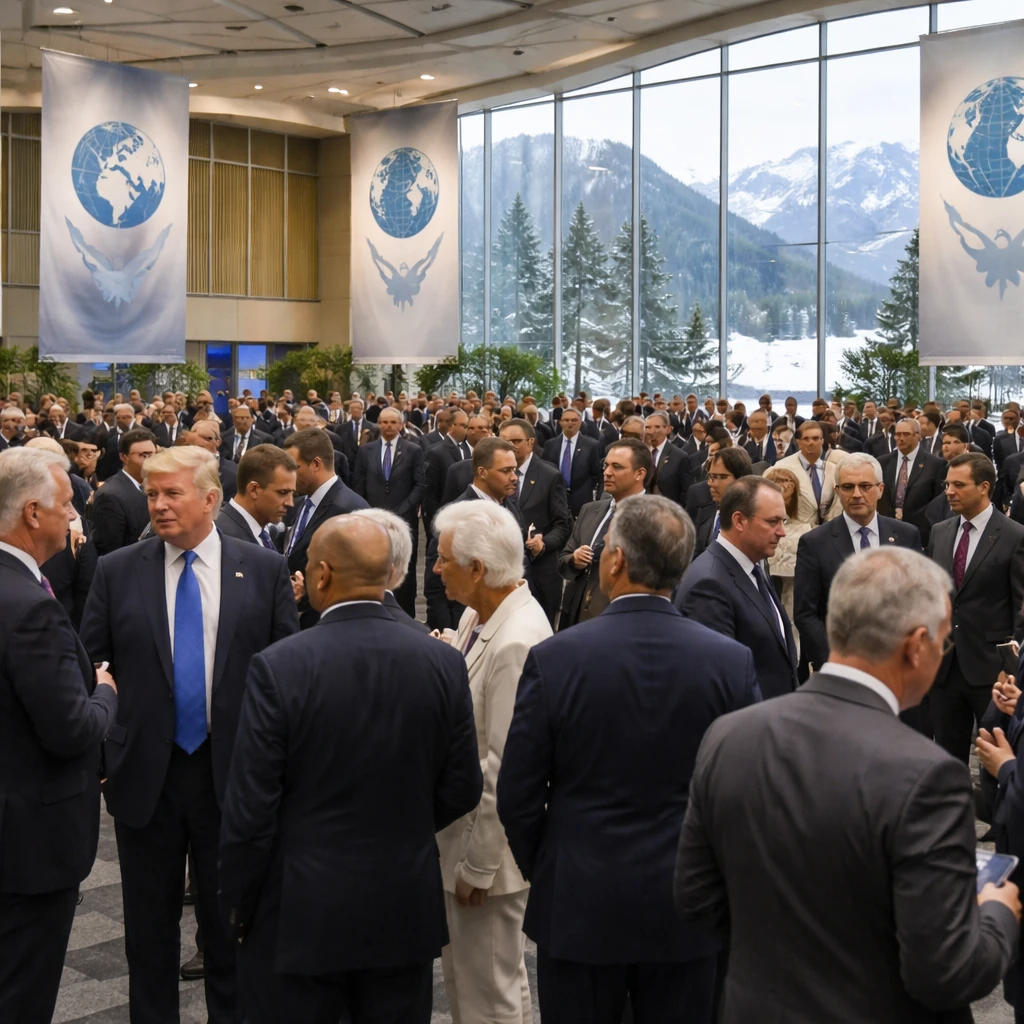
In the alpine setting of Davos, Switzerland, the emergence of Donald Trump’s Board of Peace has incited mixed reactions among world leaders. Conceived initially to address challenges in post-conflict Gaza, the initiative's scope has broadened toward tackling global crises, effectively positioning itself as a contender to the established United Nations framework for international peacebuilding.
According to discussions with a cross-section of 16 political figures and officials representing Arab nations, Latin America, and Europe at the World Economic Forum, the proposal has not met a universally voluntary reception. Numerous officials confided that signing onto the Board of Peace felt more obligatory than elective, influenced by concerns of potentially incurring the displeasure of the U.S. President. An Arab representative underscored this sentiment succinctly by questioning, "Who can say no to Trump?"—highlighting the perceived pressure around participation amidst U.S.-led geopolitical flashpoints such as sanctions, tariffs, and contentious regional conflicts.
A senior U.S. administration official revealed that the Board has secured commitments from approximately 35 world leaders since last week’s invitation issuance to about 60 nations, including prominent global players like Britain, Russia, and China. The draft charter of the Board, made available to reporters, details a governance structure featuring Trump as chairperson, and emphasizes aspirations for a "more nimble and effective international peace-building body." A formal membership signing ceremony was anticipated to take place during the Davos summit.
The Board’s earlier focus on Gaza’s reconstruction following warfare has expanded under Trump’s guidance to encompass wider international crises, encroaching upon roles traditionally fulfilled by the United Nations. Trump expressed dissatisfaction with the UN’s performance, remarking that it "has never lived up to its potential." Additionally, the board’s charter proposes a $1 billion fee for countries seeking membership, a significant financial consideration.
Several European leaders vocalized reservations about the Board’s governance and operational framework. Concerns center on clauses consolidating unilateral decision-making power in the hands of the chair—which, according to observers, points toward Trump's indefinite leadership. The chairperson's tenure provisions allow resignation only voluntarily or expulsion through unanimous executive board agreement citing incapacity, effectively securing a long-term chairmanship.
EU policymakers are engaging in ongoing deliberations, with some countries like France having declined the invitation outright. French President Emmanuel Macron is reportedly set to reject the proposal, with Foreign Minister Jean-Noel Barrot characterizing the Board's foundation as conflicting with France’s international commitments, especially regarding UN membership. Norway and Sweden have also decided against participation, while Germany and Italy remain in evaluation stages. The United Kingdom, under Prime Minister Keir Starmer, is proceeding with caution, engaging with allies but withholding official endorsement.
European diplomatic channels describe the sign-up process as labyrinthine and bogged down in administrative hurdles. Questions linger over the Board's physical headquarters locale and its legal status, which remain undefined, adding to the uncertainties surrounding the initiative. One EU diplomat labeled the process "a nightmare" and alluded to an underlying motive to establish Trump as a de facto leader for life within this framework.
Observers of foreign policy interpret the Board as a strategic maneuver by Trump to cement American influence in international affairs. Paul Salem from the Middle East Institute commented that Trump perceives himself as the central authority, whether concerning Gaza, Venezuela, or other contested regions. The Board is seen as a tool to extend an American sphere of influence, with a deliberately vague mandate allowing flexible and opaque policy moves to maintain leverage.
Supporters from various Latin American and Arab nations argue the Board complements Trump's broader strategy of showcasing U.S. strength and leveraging power to influence global developments. Turkey, a participant alongside Saudi Arabia, conveyed a cautiously optimistic stance. Turkish Foreign Minister Hakan Fidan acknowledged potential limitations but emphasized any positive impact the Board could yield, from Gaza’s situation to humanitarian benefits in Africa, as valuable.
Nevertheless, the initiative has generated apprehension in some quarters, where reluctance to join appears fueled by the fear of potential economic retaliation. Trump notably responded to France’s refusal with threats of punitive trade actions, including imposing steep tariffs on French wine and champagne in an attempt to compel compliance.