
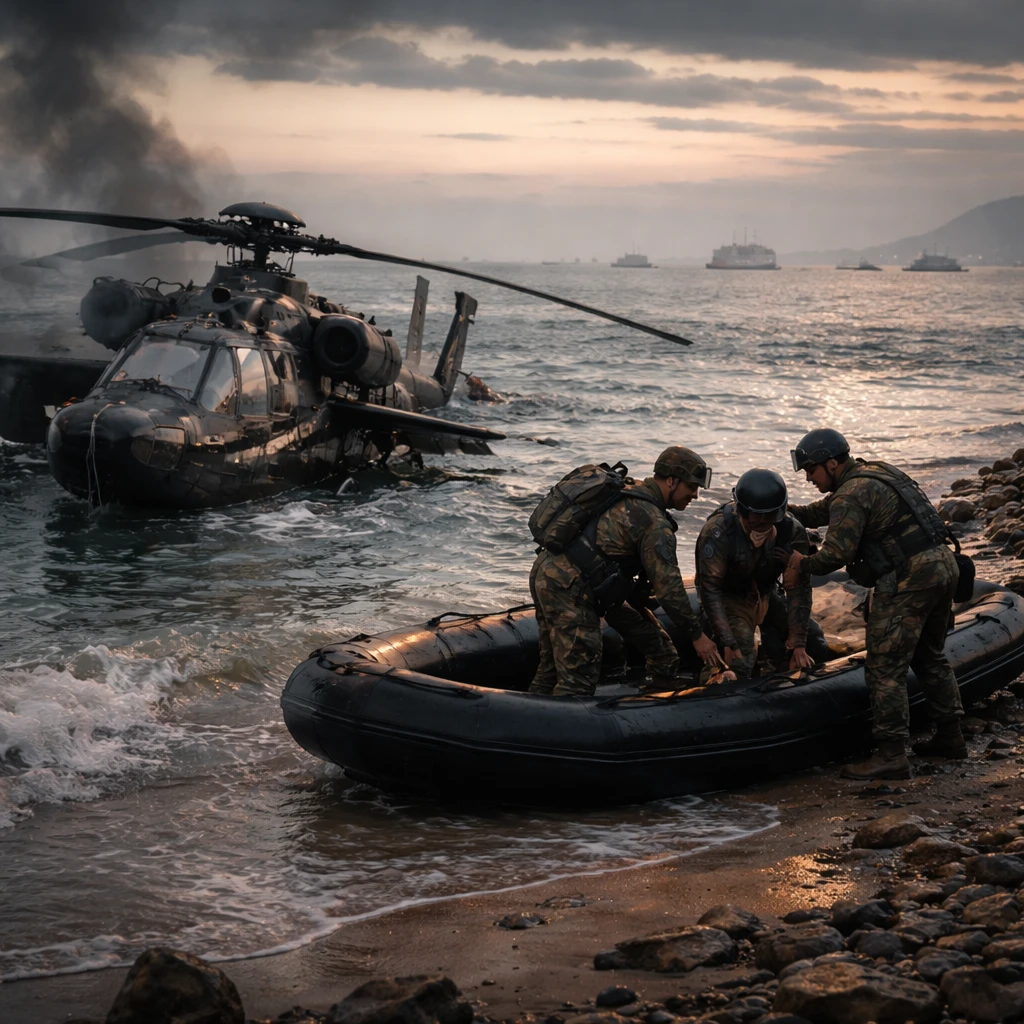
President Donald Trump confirmed on Tuesday that two U.S. pilots whose helicopter went down near the Strait of Hormuz are unhurt, following media reports that the crew of an Apache gunship had been rescued after the aircraft went down close to the Iran-controlled waterway.
When asked about the fate of the aircrew while speaking on the runway at John F. Kennedy International Airport ahead of his return to Washington, D.C., Trump said: "The pilots are fine. Nobody injured." He added officials would issue a report later in the day about what had happened.
The New York Times reported the crew had been pulled from the scene after the Apache gunship went down near the strategically important channel. It was not immediately possible to determine whether the helicopter had been struck by Iranian fire, experienced a mechanical fault, or encountered another problem, the report said.
U.S. government spokespeople did not immediately provide comment when contacted. The White House, the U.S. Department of State and U.S. Central Command did not immediately respond to requests for comment.
The crash came a day after Iran and Israel said they had paused attacks on one another following an appeal from President Trump, a halt described by both sides as temporary and conditioned by continued developments on the ground. Tehran warned it would resume strikes if Israel continued to attack Hezbollah positions in Lebanon.
The fragile pause in hostilities unfolded as the United States seeks an agreement with Tehran to end a conflict that has entered its fourth month. Speaking to reporters, Trump said he might have "an idea" for a deal with Iran in the coming days but offered no details.
The president, whose approval numbers are described in public reporting as at historically low levels ahead of the November midterm elections, has frequently signaled that a diplomatic breakthrough with Tehran could be imminent, but no comprehensive accord had yet been announced.
The weekend preceding the helicopter incident saw the most direct exchanges between Iran and Israel since a ceasefire in April. Tehran launched missiles toward Israeli territory late on Sunday, saying the strikes were retaliation for attacks on Hezbollah near Beirut. Israel responded by striking Iranian air defence systems and a petrochemical facility it said was used in ballistic missile production.
Iran’s Islamic Revolutionary Guard Corps said it launched a retaliatory strike aimed at a similar facility in the northern Israeli city of Haifa. Authorities on both sides reported no fatalities from those exchanges.
U.S. and Israeli officials confirmed that Trump and Israeli Prime Minister Benjamin Netanyahu held a telephone conversation on Monday. In an interview with Axios, the president said he warned Netanyahu that if Israel returned to open war with Iran, it might find itself without U.S. support.
"I said, 'Bibi, you better be careful, or you will be on your own very soon,'" Trump said, recounting his warning to the Israeli leader.
Israeli military officials stated their forces stood ready to continue operations "for as long as it takes," while Iranian authorities adopted a similarly resolute posture. A military source quoted by the semi-official Tasnim news agency said Tehran was prepared for an extended conflict and could renew strikes on U.S. interests in the region.
Iranian Foreign Ministry spokesperson Esmaeil Baghaei described exchanges between Tehran and Washington as taking place in an atmosphere of "extreme suspicion." Tehran has repeatedly said that any peace arrangement with the United States depends in part on a cessation of fighting in Lebanon, where Israel launched an invasion in March aimed at Hezbollah fighters who had crossed the border. Israel maintains its Lebanon campaign, saying it should be handled independently of any U.S.-Iran ceasefire. Hezbollah has continued to mount attacks.
Tehran has also continued to restrict most shipping through the Strait of Hormuz, a chokepoint that prior to the war carried about a fifth of the world’s crude oil and liquefied natural gas shipments. Washington has implemented its own blockade of Iranian ports. Iran’s negotiating demands include lifting international sanctions, unlocking billions of dollars in frozen assets, and formal recognition of its control over the strait. Trump has said any peace deal must prevent Iran from developing a nuclear weapon.
At midday press remarks, when asked whether he knew what caused the helicopter to go down, the president replied that an official explanation would be provided later on Tuesday. Beyond confirming the pilots were unharmed, he declined to elaborate further.
As U.S. and regional leaders weigh diplomatic and military options, the cause of the helicopter crash remains unresolved. Officials have not publicly confirmed whether the aircraft was operating in a combat role or the precise circumstances that led to its loss. The ongoing uncertainty comes against the backdrop of military operations, diplomatic messaging and competing public stances that together leave the situation fluid.