
In a notable exchange at the annual World Economic Forum gathering in Davos, Switzerland, U.S. President Donald Trump publicly criticized Mark Carney, who recently addressed the forum with a focus on emerging fractures in the global rules-based order. President Trump’s speech on January 21 covered a spectrum of topics including the strategic desire to acquire Greenland, plans related to Venezuela, and considerations for the Federal Reserve leadership. However, his pointed commentary targeted Carney, the Canadian Governor of the Bank of England, following Carney’s standing ovation-winning address the previous day.
Trump explicitly told Carney, “Canada lives because of the United States,” urging Canada to appreciate the underlying economic and strategic support it receives from its southern neighbor. He urged Carney to recall this relationship the next time he issues public statements.
Carney’s speech outlined Canada’s intention to seek out new partnerships with countries sharing similar values, reflecting the complexities of navigating relations with the Trump administration in Washington. He described current international conditions as a “rupture,” marking a clear break rather than a mere transition in the global order. Carney highlighted the rise of so-called “great powers” wielding economic integration and tariffs as tools of influence and power, although he did not single out the United States or President Trump directly.
“We know the old order is not coming back. We shouldn’t mourn it. Nostalgia is not a strategy,” Carney said, signaling a call to adapt to new geopolitical realities.
Additional context reveals that President Trump has previously made remarks hinting at possible annexation of Canada. Supporting this stance, on the prior day of the forum, he shared an AI-generated map image that positioned Canada and Greenland under U.S. territory.
Official spokespeople for Mark Carney have declined to comment on President Trump's subsequent speech.
These public remarks underline tensions and differing views on international relations and economic strategy between the United States and Canada, particularly under the current U.S. administration’s approach to diplomacy and trade.
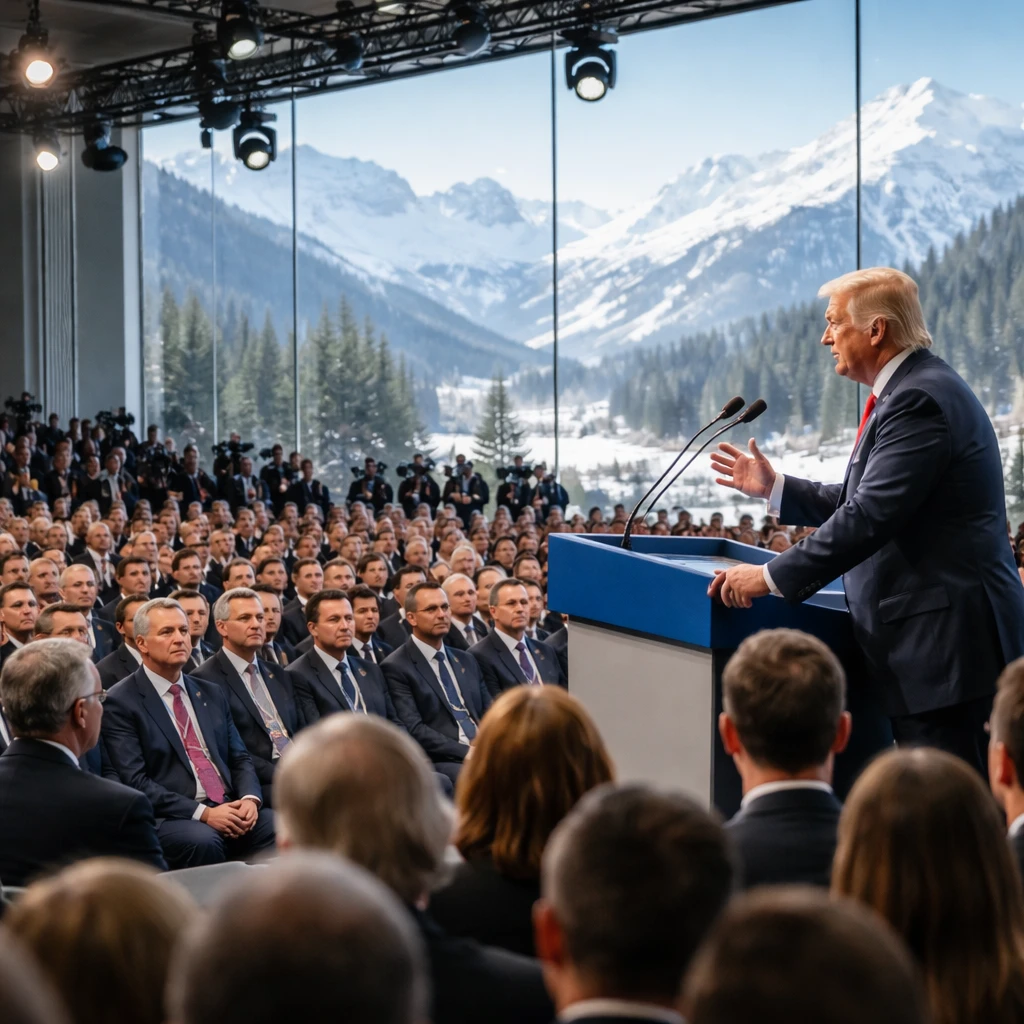
During the World Economic Forum in Davos, U.S. President Donald Trump openly rebuked Canadian Governor Mark Carney following Carney’s speech on shifts in the global economic order. Trump emphasized the United States' critical influence on Canada’s wellbeing and dismissed Carney's warnings about geopolitical changes. Carney’s call for forming new alliances in response to shifting global power dynamics contrasts with Trump’s remarks that highlighted American dominance and historical ties.
Key Points
- U.S. President Trump rebuked Canadian Governor Mark Carney at the Davos forum, emphasizing America's critical role in Canada's survival and prosperity.
- Mark Carney highlighted a fundamental rupture in the global rules-based order and called for Canada to build alliances with like-minded nations amid shifting global power dynamics.
- Trump's speech touched on multiple topics including Greenland's possible acquisition and his stance on Venezuela, but he focused his strongest rhetoric on Canada and Carney’s statements.
Risks
- Ongoing tensions between the U.S. and Canada could disrupt economic and trade relations impacting sectors reliant on cross-border supply chains, notably in machinery and industrial goods.
- The breakdown in consensus about the international order may increase volatility in global markets and impede cooperative mechanisms in aerospace and defense industries reliant on multinational agreements.
- The unpredictable nature of U.S. foreign policy under the Trump administration introduces uncertainty for businesses and governments in North America planning future investments and partnerships.