
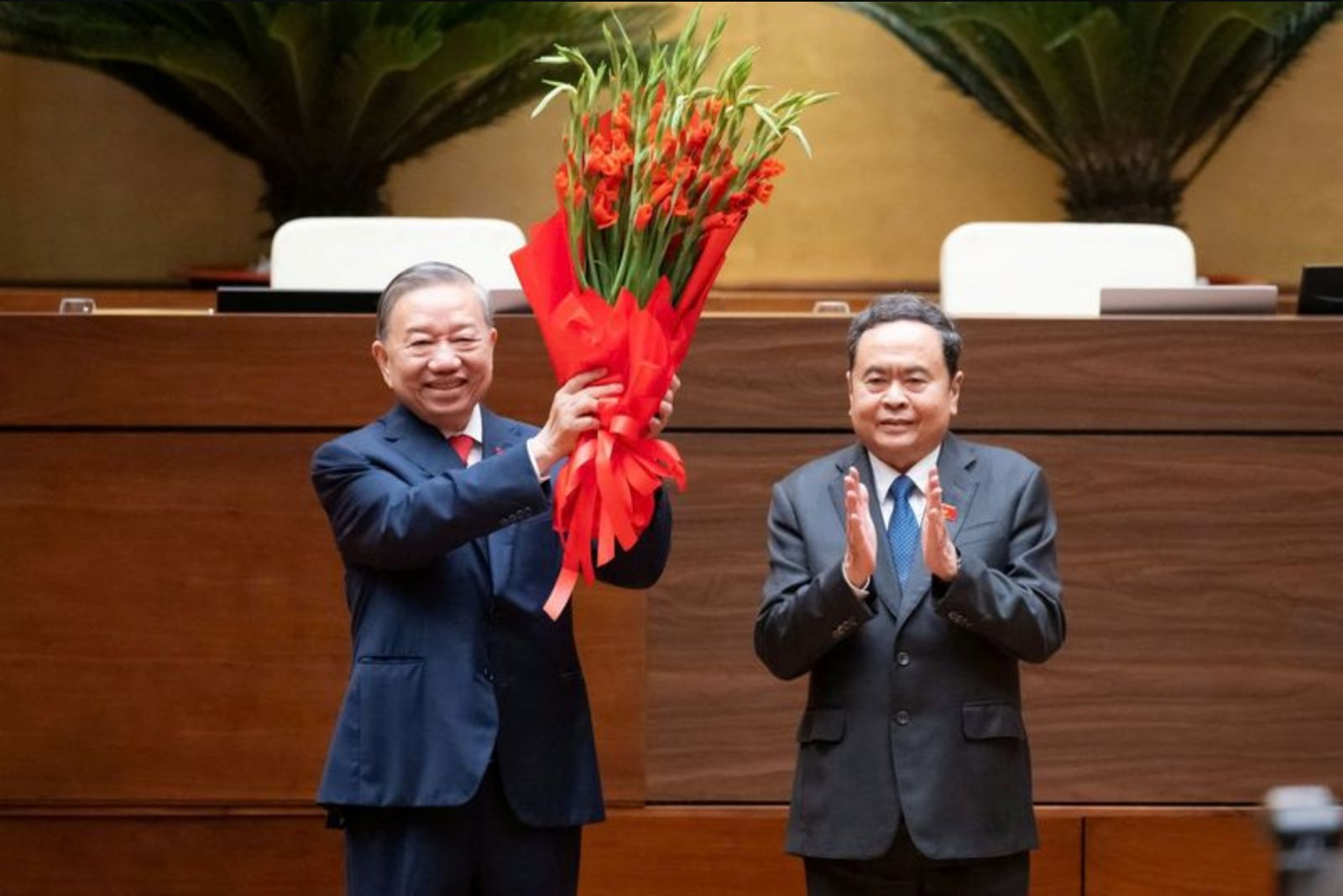
Vietnam’s parliament on Tuesday formally installed Communist Party Secretary General To Lam as the country’s state president for a five-year term, concentrating the top party and state roles in a single individual. The National Assembly session recorded unanimous endorsement from all 495 deputies who were present, while five lawmakers did not attend.
The outcome, described by officials as the result of nominations finalised at a late March meeting, restores to Lam the presidency he previously held, and follows his re-election for a second term as general secretary in January. In a parallel and largely expected decision later the same day, the assembly also unanimously elected Le Minh Hung as prime minister.
Lam’s mandate and immediate priorities
After the vote, Lam addressed deputies on television, saying it was an honour to serve in both capacities and outlining his policy priorities. He pledged to pursue "a new growth model with science, technology, innovation, and digital transformation as the primary driving forces" and said his main goals would be to maintain stability, drive rapid and sustainable national development and improve "all aspects of people’s lives."
Lam, 68, is a former head of public security. He briefly held both the party and state leadership roles following the death in 2024 of the late party general secretary Nguyen Phu Trong. Although Lam had relinquished the presidency subsequently to army general Luong Cuong, he continued to act publicly in a presidential capacity, travelling extensively and representing Vietnam in meetings with foreign leaders.
Analysts weigh the political impact
Commentators cited in the assembly debate noted the significance of consolidating power in a single figure after decades of Vietnam’s preference for a collective leadership model. Le Hong Hiep, a senior fellow at the ISEAS Yusof Ishak Institute in Singapore, warned that "concentrating greater power in To Lam’s hands could pose risks to Vietnam’s political system, such as increased authoritarianism." At the same time, he said, centralisation could allow the government to "formulate and implement policies more quickly and effectively," supporting economic growth.
Alexander Vuving of the Asia-Pacific Center for Security Studies in the United States commented that the combination of roles "will shift Vietnam’s domestic politics to a new normal where most of the old assumptions about Vietnam’s politics, including those about collective leadership, are no longer valid."
Economic agenda and governance style
During his earlier tenure as party chief, Lam initiated broad economic changes aimed at boosting Vietnam’s competitiveness. He has articulated a goal of achieving double-digit growth through a development model that moves away from reliance on low-cost manufacturing - a sector that has long underpinned Vietnam’s export-driven expansion led by multinational firms.
Observers say Lam has shown pragmatic flexibility in execution. He has backed private conglomerates while also taking steps to reassure party traditionalists; prior to his reappointment he issued a directive emphasising the leading role of state-owned enterprises. The combination of support for both private sector expansion and a strengthened role for state businesses reflects a pragmatic approach intended to balance reformist impulses with internal party concerns.
Foreign investors have often pointed to political stability under Vietnam’s leadership and view Lam as broadly pro-business. Nonetheless, his support for national champions and an aggressive growth push has generated concerns among some stakeholders about potential favouritism, corruption risks, asset bubbles and waste.
Foreign policy posture
Lam has maintained Vietnam’s approach described as "Bamboo Diplomacy," seeking to balance relations with major powers while expanding international partnerships. Khang Vu, a visiting scholar at Boston College, said that Lam’s dual role "would not signal any changes in Vietnam’s foreign policy, even if there are concerns that Vietnam is concentrating more power in a single individual."
New prime minister and economic management
Le Minh Hung, 55, the newly elected prime minister, served as governor of the central bank from 2016 to 2020 and was the youngest person to occupy that position. He replaces Pham Minh Chinh, 67, who led the country through a period of rapid economic expansion during his five-year term and who was among Vietnam’s most visible leaders domestically and internationally.
Hung has generally kept a low profile in his party roles and during his time at the central bank. While not formally trained as an economist, his nomination is viewed by some officials as an effort to strengthen economic expertise within the highest levels of government, which have included a number of leaders with security backgrounds.
Although Hung does not have a personal career in security, his family has close ties to the ministry previously led by Lam: Hung’s father served as public security minister, and two of his brothers are generals within security forces.
Implications for governance and markets
The consolidation of party and state leadership under Lam could speed policy implementation, which may be seen as advantageous for investors and managers tracking decisions that affect production rates, supply chains and capital allocation. At the same time, analysts cited concerns about governance risks that could influence confidence in regulatory fairness and state support for selected firms. For sectors tied to state-owned enterprises, large private conglomerates and financial markets, the policy direction and degree of state involvement will be critical variables to monitor.
Given the limited scope of public detail beyond the formal votes and statements, observers will be watching for how Lam and the new cabinet translate declared priorities into concrete policies and how those measures affect investment flows, corporate strategy and the balance between private and state-led development.
Summary of the parliamentary outcomes:
- To Lam was unanimously elected state president by 495 deputies present; five deputies were absent.
- Le Minh Hung was unanimously elected prime minister.
- Lam pledged a technology- and innovation-driven growth model, with stability and improvements in living standards as stated priorities.