
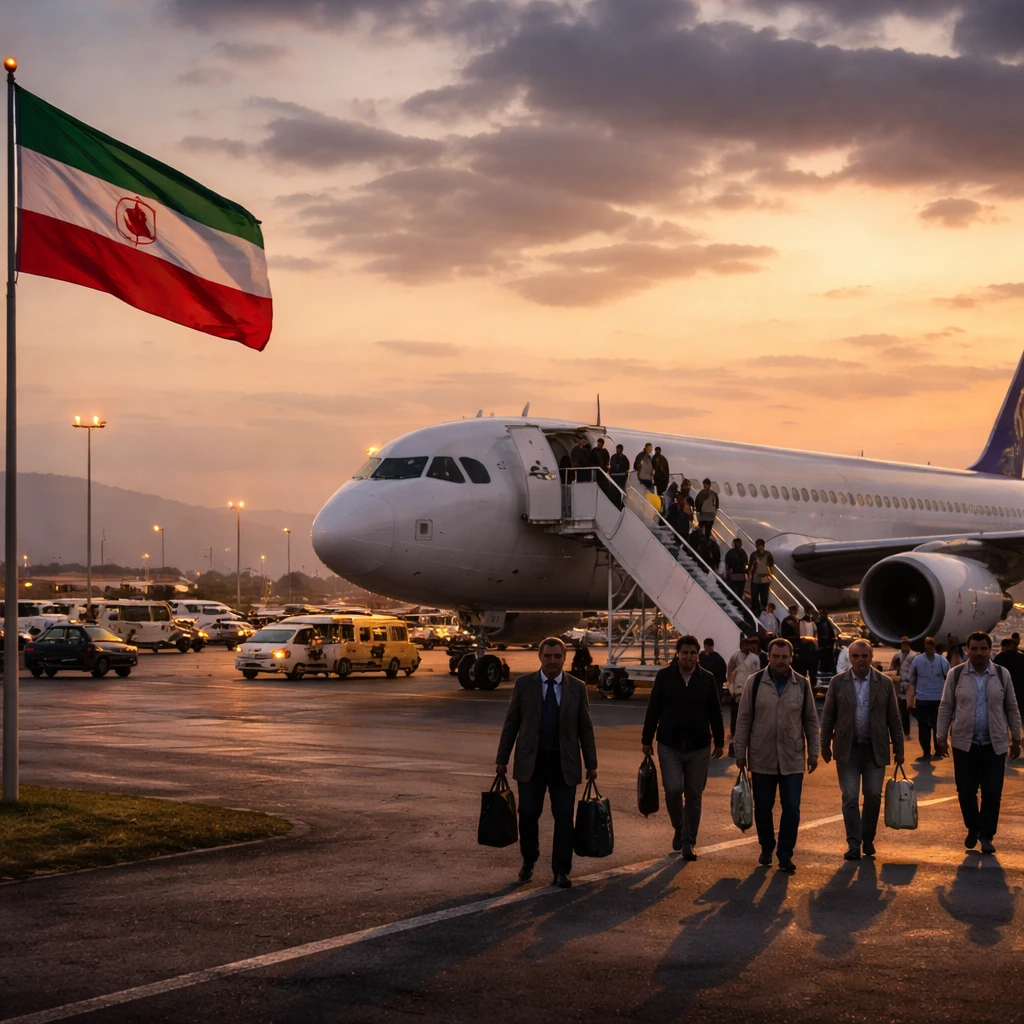
DUBAI, Jan 26 - A third contingent of Iranians deported from the United States has started returning to Iran, Iran’s semi-official Tasnim news agency reported on Monday, in the latest movement amid heightened tensions between Washington and Tehran.
Tasnim said the group travelled back via Cairo and Kuwait, and that "These people, who have been under pressure to leave (the U.S.) for two months, made their return journey via Cairo and Kuwait." The agency reported that 14 people arrived at Imam Khomeini International Airport on a flight today, and that "the rest will return in the coming weeks." Tasnim did not provide a total figure for the size of this group.
The transfers have required an unusual degree of coordination between two adversaries, Tasnim added, underscoring the logistical and diplomatic complexity of moving deportees across multiple countries.
The departures follow a period of escalating rhetoric between the two countries. Last week, President Donald Trump renewed warnings to Tehran over the killing of protesters and any move to restart its nuclear program.
Officials had previously disclosed that, in September, the U.S. had identified about 400 Iranians for deportation. At that time, a first flight carrying 120 people returned to Tehran via Qatar’s capital. A second group of 55 returned in December, a move that prompted Iran’s foreign ministry to accuse Washington of carrying out deportations on "political grounds and anti-migrant policies."
The most recent repatriation marks the third publicly reported batch to reach Iran following U.S. removal actions. Details remain limited about the overall count of those repatriated in this round and about the timetable for remaining returns. Tasnim’s account highlights both the operational steps taken to move people through intermediaries and the continuing diplomatic frictions surrounding the issue.
As the situation develops, official tallies and further statements from the involved governments will determine the full scope of the deportation program and its immediate implications for bilateral ties.
Summary
Tasnim reports a third group of deported Iranians returning to Tehran via Cairo and Kuwait. Fourteen arrived at Imam Khomeini International Airport, with additional arrivals expected in the coming weeks. The transfers required coordination between adversarial governments and follow earlier flights that returned 120 people and 55 people respectively. Iranian authorities have criticized the deportations as politically driven.
Key points
- Third repatriation reported by Tasnim, with 14 arrivals confirmed at Imam Khomeini International Airport and more expected.
- Transfers routed through Cairo and Kuwait, reflecting complex coordination between the United States and Iran.
- Earlier phases included a first flight of 120 people returning via Qatar’s capital and a second group of 55 in December; about 400 individuals were identified by U.S. officials in September.
Sectors potentially impacted
- Government and diplomacy - the deportations and accompanying statements affect bilateral relations and diplomatic channels.
- Aviation and transit - use of intermediate airports and international flights indicates operational impacts on transport coordination.
- Immigration enforcement - the actions reflect enforcement policies and cross-border migrant management.
Risks and uncertainties
- Unclear total numbers - Tasnim did not specify the full size of the returning group, leaving uncertainty about how many remain to be repatriated.
- Diplomatic complexity - the transfers required an unusual level of coordination between adversaries, creating uncertainty about future operational arrangements.
- Political tensions - renewed warnings from the U.S. president and Iran’s accusations of "political grounds and anti-migrant policies" add unpredictability to bilateral relations.