
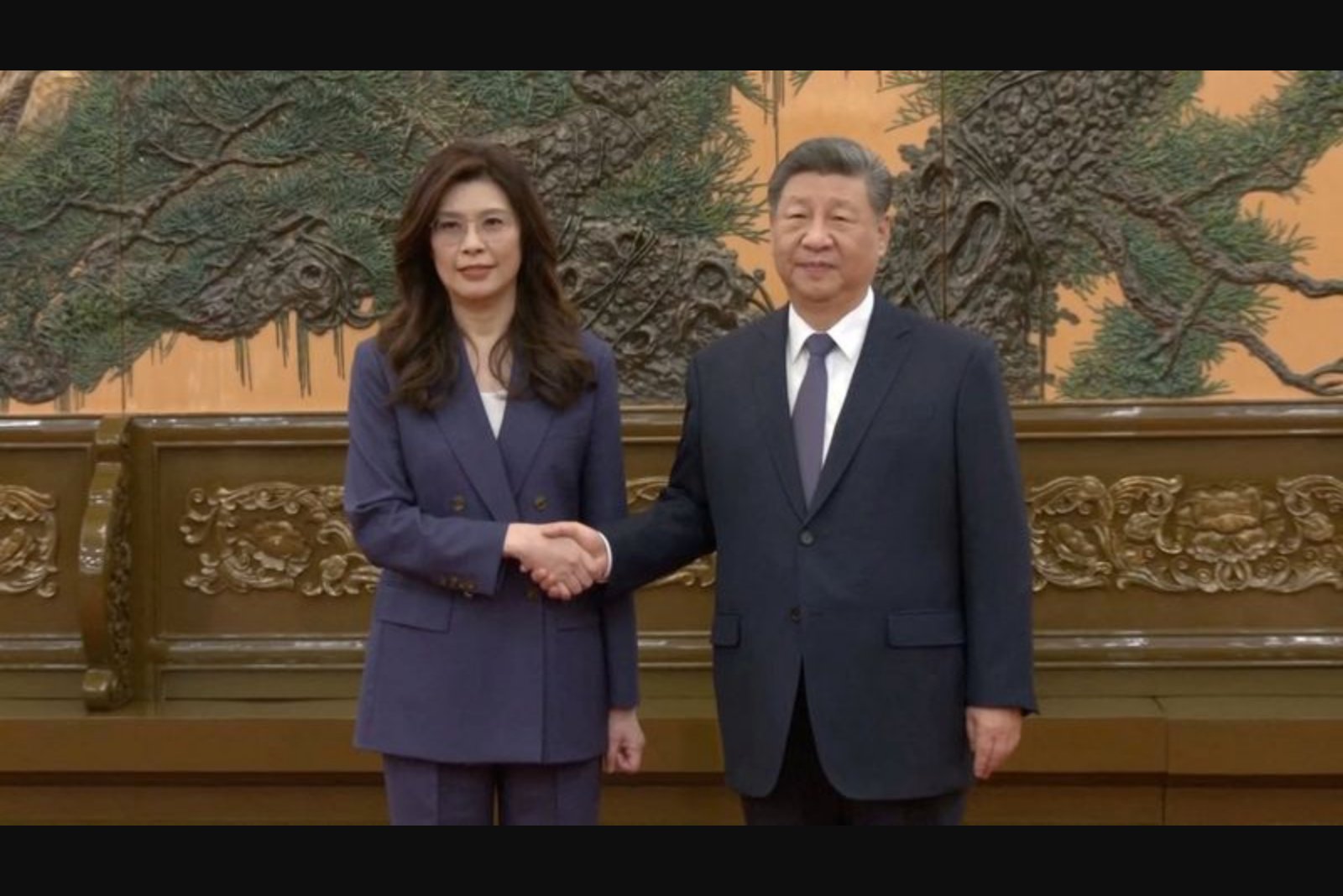
Taiwan's defence ministry said on Saturday that it observed 16 Chinese warplanes operating in the vicinity of the island during the previous day, a period that overlapped with a meeting in Beijing between Chinese President Xi Jinping and Cheng Li-wun, the chairwoman of Taiwan's largest opposition party, the Kuomintang.
The defence ministry's daily account of Chinese military activity noted that the aircraft flew near Taiwan from mid-morning to mid-afternoon on Friday. The formal meeting in Beijing between Xi and Cheng was recorded at 11 am (0300 GMT).
At the meeting, Xi reiterated a hardline position on Taiwan, saying he "absolutely would not tolerate" independence for the island, which the Chinese leadership views as part of its territory. Cheng described her visit as a reconciliation mission aimed at easing tensions, and told Xi she anticipated that the KMT and the Chinese Communist Party would work toward the "institutionalisation" of peace across the Taiwan Strait.
Commenting from Taipei on Saturday, Shen Yu-chung, a deputy minister at Taiwan's Mainland Affairs Council - the agency responsible for China policy - told reporters that using military coercion to influence political negotiations with Taiwan has been Beijing's "go-to tactic." Shen said: "So on one hand we see them sending out messages of peace, while on the other hand they continue to use military force to pressure Taiwan without letup."
Requests for comment to China's Taiwan Affairs Office received no response, according to the reporting.
In Beijing, KMT Vice Chairman Chang Jung-kung was quoted in a party statement as saying that promoting peace requires giving Taiwan's people a clear choice between peace and reconciliation or war. Chang added that engaging with China and advancing cross-strait peace represents "peace with dignity," rather than what he described as bowing the head to "shake hands," language he contrasted with remarks attributed to Taiwan President Lai Ching-te.
President Lai's office released a statement on Friday night characterising the Xi-Cheng meeting as an effort to emphasise that "Taiwan is part of the People's Republic of China" and to advance "the annexation of Taiwan." Lai's spokesperson, Karen Kuo, reiterated the administration's position that "Taiwan's future can only be decided by the Taiwanese people themselves."
This sequence of diplomatic engagement and concurrent military activity highlights continuing tensions in cross-strait relations and the competing political narratives presented by Beijing, Taiwan's opposition KMT, and Taiwan's current administration.