
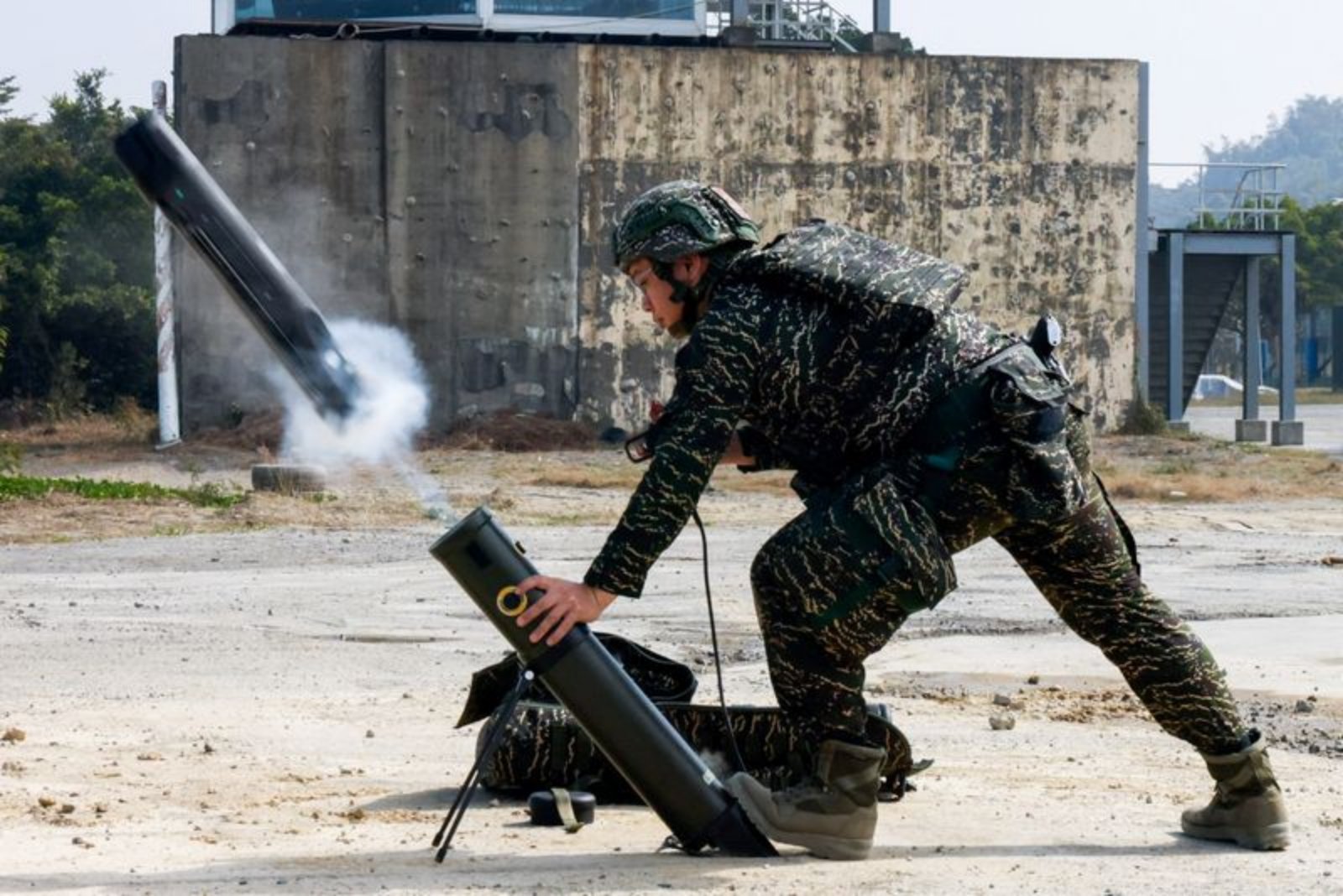
KAOHSIUNG, Taiwan, Jan 29 - Taiwan's armed forces conducted a live simulation on Thursday designed to practice repelling an attempted landing from the sea, employing a mix of shore-based missiles, unmanned aerial systems and fast-attack craft.
The exercise took place on a stretch of beach that is part of the Zuoying naval base in the southern city of Kaohsiung. Organisers laid out a scenario in which an unidentified vessel is first detected loitering offshore. Drones are dispatched to investigate, and when hostile intent is confirmed Taiwanese attack drones and rapid, missile-equipped patrol boats engage. Sniper teams are deployed to target enemy personnel onshore, while locally produced Hsiung Feng anti-ship missiles are launched from concealed mobile beach positions.
A Marine Corps officer, speaking while fully masked and declining to give his name for security reasons, told reporters the near-shore exercise and its coordinated strike missions helped establish a "kill chain and effectively execute joint interceptions." He added that it "demonstrated the Navy's multi-layered, multi-wave defensive combat effectiveness, as well as the Marine Corps' combat power and resilience in rapidly taking control from both the sea and the land."
Taiwan routinely carries out drills ahead of the Lunar New Year holiday, which begins next month, but officials noted these were the first such drills presented in front of the media since China concluded a recent set of war games around the island in late December. The government reiterates that only the people of the island may determine Taiwan's future, while China continues to regard Taiwan as part of its territory and has not ruled out use of force.
Military planners emphasised that any amphibious invasion would face significant challenges, given the need for an attacker to cross the Taiwan Strait and then concentrate landing forces on a few beaches suited to a large-scale amphibious assault. The drill aimed to practice layered responses that combine detection, unmanned reconnaissance, surface action and shore-based strike capabilities.
Earlier in the week the armed forces staged a separate demonstration of the U.S.-made High Mobility Artillery Rocket System, or HIMARS, showing how the system could be used to strike the Penghu islands in the Taiwan Strait in the event that those islands were seized and converted into bases for attacks on Taiwan proper. The Lockheed Martin HIMARS is described by military officials as one of Taiwan's newest and most precise strike systems; the weapon has also been used extensively by Ukraine in its conflict with Russia.
Under President Lai Ching-te's defence-modernisation programme, training has been reoriented toward more combat-realistic scenarios. The administration has pushed to move away from scripted, ceremonial demonstrations toward exercises that simulate the conditions and tempo of actual combat operations, officials said.
Context and takeaways
The Kaohsiung exercise combined unmanned systems, small fast craft and shore-launched anti-ship missiles to practice integrated coastal defence. By staging the drill in public, Taiwan's military sought to illustrate both tactical concepts and the practical application of newly fielded weaponry as part of an overall shift toward more realistic training.