
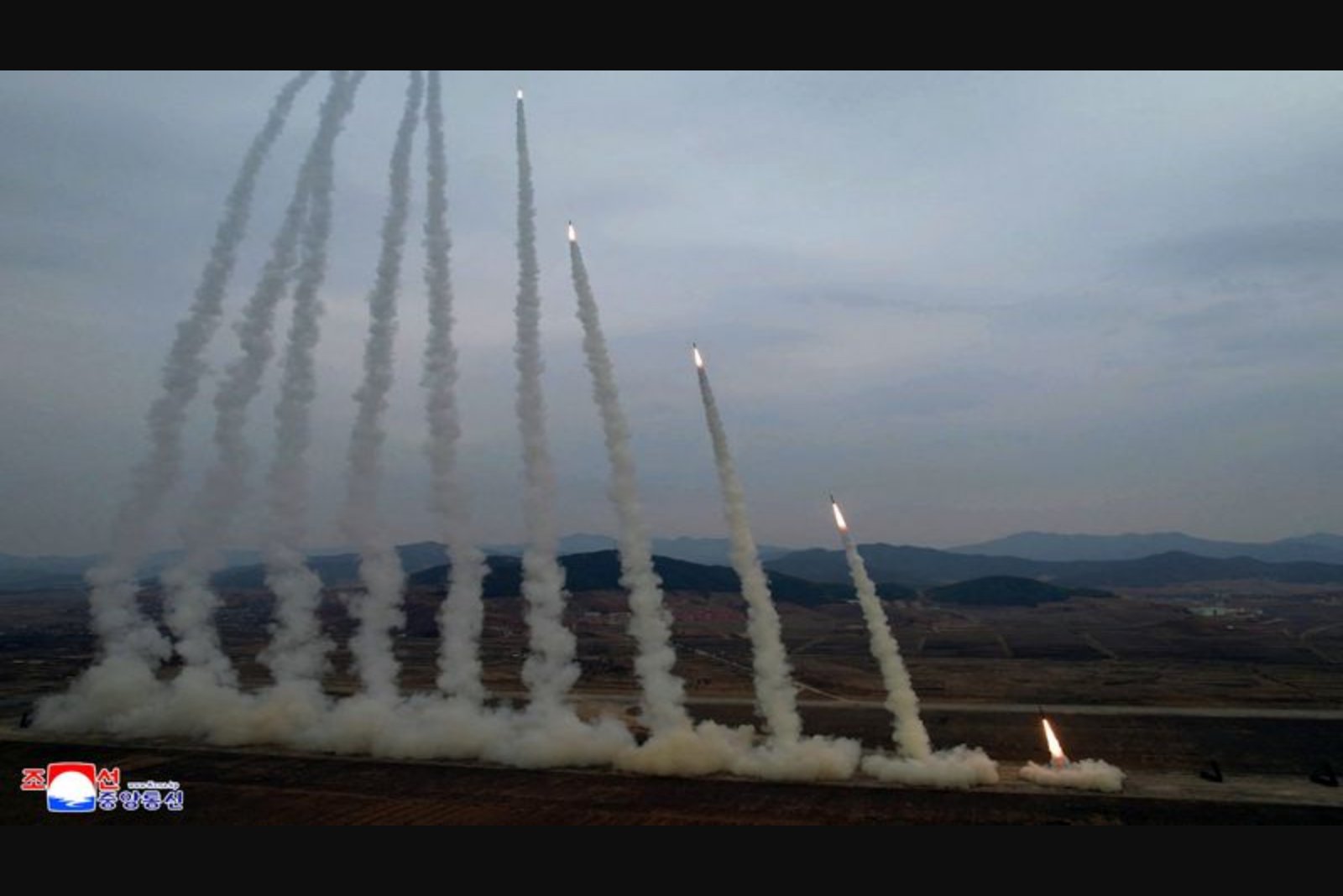
South Korean lawmakers said on Monday that North Korea's recent ground test of a solid-fuel rocket engine is being developed for intercontinental ballistic missiles (ICBMs) constructed with carbon-fibre airframes to extend range and enable the delivery of heavier and potentially multiple warheads.
Lawmakers made the comments after a closed-door briefing by South Korea's National Intelligence Service (NIS). Member of parliament Park Sun-won told reporters that footage shown by North Korean state media during the March engine test displayed a missile airframe made from carbon fibre. Park emphasized that carbon fibre is both lightweight and strong, characteristics that can allow a missile to carry additional warhead weight.
Analysts tracking the program believe the solid-fuel engine tested on the ground in March is intended for North Korea's latest ICBM. They assess that the new engine likely produces greater thrust than a model tested in 2024. The 2024 engine was already assessed as having the capability to strike anywhere on the mainland United States.
North Korea has continued to conduct longer-range missile launches on lofted trajectories rather than full-range arcs. Those lofted tests are aimed to have projectiles splash down in the ocean off its east coast or to the east of Japan, allowing the regime to test missile performance without flying the weapons the full distances for which they are designed.
North Korean leader Kim Jong Un was present for the March 28 engine test and described it as a significant upgrade to the country's strategic forces. Observers note that North Korea has continued to test missiles and nuclear-related capabilities in defiance of a U.N. Security Council ban, and that the country appears to be steadily advancing in the development of more powerful and technically sophisticated missiles.
Key points
- March ground test of a solid-fuel rocket engine is assessed to be for a new ICBM variant.
- North Korean media footage showed a missile airframe built with carbon fibre, which can lower mass while supporting heavier payloads.
- The new engine likely has greater thrust than a 2024 model previously judged capable of reaching the U.S. mainland.
Risks and uncertainties
- Uncertainty remains about the operational deployment timeline and full performance of the new engine and carbon-fibre airframe - this affects defense and aerospace planning.
- Testing on lofted trajectories limits observable full-range flight data, leaving questions about true range and reentry performance.
- Continued missile and nuclear-related testing in defiance of U.N. sanctions creates geopolitical and security risks that could influence defense markets and procurement decisions.