
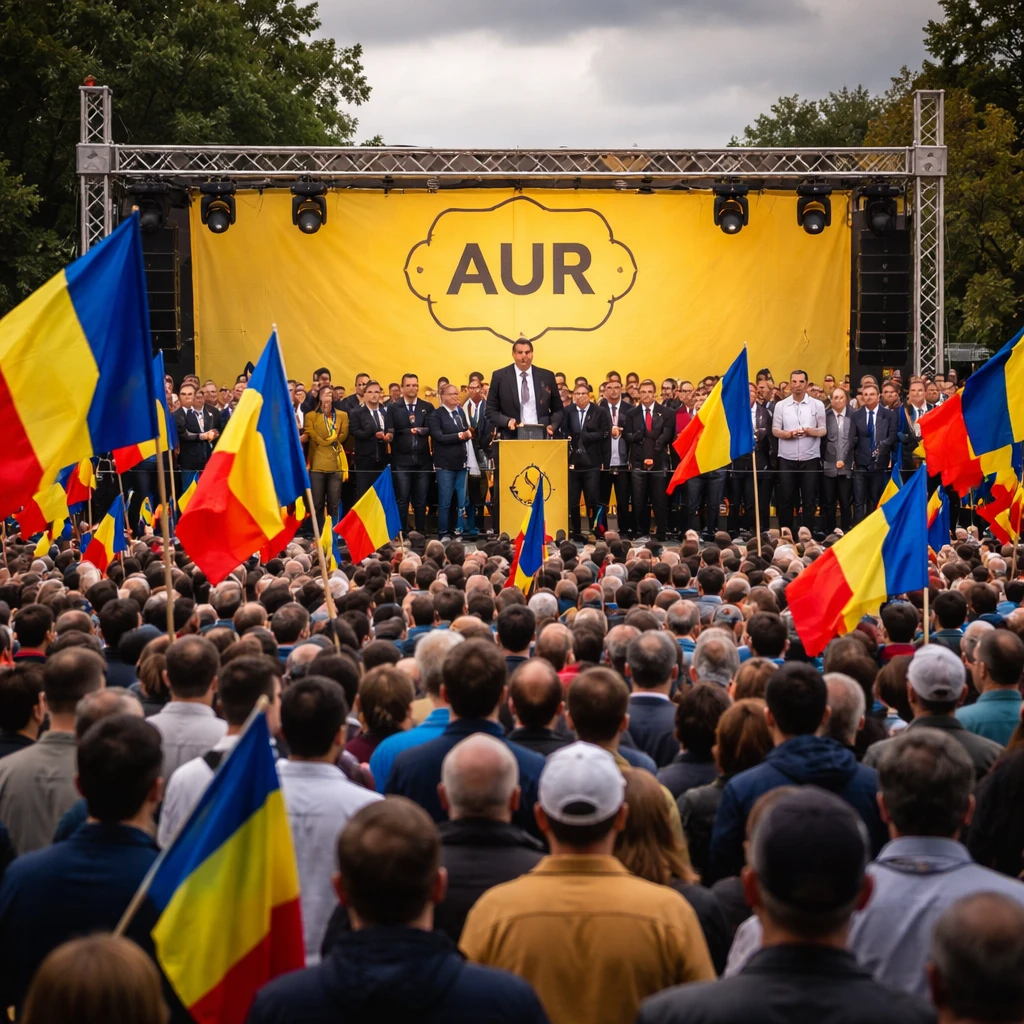
In Romania, the far-right political group Alliance for Uniting Romanians (AUR) has reached an unprecedented level of popularity, surpassing the four parties constituting the nation's pro-European coalition government, according to a poll released on January 21. Although no general elections are scheduled until 2028, this survey highlights AUR's strong position in Romanian politics.
AUR, which holds the status of the second-largest party nationwide, maintained a consistent lead throughout 2025 despite its leader, George Simion, being defeated in a presidential re-run last May. The party opposes extending military support to Ukraine, expresses criticism toward the European Union's leadership, and supports former U.S. President Donald Trump's policies on issues including energy and immigration. Romania's strategic alignment includes membership in both the European Union and NATO.
The recent poll, carried out by the firm INSCOP between January 12 and 15 and featuring a margin of error of 3.0%, reports that 40.9% of respondents intend to vote for AUR. This figure marks the highest endorsement for any hard-right formation in Romania over more than thirty years. The left-oriented Social Democratic Party (PSD), which currently holds the largest number of parliamentary seats and forms part of the ruling coalition, appears significantly behind with 18.2% support. The Liberal Party, led by Prime Minister Ilie Bolojan, remains third at 13.5%. Two other coalition partners, the centrist Save Romania Union (USR) and the ethnic Hungarian party UDMR, registered supports of 11.7% and 4.9%, respectively.
This polling development follows an election cycle marked by disruption, including the annulment last year of a presidential election originally scheduled for December 2024. This cancellation resulted from allegations of Russian interference favoring the far-right frontrunner Calin Georgescu and plunged the nation into its gravest political crisis in decades. The unfolding turmoil revealed Romania's susceptibility to hybrid warfare and misinformation campaigns, deeply divided its electorate, caused downturns in financial markets, and threatened its status as an investment-grade sovereign.
Subsequent to the re-run election, a broad coalition government took power and implemented fiscal reforms to address Romania’s substantial budget deficit—the largest within the European Union. These reforms involved tax hikes and spending cuts aimed at narrowing the gap, with the deficit forecasted to decrease to around 6% of GDP in 2025, down from more than 9% in 2024. These measures have been essential in maintaining Romania’s investment-grade credit rating and in unlocking European Union funding. However, they have also incited public protests and bolstered the opposition's support, reflecting socio-political tensions linked to economic policy.