
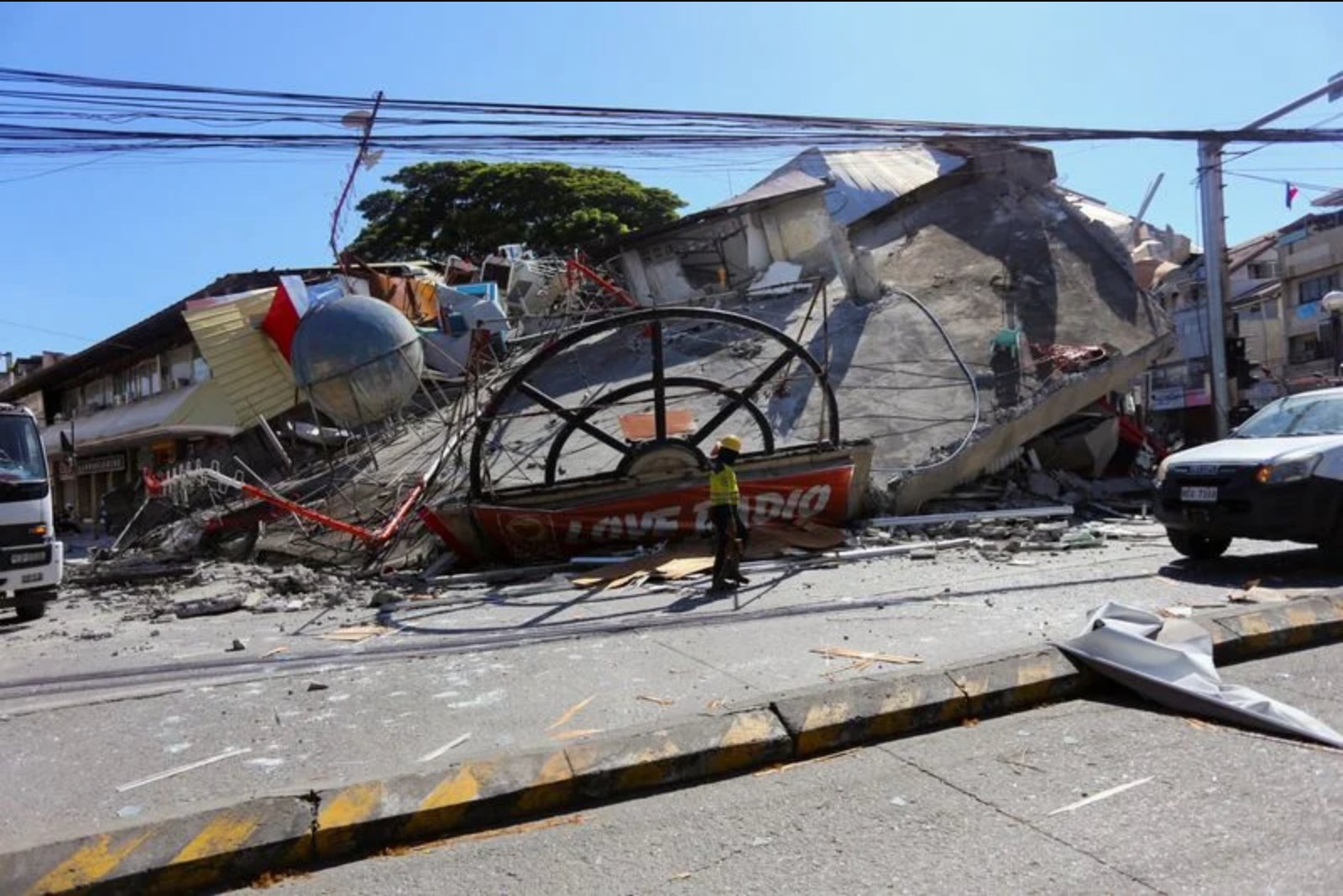
Rescue teams continued to comb through debris on Tuesday at a multi-tenant commercial building in General Santos, the city hardest hit by a powerful earthquake that has left at least 37 people dead and hundreds wounded. Emergency responders were trying to reach two people who were still thought to be trapped inside the structure, which housed a grocery store and other businesses.
Regional fire officer Edgar Tanawan, who is leading the operation, said two people had been pulled out alive from the collapsed building while a third victim recovered from the rubble had been declared dead. Scanning equipment has so far registered no sign of life from the two remaining individuals, he said.
“It’s difficult to accept, as a mother, that my son is still trapped there,” said Dioslinda Deluvio, 65, distraught as she waited outside the wrecked building for word about her son. “I don’t know… it’s very hard to accept. My only call is to have him retrieved today so we can be at peace.”
The 7.8-magnitude earthquake struck early on Monday about 20 km (12.4 miles) off the coast of Sarangani province, prompting tsunami warnings for several countries and sending strong tremors across the island of Mindanao. Shaking was reported as far away as the city of Manado on the Indonesian island of Sulawesi, about 420 km (261 miles) from the epicenter.
Officials reported the death toll at a minimum of 37, with more than 400 people injured and four still missing as search-and-rescue efforts proceeded. Scenes of destruction were clear in several parts of General Santos, a city of more than 700,000 people that has been placed under a state of calamity. Collapsed buildings, rubble-strewn streets and a tangle of toppled power lines and utility posts marked many neighborhoods.
Disaster management teams have been conducting inspections of damaged buildings while crews worked to restore power and water to thousands of affected residents. The scale of damage included both commercial properties and public infrastructure, hampering immediate recovery efforts and complicating medical responses.
Authorities noted that the quake came eight months after the country endured its deadliest tremor in 12 years, when a shallow 6.9-magnitude earthquake struck off the central island of Cebu and resulted in 79 fatalities. In the latest event, a broad range of public services and institutions have been disrupted.
Schools, which had reopened on Monday after a long break, were closed again as officials carried out safety inspections. Rafaelito Alejandro, head of the office of civil defence, said that thousands of school buildings had sustained damage ranging from minor to severe. One video shared by a school captured the moment the quake struck: a large group of children seated on the floor swaying violently before fleeing as a makeshift shelter collapsed behind them.
The Philippine Institute of Volcanology and Seismology recorded 23 strong aftershocks following the main quake, the most powerful measuring magnitude 6.7. These repeated tremors forced some residents to spend the night in evacuation centres and tents as authorities prioritized stabilizing damaged structures and preventing further casualties.
In General Santos and nearby Sarangani province, medical personnel treated patients in makeshift tents while officials evaluated hospitals to confirm they were safe for ongoing use. Health authorities emphasized the critical need to restore electricity, noting that power outages limited access to sensitive and sophisticated treatments required by some patients.
Search operations have focused on both commercial and residential buildings where collapses were reported. In General Santos, responders worked amid downed utility poles and obstructed roads, while efforts continued to account for those still unlocated. Local and regional disaster teams coordinated to prioritize life-saving work, clear debris, and begin restoring essential services where possible.
As recovery operations progress, officials expressed hope the death toll would not increase further, but acknowledged that ongoing searches and aftershocks could complicate efforts. For families waiting outside damaged sites, the priority remains locating loved ones and bringing them to safety as quickly as possible.