
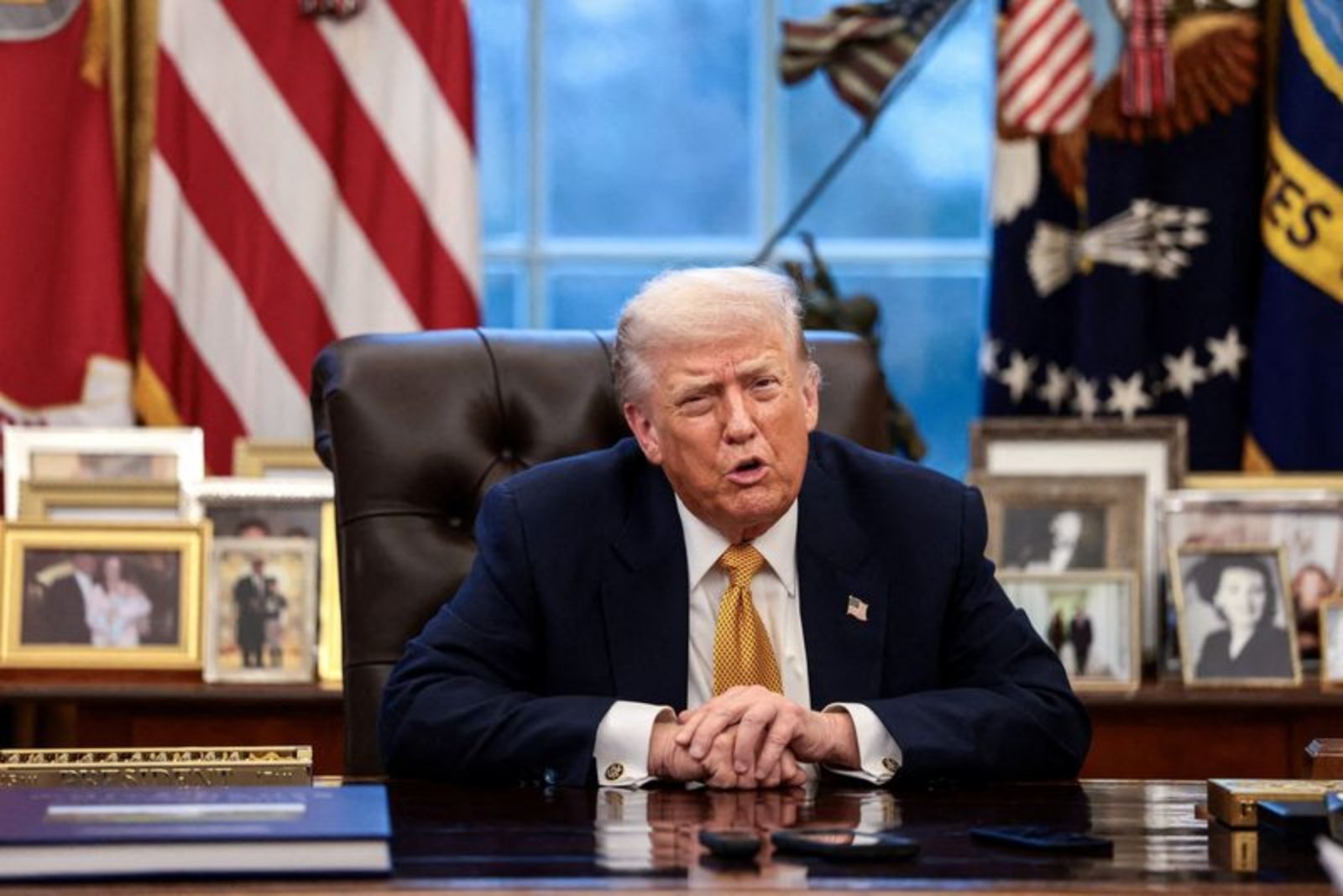
U.S. President Donald Trump’s proposal to bring an end to the Gaza conflict took a visible step forward with the reopening on Monday of the Rafah crossing into Egypt, a development that has pushed the plan into its second phase. But despite this movement, several foundational questions remain unanswered - most notably whether Hamas will relinquish its weapons.
The plan, first unveiled by Trump in September, is structured as roughly a 20-point sequence beginning with an initial truce and leading to a broader settlement. Its end state envisages Hamas disarming and no longer exercising governance over Gaza, a withdrawal of Israeli forces, and large-scale reconstruction of the territory under international supervision. The framework received widespread international backing, although the parties have not yet reached agreement on every element.
On October 9, Israel and Hamas signed a ceasefire arrangement covering the plan’s first phase. That agreement called for a halt to major hostilities, the release of remaining hostages in Gaza in return for thousands of Palestinian prisoners held by Israel, a partial Israeli pullback, a surge in humanitarian assistance and reopening of the Rafah crossing. The plan’s initial phase was also endorsed by a United Nations Security Council resolution authorising a transitional governing body and an international stabilisation force for Gaza.
Current situation
The ceasefire came into effect on October 10 and substantially curtailed large-scale combat, but firefights and fatalities have continued. Gaza health authorities report that at least 488 Palestinians have been killed by Israeli fire since October 10, while the Israeli military reports four soldiers killed by militants in the same period.
Israeli forces have withdrawn from certain positions and suspended ground assaults, yet they continue to control 53% of Gaza. That control includes heavily damaged urban areas along both the Israeli and Egyptian borders where structures have been demolished and residents ordered to evacuate. As a consequence, almost all of Gaza’s population of more than 2 million people is now concentrated in a narrow coastal strip, where Hamas has re-established authority. Many of those people live in partially destroyed buildings or in makeshift tents.
Humanitarian agencies and Palestinian organisations assert that Israel is not allowing aid into Gaza at the pace envisaged under the first phase commitments, while Israel maintains it is fulfilling those obligations. Within Israeli-held parts of Gaza, armed anti-Hamas Palestinian groups have reportedly established bases; Hamas dismisses these groups as collaborators lacking popular support.
Despite the truce, the two sides have made limited progress toward resolving the larger disputes that must be settled before the plan can proceed to its later stages. The envisaged next step foresees demilitarisation of Gaza, further Israeli withdrawal and the deployment of international peacekeepers.
What the second phase involves
Following the turn of the year, Washington signalled the launch of the plan’s second phase and announced the formation of a committee of Palestinian technocrats charged with running Gaza under international oversight. These technocrats are to be supervised by a "Board of Peace" composed of foreign dignitaries and led by Trump, an initiative he has proposed to address Gaza and that he has said could be applied to other conflicts.
Key provisions of the second phase include the disarmament of Hamas and demilitarisation of the enclave in exchange for a full Israeli troop withdrawal. Diplomatic sources estimate that Hamas retains several hundred rockets as well as thousands of light firearms, including rifles. Hamas has agreed to discuss disarmament with other Palestinian factions and mediators, according to sources, but two Hamas officials told Reuters that no concrete, detailed disarmament proposal has been put to the group by Washington or mediators.
At least two senior Israeli officials have told Reuters the military is preparing for a renewed campaign if Hamas refuses to give up its weapons and that they do not expect voluntary disarmament without force. Separately, Hamas is reported to be seeking to integrate its 10,000 police officers into the technocrat-led administration in Gaza, a position that Israel opposes.
Outstanding questions and constraints
Several major items remain unresolved. An international stabilisation force intended to secure Gaza’s interior and support peacekeeping efforts has been authorised in concept, but its composition, the precise scope of responsibilities and its mandate have not been finalised. Similarly, the role of the Palestinian Authority - the internationally recognised body that administers limited areas of the West Bank - is tied to unspecified reforms it must implement before it could assume a role in Gaza; the specifics of those reforms have not been detailed.
Plans to finance, manage and supervise Gaza’s reconstruction are also incomplete. Earlier this month, Jared Kushner outlined a vision for a "New Gaza" to be rebuilt from the ground up, accompanied by computer-generated imagery showing modern residential and industrial zones. That proposal did not address essential elements such as property rights or compensation for Palestinians who lost homes, businesses and livelihoods during the war, nor did it define where displaced people would live while reconstruction proceeded.
Given the remaining gaps, many Israelis and Palestinians suspect the Trump plan may never be fully implemented and that the conflict could become frozen indefinitely. Israeli officials have indicated that if Hamas does not disarm, they are prepared to return to active military operations.
Conclusion
The reopening of Rafah marks tangible progress toward the next stage of the Trump plan, but the initiative’s success hinges on several unresolved and contentious issues. Central among them is the question of Hamas’s weapons. Without a clear, accepted mechanism for disarmament, a defined mandate and composition for any international stabilisation force, and a practical, funded approach to reconstruction - including answers on property rights and temporary housing for the displaced - the plan faces serious implementation challenges. Israeli warnings of a potential return to war if these conditions are not met underscore the fragile nature of the current calm.
For now, the diplomatic architecture laid out in the plan exists chiefly as a framework: an endorsed sequence of steps with significant gaps in the operational details that will determine whether it can deliver a durable end to the conflict or leave Gaza locked in a prolonged, unresolved crisis.