
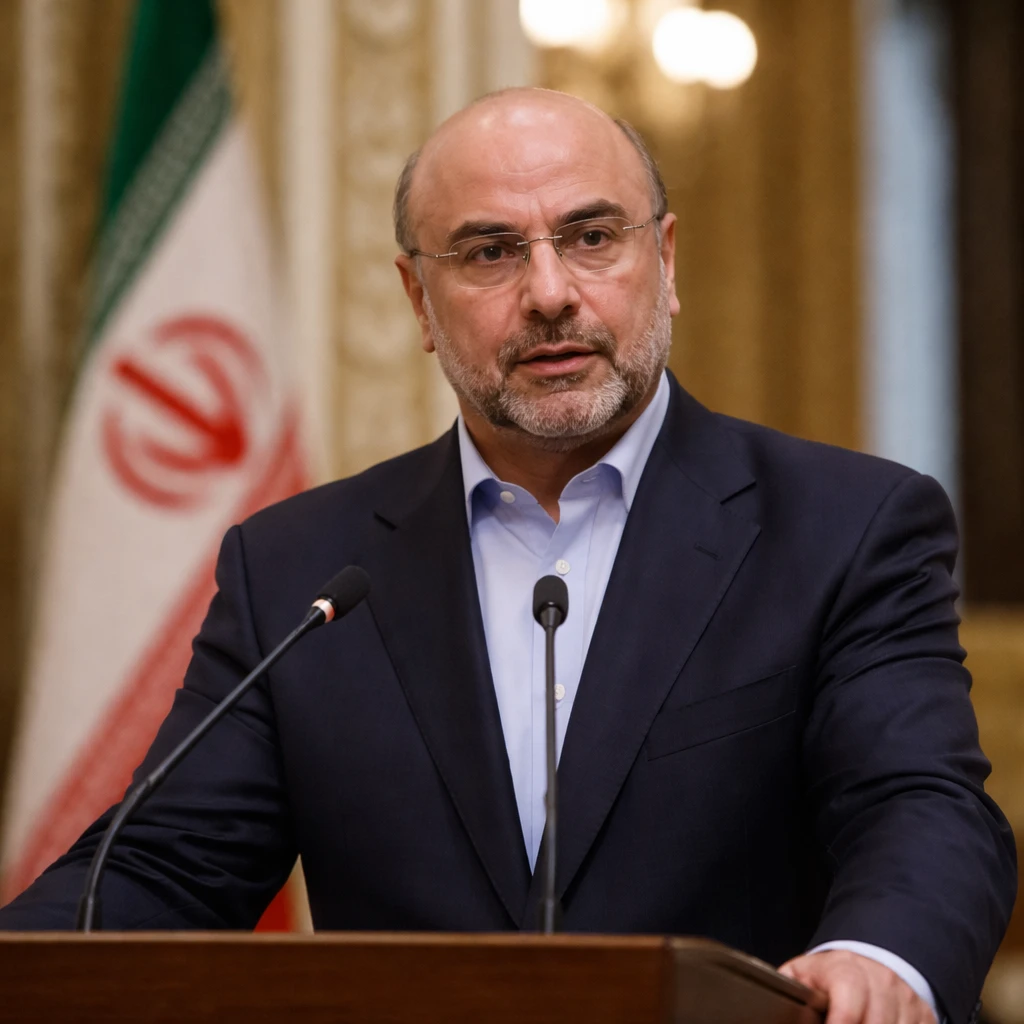
DUBAI, April 8 - Mohammad Baqer Qalibaf, who presides over Iran's parliament, has taken on a more prominent negotiating role as recent U.S. and Israeli strikes have hollowed out parts of the Islamic Republic's leadership. Pakistani sources say Qalibaf, alongside Foreign Minister Abbas Araqchi, will travel to Islamabad - which had sought U.S. assurances to keep them off any American or Israeli hit list - to lead talks with Washington to formalize and potentially extend Wednesday's truce.
With a number of Iran's most prominent officials killed or sidelined by a sustained campaign of targeted strikes, Qalibaf - a former commander in the Islamic Revolutionary Guard Corps (IRGC), ex-mayor of Tehran, former national police chief and repeat presidential candidate - has become an important connector among the country's political, security and clerical elites.
Officials in Tehran now appear to be attempting to regroup after more than five weeks since the assault on Iran began with the killing of supreme leader Ayatollah Ali Khamenei. While battered by the attritional campaign, the leadership in the capital remains in place and is moving to manage the crisis and negotiate terms with external parties.
Hardline rhetoric coupled with pragmatic reach
Qalibaf has long been identified as a staunch supporter of the Islamic Republic's theocratic system and as a close protégé of Khamenei. He has been a vocal opponent of Israel and the United States since the killing of Khamenei, publicly promising what he described as severe retaliatory measures. In a televised address following that killing, he directed strong language at U.S. President Donald Trump and Israeli Prime Minister Benjamin Netanyahu, warning of "such devastating blows" that they would be compelled to beg.
That uncompromising posture reflects Qalibaf's role as a hardline defender of the regime, including a record of forceful responses to internal dissent. Yet his profile also includes elements of pragmatism and modernization. During his 2005 presidential campaign he presented himself in military pilot's uniform in adverts to emphasize a professional image, and over time he has cultivated the ability to communicate across Iran's military and clerical establishments.
Analysts and officials cited in reporting point to that combination of firebrand rhetoric and practical ties to multiple centers of power as factors that have elevated him as a candidate to conduct sensitive talks with the United States as the conflict has unfolded.
Background and career
Born in Torqabeh in northeastern Iran in 1961, Qalibaf's formative years included mosque lectures as the 1979 Islamic Revolution gained momentum. He joined the Revolutionary Guards after Iraq's invasion of Iran, and within three years rose to the rank of general. After the war, he remained with the Guards, qualifying as a military pilot and ultimately heading the Guards' air force unit.
During his career with the Guards, Qalibaf was involved in domestic security actions, including participation in a 1999 crackdown on university students and co-signing a letter with other commanders that threatened to remove reformist president Mohammad Khatami if he did not rein in protests. As public unrest and international pressure mounted, Khamenei increasingly turned to security figures such as Qalibaf for support.
Qalibaf served as national police chief and has been accused of ordering force against protesters in his time in that role. He ran for president several times - in 2005, 2013 and 2024 - and withdrew from the 2017 contest to avoid splitting the hardline vote. He succeeded Mahmoud Ahmadinejad as Tehran mayor and held the mayoralty for 12 years, during which he took credit for helping to suppress months of unrest following the disputed 2009 presidential result.
In 2020 he returned to national politics as a member of parliament and was elected speaker, placing him among the most senior figures in Iran's political hierarchy.
Summary
Mohammad Baqer Qalibaf, Iran's parliament speaker and former IRGC commander, is set to be a principal negotiator in talks to solidify and extend a truce announced on Wednesday. Pakistani sources say he and Foreign Minister Abbas Araqchi will travel to Islamabad to lead discussions with the United States. Qalibaf's blend of hardline rhetoric and pragmatic connections to military and clerical circles, alongside his extensive security and political background, has positioned him to take on this role amid the depletion of Iran's leadership following a campaign of targeted strikes.
Key points
- Qalibaf and Foreign Minister Abbas Araqchi are reported to be traveling to Islamabad to negotiate with the United States over a truce and its possible extension.
- Qalibaf's standing is reinforced by his history as a Revolutionary Guards commander, Tehran mayor, national police chief and multiple-time presidential candidate, giving him influence across security, political and clerical circles.
- The attritional campaign that began with the killing of supreme leader Ayatollah Ali Khamenei has removed several prominent figures from Iran's leadership, increasing the importance of officials like Qalibaf in both domestic governance and external negotiations.
Risks and uncertainties
- Leadership instability - The article highlights a concerted assassination campaign that has reduced the ranks of Iran's most senior figures, creating uncertainty about the continuity and coherence of decision-making at the highest levels. This instability could complicate implementation of any negotiated terms.
- Security of negotiators - Islamabad had publicly urged Washington to exclude Qalibaf and Araqchi from any U.S. or Israeli hit list, pointing to the ongoing security risks for high-level Iranian officials traveling to negotiate. The safety of negotiating delegations presents a tangible uncertainty.
- Negotiation outcomes - While Qalibaf is positioned to lead talks, the article does not report on any agreed terms or guarantees, leaving the success and durability of any truce extension unclear.
Tags
- Iran
- Qalibaf
- Diplomacy
- Security
- Politics