
In a climate of escalating tensions, Canadian Prime Minister Mark Carney’s recent remarks at the World Economic Forum in Davos have ignited widespread domestic backing, positioning him as a defender of Canadian sovereignty amid pointed criticism from U.S. President Donald Trump.
During his speech, Carney issued a strong condemnation of what he described as the exploitation of economic integration by powerful nations, using tariffs as strategic tools. He declared that the era of a rules-based global economic order is over and called upon "middle powers," including Canada, to unite in the face of hegemonic pressures exerted primarily by the United States. Emphasizing self-reliance, Carney stated, "When the rules no longer protect you, you must protect yourself." He underscored the necessity for collaboration among middle powers, cautioning that those excluded from decision-making forums risk being targeted economically: "if you are not on the table, you are on the menu."
President Trump responded robustly to Carney’s speech, asserting that Canada thrives because of its relationship with the U.S. Speaking directly to Carney at Davos, Trump admonished him to remember America's past generosity before making such remarks. This verbal exchange followed Trump’s earlier social media post featuring an artificial intelligence-generated image of Canada and Greenland draped in the American flag.
Carney’s address marked a significant moment during an otherwise eventful international trip. He successfully secured a trade agreement with China and has actively pursued new alliances in the Middle East, aiming to reduce Canada’s heavy economic dependence on the United States.
According to Laura Stephenson, a political science professor at the University of Western Ontario, Carney’s forthrightness inspires both national pride and some apprehension. She noted that Canadians generally appreciate Carney’s courage in publicly confronting these issues, though the reaction varies among those with varying degrees of exposure to U.S. trade, especially considering the impending review of the trade agreement between Canada, the U.S., and Mexico (CUSMA).
Despite his assertive rhetoric, Carney’s direct negotiations with the U.S. remain unresolved; his initially tough stance has softened in areas, illustrated by Canada’s withdrawal of a digital services tax to facilitate resumed talks and his apology for a Canadian advertisement that had angered President Trump.
On the streets of Toronto, retired athlete Ann Peel expressed deep concern over the increasingly aggressive rhetoric from Trump, describing him as a "big bully." Peel highlighted the significance of Carney’s speech in articulating a worldview diametrically opposed to that of the U.S., emphasizing Canadian values and resolve. "We’re very values-based," she said, "Canadians, as a people, stand proud. We’re not just going to roll over because the United States wants us to."
Public discontent with Trump's rhetoric has manifested in tangible ways, with Canadians substantially reducing travel to the U.S., boycotting American alcoholic beverages, and prioritizing domestically produced goods.
Analysts observe that Carney’s speech has achieved notable bipartisan support in Canada. Jonathan Kalles, former senior adviser to ex-Prime Minister Justin Trudeau, noted the cross-party endorsement, including from some conservative figures. Polling data indicates Carney maintains an approval rating exceeding 50% since his assumption of office in April of the previous year, holding a strong lead over Conservative leader Pierre Poilievre. The Liberal Party overturned a significant Conservative advantage to win the last federal election, partially attributed to Trump's sovereignty threats.
Support extended from across the political divide, with former industry minister James Moore encouraging the public to set aside partisan differences and acknowledge the speech's significance. Conservative Member of Parliament Michelle Rempel Garner praised Carney’s acknowledgment of geopolitical challenges and urged the prime minister to accompany words with concrete action.
University of Toronto international relations professor Jack Cunningham interpreted the strong Canadian reaction as pride in Carney’s willingness to confront Trump directly, in contrast to other global leaders who have opted for more cautious approaches. Cunningham remarked that Canadians appreciate a leader who not only challenges Trump but also retains his respect, expressing hope that Canada will no longer face such challenges in isolation.
Carney’s emphasis on the necessity for middle powers to band together hints at a new diplomatic posture for Canada, aiming to safeguard its economic and political interests through diversified partnerships rather than dependence on a single dominant neighbor.
While the situation evolves, the interplay of domestic approval, diplomatic negotiation, and U.S. reactions underscores the precarious balance Canada must maintain amid shifting global power dynamics.
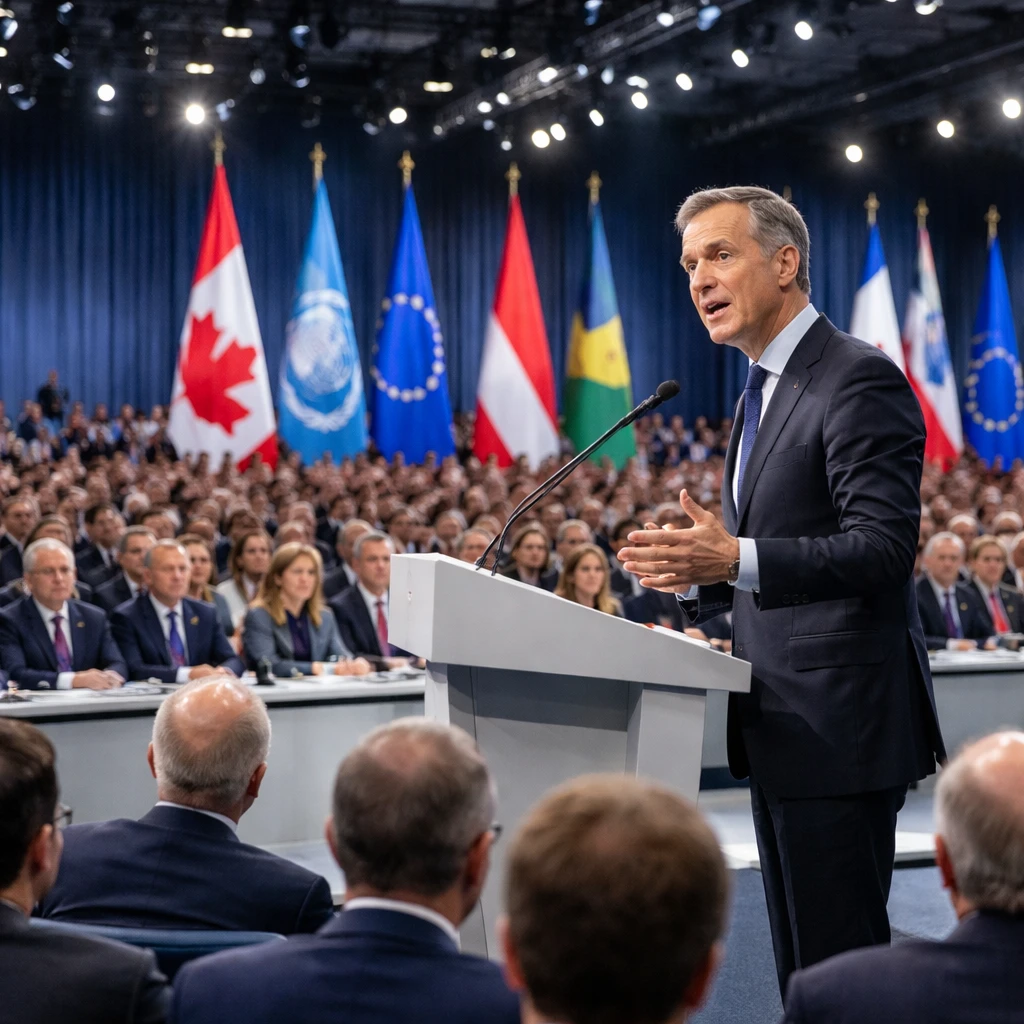
Canadian Prime Minister Mark Carney has drawn significant domestic support following his candid address at the World Economic Forum in Davos, where he criticized dominant global powers' use of economic integration as leverage. His stance elicited a sharp response from U.S. President Donald Trump, who emphasized Canada’s economic dependence on the United States. The exchange highlights growing nationalist sentiments and exposes Canada's efforts to diversify its economic partnerships beyond its southern neighbor.
Key Points
- Mark Carney’s speech at Davos openly criticized dominant nations using economic integration and tariffs as leverage, calling for middle powers to unite against American hegemony.
- U.S. President Donald Trump responded by emphasizing Canada’s economic reliance on the United States and issued direct remarks to Carney, intensifying diplomatic tensions.
- Carney’s efforts include diversifying Canada’s economic partnerships with new trade deals in China and the Middle East, reducing dependency on the U.S., garnering broad domestic political support.
Risks
- The ongoing review of the CUSMA trade agreement and uncertain outcomes may generate economic instability for sectors dependent on U.S. trade.
- Rising nationalist rhetoric and confrontational diplomacy risk escalating political and economic tensions between Canada and the United States, influencing cross-border business and consumer confidence.
- Potential uneven impact within Canada exists as those reliant on U.S. trade may experience anxiety or economic disruption from deteriorating bilateral relations.