
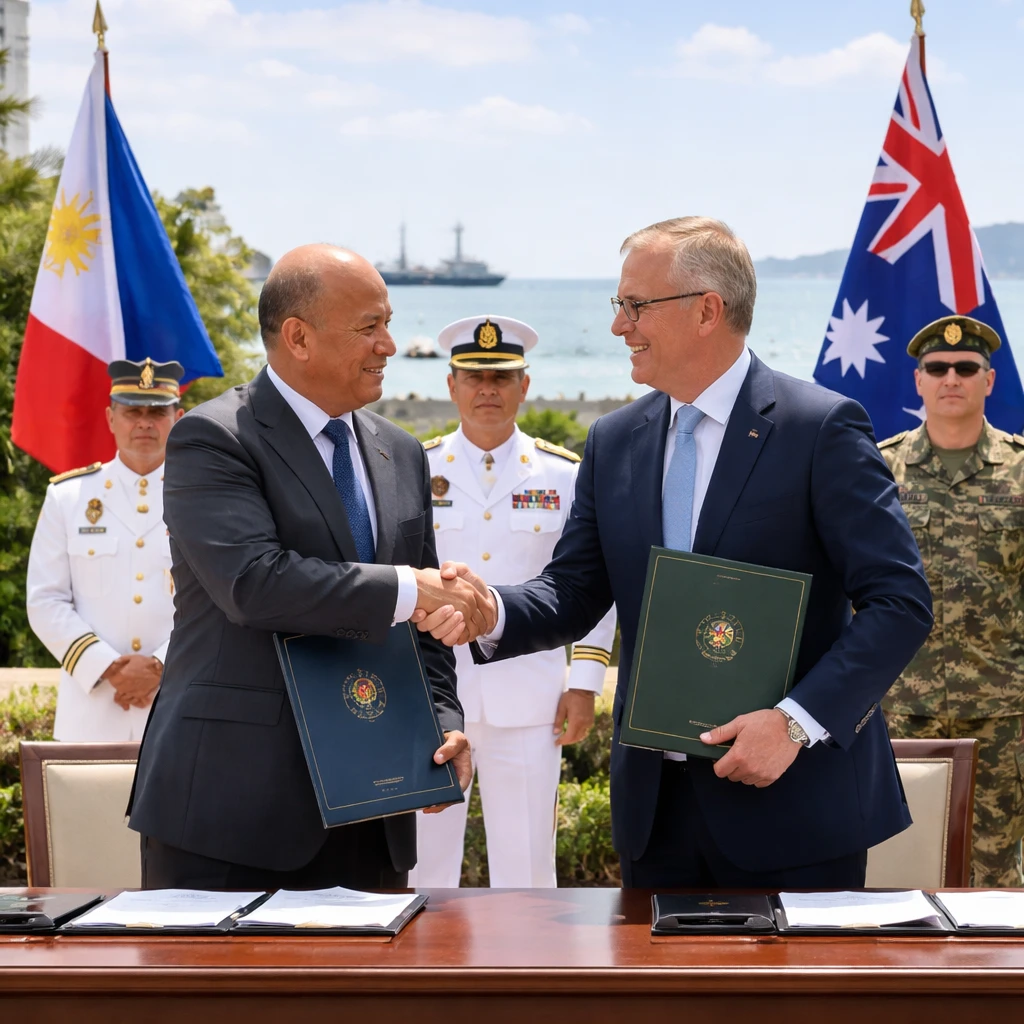
MANILA, Nov 15 - The governments of the Philippines and Australia signed a defence cooperation arrangement on Sunday aimed at reducing administrative barriers to joint military activities, Manila said, further deepening security cooperation between the two nations.
Philippine Defence Secretary Gilberto Teodoro said the pact will simplify procedures tied to the bilateral Status of Visiting Forces Agreement, or SOVFA, by streamlining coordination steps that have previously been cumbersome for joint operations.
"Rather than 100 steps to do a single thing, it will just now take 10," Teodoro told reporters, characterising the agreement as an "anti-red tape measure" for implementing SOVFA. He said the arrangement would enable closer collaboration across maritime, air and land forces, as well as on humanitarian and disaster response missions.
Teodoro also said the arrangement would strengthen the Philippines' "credible deterrence posture," explicitly citing the South China Sea as an area of concern where enhanced capabilities and cooperation would be applied.
Australian Prime Minister Anthony Albanese was present for the signing in Manila while attending an Association of Southeast Asian Nations summit. He said the agreement would boost maritime awareness and information sharing between the two countries and expand avenues for strategic dialogue, training, interoperability and development of defence infrastructure.
Albanese additionally announced more Australian investment in maritime domain awareness, specifying support for drone technology, equipment and training aimed at improving detection of maritime and cybersecurity threats.
The Philippines has been widening its network of security partnerships while maintaining its long-standing treaty relationship with the United States. Manila has framed this approach as a response to what it describes as aggressive behaviour by China in the South China Sea, where multiple countries have overlapping maritime claims.
Australia has regularly backed Manila's stance on the strategic waterway, including support for the 2016 ruling by an international arbitral tribunal that found China's expansive claims lacked basis under international law. China rejects that ruling.
Beijing maintains that its measures in the South China Sea have been lawful and professional, and it frequently objects to the Philippines conducting joint military activities with allied partners, saying such drills increase tensions in the region.
Questions remain about how quickly streamlined procedures will translate into more frequent or larger-scale joint exercises, and how investors may respond to shifting security ties in the region. The arrangement itself is presented by officials as a procedural change to facilitate existing agreements rather than a new operational treaty.
Information provided at the signing highlighted the intended areas of cooperation and the investments Australia plans to make in maritime domain awareness, but did not offer a detailed timetable for implementation of specific joint activities.
Officials described the pact as a practical measure to reduce administrative friction and as a complement to broader diplomatic and defence relationships already in place between the Philippines, Australia and other partners.