
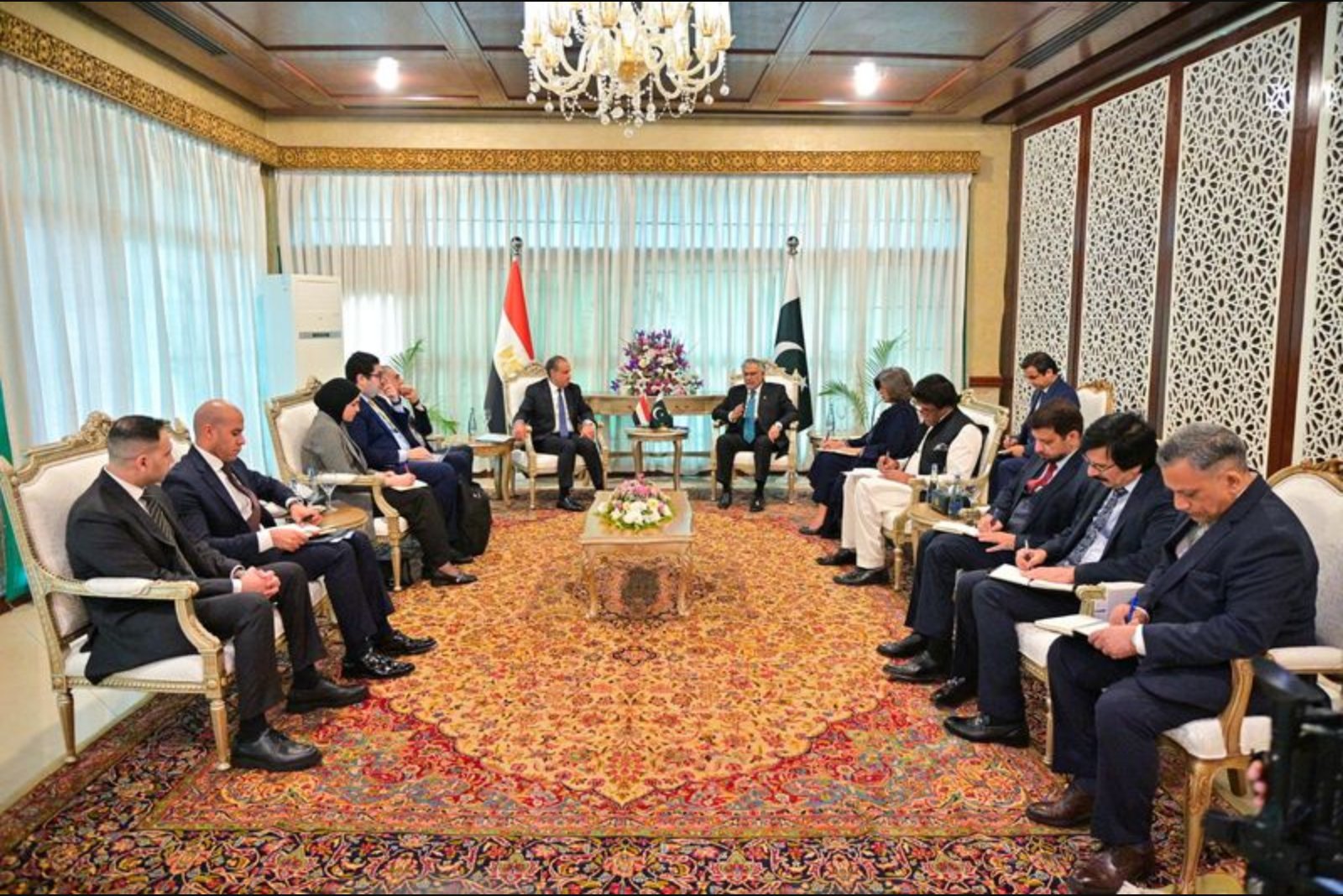
Islamabad convened a meeting on Sunday that brought together the foreign ministers of Turkey, Egypt and Saudi Arabia in an effort to help broker an end to the Iran war, with the opening exchanges focusing on proposals intended to reopen the Strait of Hormuz to commercial shipping, five sources familiar with the matter said.
The arrival of the three regional powers in Pakistan coincided with a warning from Iran to the United States against a ground attack and a jump in global oil prices amid continuing hostilities involving Iran, the U.S. and Israel.
Participants in the Pakistan-hosted talks have discussed ideas to submit to Washington that are tied to maritime traffic and the potential reopening of the Strait of Hormuz, the sources said. The waterway, which was previously a conduit for roughly one-fifth of global oil and liquefied natural gas shipments, has had its flows effectively halted by Iran in response to the U.S. and Israeli air strikes that began about a month ago.
Proposals to restore passage
Pakistan, which shares a border with Iran like Turkey does, has positioned itself as a diplomatic intermediary given its ties to both Tehran and Washington. Ankara and Cairo have also taken on active roles in these mediation efforts.
According to one Pakistani source, a set of proposals including ideas from Egypt were transmitted by Pakistan to the White House prior to Sunday’s meeting. Those proposals included fee structures modeled on the Suez Canal approach, the source said.
Two additional Pakistani sources reported that Turkey, Egypt and Saudi Arabia have considered forming a consortium to manage oil flows through the Strait, and that they had invited Pakistan to participate. The same sources said the consortium concept had been taken up in discussions with both the United States and Iran.
One Pakistani source also said that Army Chief Asim Munir had maintained regular contact with U.S. Vice President JD Vance.
Responses and diplomatic tone
Requests for comment to Egypt’s and Pakistan’s foreign ministries went unanswered. The Saudi government media office and the White House did not immediately reply to requests for comment, according to sources on the scene.
A Turkish diplomatic source, speaking on condition of anonymity, said Ankara’s main aim in joining the discussions was to secure a ceasefire. "Ensuring the safe passage of ships could serve as an important confidence-building measure in this regard," the source added.
Earlier on Sunday Pakistan’s Foreign Minister Ishaq Dar conducted separate one-on-one meetings with his Turkish and Egyptian counterparts, reiterating the need for dialogue and sustained diplomatic engagement, the Pakistani foreign office said.
In a separate development, Dar posted on X that Iran had agreed to allow 20 additional Pakistani-flagged vessels to transit the Strait of Hormuz.
The talks in Islamabad represent an attempt by regional actors to stabilise maritime traffic and find arrangements that could alleviate the impact of the fighting on global energy shipments. The discussions reflect a mix of diplomatic channels and operational ideas, from fee structures to shared management, all oriented toward reopening a waterway that has been central to global oil and gas flows.