
President Yoweri Museveni of Uganda, aged 81, has recently begun his seventh presidential term, but attention has turned swiftly towards his son, Muhoozi Kainerugaba, who leads the military and is widely regarded as the frontrunner to succeed his father. Muhoozi, noted for his confrontational and often provocative presence on social media, played a substantial role in ensuring the electoral victory by overseeing a robust clampdown on opposition forces and orchestrating a nationwide internet shutdown, according to insiders familiar with recent events.
Controversially, Muhoozi has publicly threatened opposition leader Bobi Wine, who alleges electoral rigging and remains in hiding. On one occasion, Muhoozi claimed that security forces killed 30 “terrorists” linked to Wine’s party and arrested 2,000 “hooligans,” although there has been no confirmation or comment from the opposition party on these figures.
Leading up to the election, gatherings organized by opposition groups were frequently disrupted by security personnel, with supporters detained and, at times, subjected to gunfire. An adviser close to Muhoozi, Andrew Mwenda, confirmed involvement in the four-day internet blackout, describing it as a preventative measure against sabotage. Muhoozi also personally coordinated police and military efforts to crack down on supporters of the National Unity Platform, driven by Wine, illustrating his designation as Uganda’s top security authority.
Attempts to reach Muhoozi or obtain comments from government, military, or presidential representatives concerning the internet blackout, the suppression of opposition, and succession plans have been unsuccessful.
Known for his military education at the UK’s Sandhurst academy and admiration for revolutionary leaders Mao Zedong and Fidel Castro, Muhoozi declared in 2023 his intent to become president, expressing frustration at waiting indefinitely. Subsequently, he expelled critics within both the ruling party and the military by retiring competing officers and significantly increasing soldier wages to secure their loyalty.
President Museveni has yet to publicly state his preferred successor, leaving the decision to his political party. While Muhoozi’s aspirations have caused unease among close aides of Museveni, his prominent role in securing the last election victory has bolstered his influence.
The transfer of power from father to son carries potential risks for Uganda, a stable East African nation with a $65 billion economy. Muhoozi’s reputation is marked by aggressive and unpredictable behavior, demonstrated through late-night social media threats against political opponents and neighboring countries, some of which he and his father later retracted, claiming elements of irony.
Although some senior Ugandan political and military figures are displeased with his style, Muhoozi’s authority as the leading security figure and presumed heir apparent appears unrivaled, experts with close knowledge of the political dynamics argue. Kristof Titeca, an academic specializing in Ugandan affairs, notes the difficulty in identifying viable challengers outside Museveni’s family at this time.
Muhoozi’s upbringing included exile in Tanzania, Kenya, and Sweden prior to Museveni’s rise to power in 1986. On his return, he led the elite Special Forces Command, strengthening his military credentials. Any critique of his political maneuvers has rarely led to serious consequences, leading to perceptions of unequal treatment relative to other military officers.
In 2022, Museveni and his brother Salim Saleh—also a presidential adviser—allegedly cautioned Muhoozi on the content of his online statements, according to business sources citing family members. Saleh has not publicly responded to such reports.
Contrasting with his online persona, individuals who have met Muhoozi describe him as thoughtful and strategic in private. Political commentator Charles Onyango-Obbo remarked that Muhoozi behaves markedly differently once off social media. According to Mwenda, many of his incendiary posts were intended as jokes, and Muhoozi reportedly drinks socially but does not misuse alcohol.
Should Museveni pass while in office, the vice president is required to serve as interim head of state until elections can be held. Salim Saleh is widely anticipated to influence the leadership transition on behalf of the family.
Opposition figures remain wary of Muhoozi’s potential ascendancy. Bobi Wine commented from an undisclosed location that no one is safe in Uganda, pointing implicitly at Muhoozi’s threatening demeanor. Within the ruling National Resistance Movement party, veterans express concern over Muhoozi’s rise, though their hold on power has diminished due to purges that left the party’s central committee more supportive of him.
Muhoozi has improved the remuneration of ordinary soldiers—sometimes by over 300%—and personally oversees promotions, retirements, and anti-corruption efforts in the military.
His close relationship with Rwanda’s President Paul Kagame, whom he affectionately calls "Uncle Paul," has fueled speculation about possible external support if his leadership is contested, a longtime association described as advantageous by his adviser Mwenda. Rwanda’s government has not replied to inquiries regarding this relationship.
Among Uganda’s predominantly youthful population, with an average age of 16, many reject the idea of dynastic succession. In Kampala, 23-year-old Fahad asserted that Uganda is not a kingdom and that attempts to install Muhoozi in his father’s place would be rejected by the citizens.
As Uganda’s political future unfolds, uncertainty persists over how these dynamics will impact governance stability and economic performance in the region.
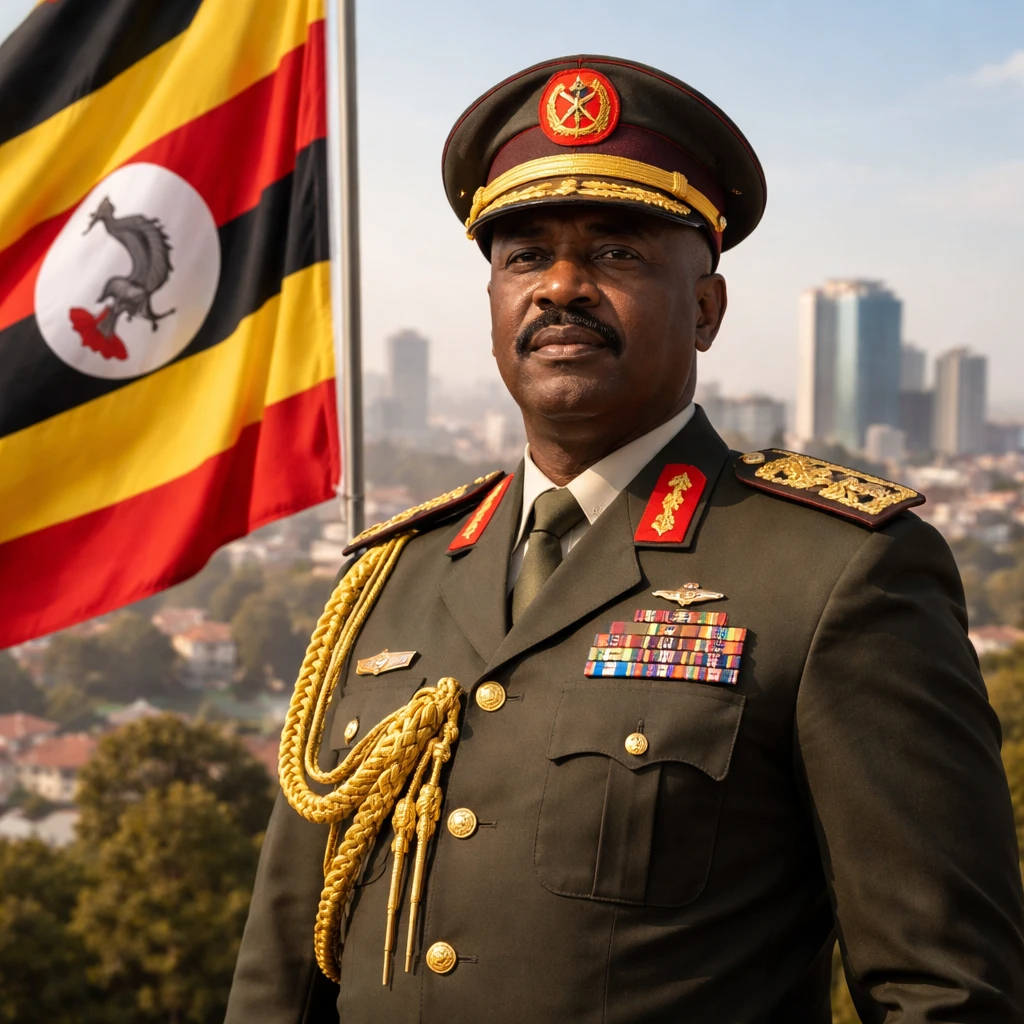
As President Yoweri Museveni begins his seventh term at 81 years old, his son Muhoozi Kainerugaba, head of Uganda’s military, is increasingly poised to assume leadership. Muhoozi’s firm handling of opposition suppression, including internet blackouts and arrests, and strategic moves within the military and ruling party structure have strengthened his position despite public controversies.
Key Points
- Muhoozi Kainerugaba, Uganda’s military head and son of President Museveni, is the leading candidate to succeed his father after helping secure the recent election victory through security crackdowns and an internet shutdown.
- The National Resistance Movement has seen a reshuffle strengthening Muhoozi’s support within party ranks, while opposition parties face continued suppression and allegations of election rigging.
- Muhoozi has increased soldier salaries substantially and maintains strong ties with regional leaders, notably Rwanda’s Paul Kagame, enhancing his security and political position.
Risks
- The potential for unrest or backlash stemming from a dynastic succession in Uganda poses risks to political stability and economic confidence within the country and region.
- Muhoozi’s aggressive and unpredictable public conduct could exacerbate tensions both domestically and with neighboring countries, impacting diplomatic relations.
- Continued suppression of opposition parties and civil liberties may undermine democratic governance, potentially affecting investor sentiment and long-term economic growth.