
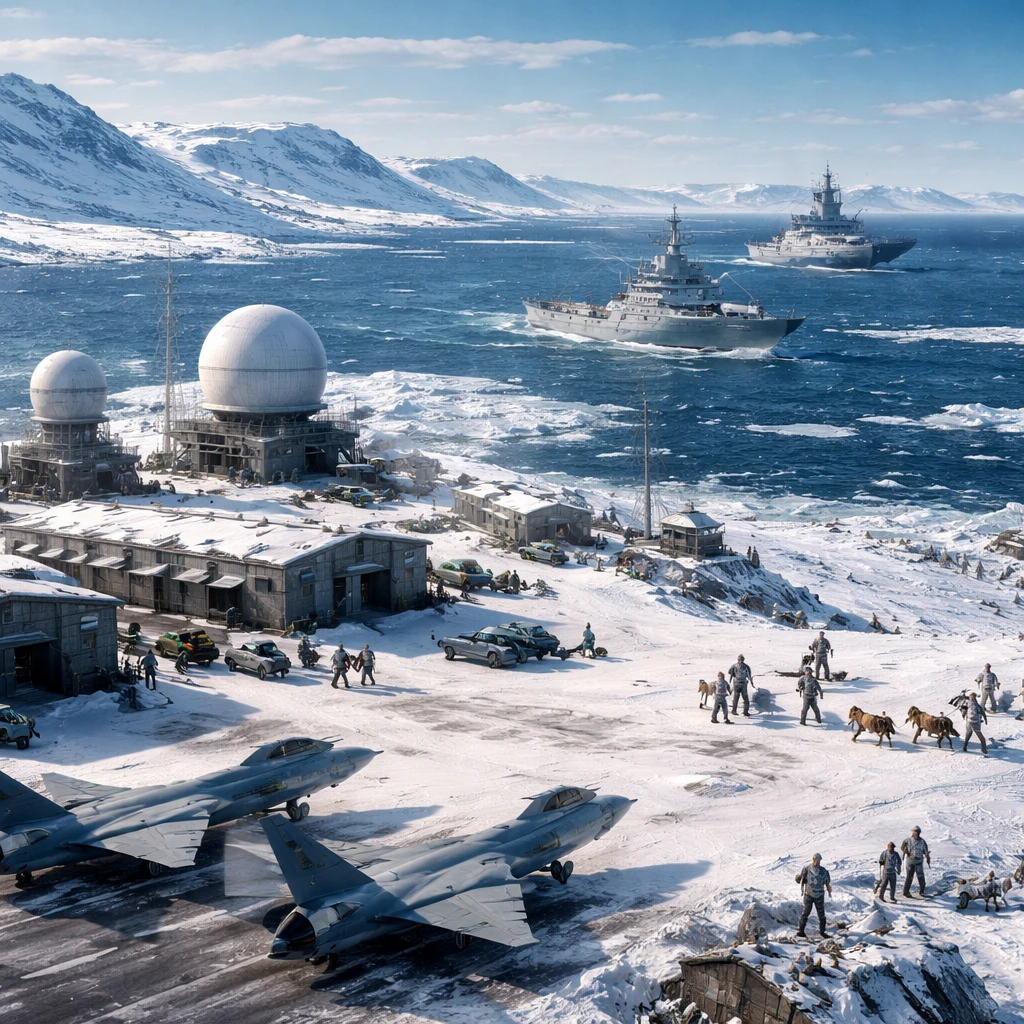
The Arctic region is a focal point of strategic military interest for eight nations that possess territorial claims: Russia, the United States, Canada, Denmark, Norway, Sweden, Finland, and Iceland. Each of these countries maintains specific military assets or agreements reflecting their strategic priorities in this geopolitically sensitive and resource-rich area.
Russia’s Extensive Arctic Military Infrastructure
Russia controls approximately half of the Arctic's landmass and has invested heavily in modernizing its military capabilities there since 2005. The nation has reopened and upgraded several Soviet-era military bases located both on its Arctic mainland and on adjacent northern islands. Among Russia's key military sites is the nuclear testing facility on Novaya Zemlya, an Arctic archipelago where nuclear detonations have not occurred since 1990 but where Russia maintains a high state of readiness. The site was notably used in October for a test launch of the nuclear-powered Burevestnik cruise missile.
Furthermore, the Kola Peninsula, situated in the European Arctic, houses about two-thirds of Russia's second-strike nuclear arsenal, ensuring its ability to respond to potential nuclear attacks, according to senior defense analysts. This region also serves as the base for Russia's Northern Fleet headquartered in Severomorsk, which operates six of the country's twelve nuclear-armed submarines, while the other half are part of the Pacific Fleet based in Vladivostok. The Northern Fleet's access to the North Atlantic occurs through the Barents Sea, between the Norwegian Svalbard archipelago and the northern coast of Europe, making control of this maritime corridor crucial for Russian strategic mobility.
United States and Canada: Joint Defense and Modernization Efforts
The United States and Canada have collaborated on homeland defense since 1957 under the North American Aerospace Defense Command (NORAD), focusing on threats including nuclear missile attacks. NORAD is undergoing modernization, with Canada procuring two over-the-horizon radar systems geared towards Arctic and polar threat detection, the first of which is expected to begin operating by 2028. The U.S. administration has expressed interest in developing a new missile defense system termed Golden Dome, for which Greenland holds strategic importance.
Under a defense agreement with Denmark, the United States operates the Pituffik Space Base in northern Greenland. Apart from this, the majority of U.S. Arctic military presence is distributed among eight bases in Alaska, comprising approximately 22,000 personnel. Canada maintains five Arctic bases, including the Alert station on Ellesmere Island, recognized as the world's northernmost permanently inhabited location dedicated to signals intelligence. Additionally, Canada operates a base at Yellowknife inside the Northwest Territories supporting ranger patrol groups and an air force base.
Canada is also progressing on constructing a refueling facility for offshore patrol vessels on Baffin Island, albeit facing delays. The U.S. has plans to expand port facilities in Nome, Alaska, to support Arctic operations.
Denmark’s Arctic Command and Greenland Deployments
The Danish Joint Arctic Command, headquartered in Greenland's capital, Nuuk, is staffed by around 150 military and civilian personnel. This command has installations at several locations including Kangerlussuaq air base and four smaller military stations in eastern and northeastern Greenland, as well as a liaison officer stationed at Pituffik Space Base. A distinctive Danish military unit operating in the harsh conditions of northeastern Greenland is the Sirius dog sled patrol, which conducts long-range reconnaissance missions. This unit has garnered attention for its unique operational environment and capabilities.
Military Presence in Sweden and Finland
Sweden does not maintain bases north of the Arctic Circle but has a significant air force base at Lulea located on the northern coast of the Gulf of Bothnia and an army base with two regiments in Boden, approximately 25 miles inland. Finland operates an air force base in Rovaniemi situated on the Arctic Circle, along with a Jaeger Brigade base positioned further north in Finnish Lapland. Since joining NATO, Sweden and Finland have been integrating their military forces more closely with the alliance’s structures and operations.
Norwegian Arctic Defense Infrastructure
Norway monitors a vast maritime area of around 2 million square kilometers in the North Atlantic, including parts of the Arctic, on behalf of NATO. The country’s defense installations above the Arctic Circle include four air bases — one designated for its fleet of F-35 fighter jets — two naval bases, a network of army bases, and a reception center dedicated to accommodating allied reinforcements during crises. Notably, Norway’s Arctic archipelago of Svalbard hosts no military bases, preserving its demilitarized status.
Iceland’s Strategic Role and Limited Military Presence
While Iceland lacks a standing military force, it remains a NATO member and operates a coastguard. The country supports U.S. Navy rotational deployments of P-8A Poseidon maritime patrol aircraft at Keflavik Air Base near Reykjavik. Additionally, NATO fighter jets periodically rotate through Keflavik to maintain Iceland’s airspace security, with typical deployments lasting two to three weeks, several times per year.
This comprehensive military presence by Arctic nations underscores the strategic importance of the region from a defense and geopolitical perspective. The modernization efforts, combined with geographic positioning, reflect ongoing priorities related to national security and alliance commitments.