
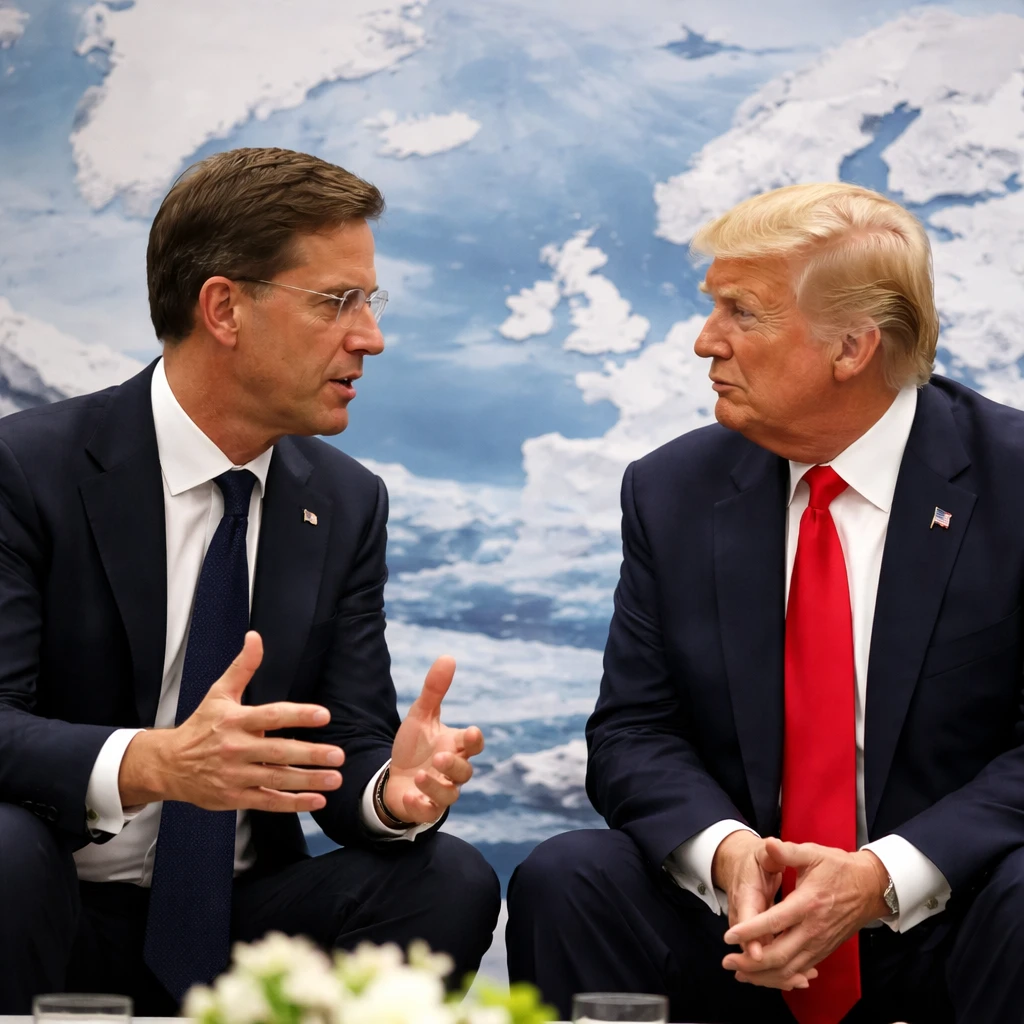
Recent diplomatic engagements have mitigated growing friction concerning Greenland between the United States and European nations. At the World Economic Forum in Davos, NATO Secretary General Mark Rutte secured a reassessment of tensions that fortified transatlantic ties, particularly in Arctic affairs.
President Donald Trump announced an agreement with Rutte outlining a "framework of a future deal" focused on the entire Arctic Region. Although the specifics of this framework remain limited, the announcement marks a diplomatic victory credited largely to Rutte’s efforts to bridge divides within NATO. According to diplomats and political experts, his intervention was crucial in preventing the alliance from edging toward serious fracture.
Rutte, who helmed the Dutch government for 14 years before assuming his NATO role less than two months prior to Trump’s 2024 reelection campaign, has earned the moniker "Trump whisperer" in European media. This designation reflects his ability to communicate effectively and build rapport with Trump, a skill demonstrated throughout the US president’s first term and continuing into his second.
His diplomatic style favors overt commendation of Trump, a tactic differing markedly from growing European skepticism toward the US leader. Finnish President Alexander Stubb praised Rutte’s role, noting the importance of his calm and collected demeanor which facilitates constructive dialogue with the US president.
While President Trump had earlier expressed desire for the US to have ownership over Greenland, he abandoned military action as a consideration prior to the Davos meeting. Many diplomats attribute the peaceful resolution in part to Rutte’s mediation, although determining the full extent of Rutte's influence on Trump’s policy changes remains complex.
One European diplomat acknowledged that while Rutte’s approach may not satisfy all party factions, his success in preserving NATO’s unity during volatile episodes involving Trump’s administration is widely recognized. The diplomat also noted that Trump’s readiness to compromise made Rutte’s role as interlocutor particularly effective.
In addition to diplomatic groundwork laid by capitals worldwide and steadfast European support for Denmark’s refusal to relinquish Greenland, Rutte’s direct engagement was a decisive factor. An experienced NATO official remarked that the agreement exemplifies why Rutte maintains close and frequent contact with President Trump.
This recent diplomatic breakthrough mirrors a prior episode in June during a meeting in The Hague. Then, Rutte cultivated Trump’s favor by describing the US leader as a "daddy" figure in global conflicts. This compliment preceded a NATO commitment to increase military and associated expenditures to 5% of GDP, satisfying a key Trump demand. The US president later referenced the "daddy" accolade at Davos with evident pleasure.
Rutte’s newest proposal establishes a security enhancement framework for Greenland and the Arctic at large, directly addressing Trump’s expressed concerns about strategic threats from China and Russia in the region.
Notably, this diplomatic posture sharply contrasts with the characterization given by French President Emmanuel Macron at Davos, who referred to Trump as a "bully." Nonetheless, Rutte consistently offers positive appraisal of Trump’s policies. A social media post shared by Trump highlighted Rutte’s commendation of American achievements in Syria, as well as efforts related to Gaza and Ukraine.
Rutte’s consensus-driven political background in the Netherlands, where he managed nuanced coalition governments, informs his diplomatic style. He frequently opts out of on-camera discussions regarding sensitive subjects to avoid inflaming public discourse, underscoring a preference for discreet problem-solving over media spectacle.
According to Tim Sweijs, research director at The Hague Centre for Strategic Studies, Rutte’s longevity in office and his habit of direct communication with diverse political actors make him an unusual figure in Dutch politics. Rather than retreating to limited inner circles during disputes, Rutte engages extensively across political lines.
However, this pragmatic approach has invited criticism, as noted by Simon Otjes, associate professor at Leiden University. Rutte’s willingness to compromise may sideline ideological visions, as reflected in his own maxim that those seeking vision should consult an eye doctor. Instead, his focus remains on achieving workable compromises, fostering inclusion, and progressing negotiations.
Otjes further explains that Rutte endeavors not only to understand Trump’s policy requirements but also to grasp the American president’s psychological needs, a strategy crucial to advancing diplomatic accords under challenging circumstances.