
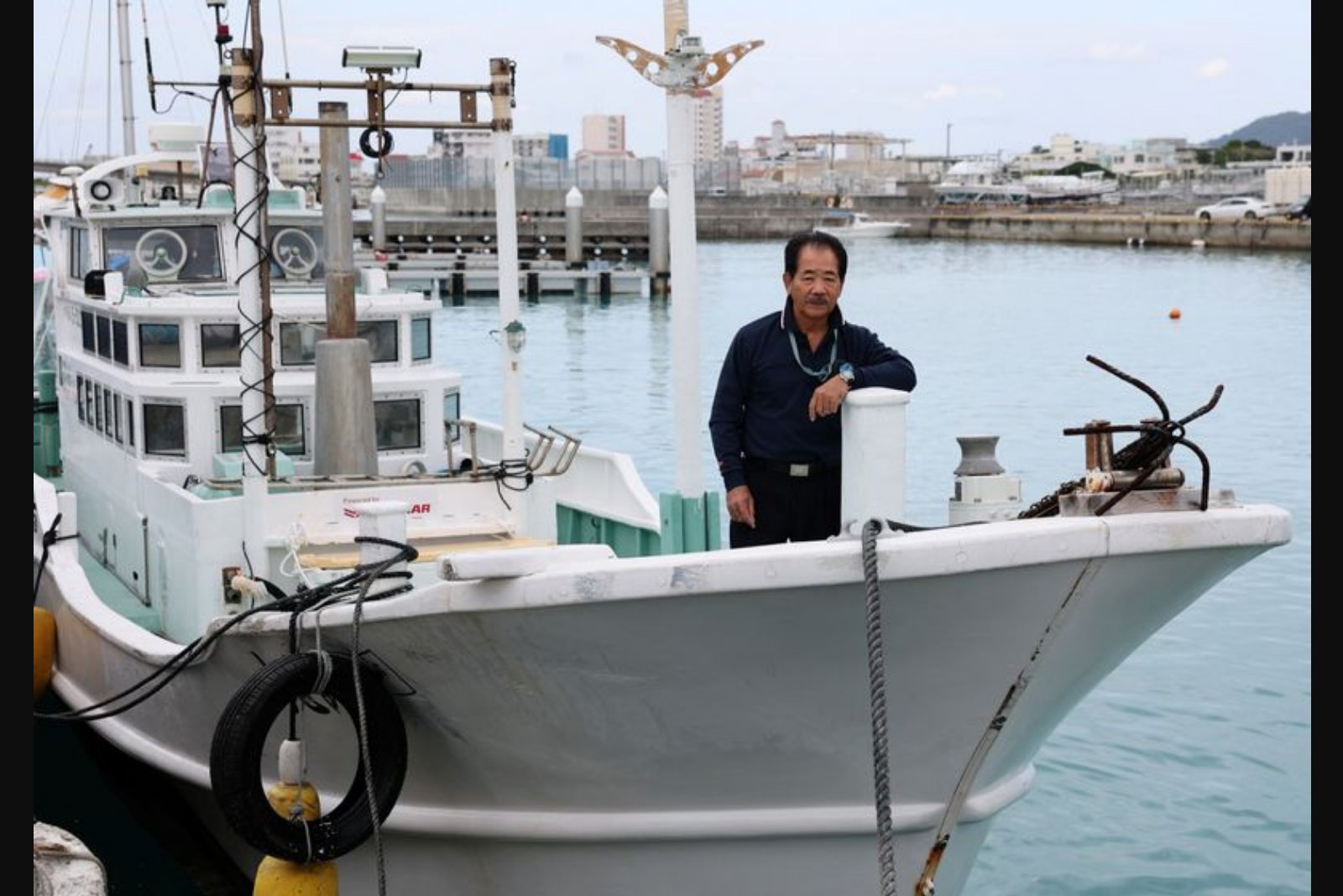
On a small fishing boat bobbing in the waters off Ishigaki, 76-year-old Hitoshi Nakama describes himself as a frontline defender of Japan’s claims over the remote islands in the East China Sea. For years he has sailed close to the uninhabited outcrops known in Japan as the Senkaku and in China as the Diaoyu, repeatedly moving to harvest the rich fishing grounds even as Chinese coast guard ships shadowed him.
But in recent months, Nakama and several other fishermen say they have received quiet appeals from Japanese officials - including coast guard personnel and other representatives - to avoid making those trips for the time being. The entreaties began toward the end of last year, according to Nakama and three other people with direct knowledge of the contacts.
The requests mark a notable shift in practice. For years Tokyo had largely tolerated such voyages, which fishermen and some nationalist supporters have used to affirm Japan’s administrative control over the islands and adjacent seas. Government caution now reflects a concern that routine fishing activity could trigger incidents with Chinese coast guard vessels that might escalate quickly.
Political context and the heightened risk environment
The islands are administered by Japan but are also claimed by China, a dispute that has long strained relations between the two countries. Tensions rose further after comments by Japanese leader Sanae Takaichi in November about how Tokyo might respond to an attack on Taiwan, an intervention that angered Beijing. In the weeks that followed, U.S. President Donald Trump reportedly asked Takaichi not to aggravate the situation. It could not be determined whether the appeals to fishermen were initiated by Takaichi or were connected to that external appeal; officials have not clarified who ordered the requests.
Japan’s foreign ministry, while asserting that the islands are an inherent part of Japanese territory and that it has repeatedly protested Chinese incursions, declined to comment on the specifics of the requests to fishermen. The ministry confirmed its longstanding diplomatic protests over Chinese activity in the area.
Fishermen caught between livelihood and security concerns
The warnings to fishermen illustrate a difficult balance for Tokyo. On the one hand, Japanese fishing trips reinforce claims of effective control over the islands. On the other, they risk entanglement with Chinese coast guard ships at a moment when relations are tense. More than a dozen individuals interviewed for this account - including fishermen, Japanese officials and security specialists - described this catch-22.
China’s foreign ministry has accused some right-wing Japanese of entering the waters around the islands under the guise of fishing with the aim of provocation. It said maritime disputes should be handled through dialogue and consultation.
A U.S. administration official declined to comment on the president’s call with Japan’s leader but reiterated that the United States opposes unilateral efforts to alter the status quo in the East China Sea.
When cautious appeals began and examples
As tensions intensified in November, appeals to fishermen increased. Hiroaki Hayashi, a businessman who leads a nationalist group that helps fund Nakama’s voyages, said a coast guard official contacted him and asked him to prevent Nakama from sailing on a planned trip at the end of that month. Nakama chose to comply and stayed away from the islands, Hayashi said.
Another fisherman, 53-year-old Kazushi Kinjo, recounted that he had intended to fish in waters around the islands on a week-long voyage beginning on November 26. While at sea and just before departing, Kinjo said he received calls from multiple unnamed officials urging him to avoid the Senkaku islands. Kinjo transited the area briefly on his return trip to his home port but did not stop to fish.
A few weeks later, on December 19, Finance Minister Satsuki Katayama - who had previously served as an adviser to the Senkaku Islands Defence Association, the nationalist group supporting Nakama - met with the fisherman in Tokyo. Nakama said the meeting lasted about 20 minutes and that Katayama asked about his earlier visits to the islands and warned that "small incidents can grow bigger and lead to war." Nakama interpreted that as a request to refrain from visiting the islands, though the minister did not state that directly.
Katayama’s office declined to comment on the meeting. The Japan Coast Guard said it notifies relevant parties about security conditions in waters surrounding the islands as necessary, but it would not discuss details of specific advisories.
Local officials and the risks of detention
Ishigaki’s mayor, Yoshitaka Nakayama, said national officials were concerned that fishermen could be detained or subjected to inspections by Chinese authorities in a period of elevated tensions. "If someone should actually be detained it would escalate into a much bigger international issue, so I think that is what the government wants to avoid," he said.
Chinese coast guard vessels have in recent years stepped up enforcement of extensive maritime claims, sometimes confronting foreign vessels. In other regional disputes, Chinese coast guard ships have used water cannon against Philippine vessels, illustrating how maritime confrontations can become physically aggressive.
The last major maritime crisis between China and Japan took place in 2010, after Japan’s coast guard detained the captain of a Chinese fishing boat following a collision near the Senkaku/Diaoyu islands. Relations were further strained in 2012 when Japan nationalised several islands that had previously been privately owned.
Security guarantees and the broader strategic stakes
Washington has stated a commitment to defend the islands under its security treaty with Japan. That assurance means any significant clash in the area could draw in the United States and raise the stakes far beyond a bilateral dispute.
Security analysts emphasize how tenuous the situation has become. Robert Ward, Japan chair at the International Institute for Strategic Studies, said the islands are a potential flashpoint and that China is pushing its claims aggressively. He described the atmosphere around the islands as "phenomenally tense" and suggested that incidents there could be a trigger for broader deterioration in ties.
Patterns of presence and activity around the islands
Activity around the Senkaku/Diaoyu islands has varied over time. The Japan Coast Guard recorded Chinese coast guard ships near the islands on a record 357 days last year. The islands are located more than 300 kilometres from mainland China, roughly 150 kilometres from Japan’s nearest inhabited territory and about 170 kilometres from Taiwan, which also asserts claims over them.
Fishing historically played an important role around the islands. After Japan first claimed them in the late 19th century, a skipjack tuna processing plant operated on Uotsuri Island until it was abandoned in the 1930s. In 1977, prior to Beijing’s more assertive posture that later discouraged fishermen, a government-commissioned research report recorded at least 164 Japanese fishing trips to the islands.
By contrast, recent years have seen a sharp decline in documented Japanese visits. Last year there were only eight recorded visits by Japanese fishing vessels, down from 18 in 2024, according to Japan’s coast guard statistics.
Competing calculations: maintaining a presence versus avoiding confrontation
Nakama and the nationalist backers who support his voyages say they are determined to reverse the decline in fishing activity around the islands, arguing that such work both sustains livelihoods and demonstrates Japan’s control. Paul Midford, professor of international studies at Meiji Gakuin University in Yokohama, said that while the point has merit, it also risks escalation as each side tries to outdo the other in showing control.
Analysts caution that a full withdrawal of Japanese economic activity from the area could invite China to intensify its presence. Ward said Japan needs to continue showing it "has a pulse" in the Senkaku Islands to avoid ceding effective control.
Economic motives and personal resolve
Not all those who travel to the islands view their trips primarily as political acts. Kinjo, the 53-year-old fisherman, said his main motivation is economic. "I earn my income there... a substantial income," he said, describing the seas as abundant with red snapper, a valued local produce.
Despite the warnings and the potential for dangerous encounters, both Kinjo and Nakama said they intended to return to the area when conditions allow. Winter seas may keep many fishermen away for now, but the men spoke of determination to resume their voyages. "I’ll go there for as long as I have this boat. I’ll keep on going," Nakama said as he sat on an ice box on his vessel’s deck in Ishigaki.
What this means for sectors and markets
The situation affects several economic and security sectors. Fishing communities face immediate income and operational risks. Defense and maritime security considerations factor into government policy choices and could influence defense procurement and coast guard operations. Broader commercial shipping and regional stability are also implicated given the islands’ strategic location and the potential for incidents to involve allied security commitments.
For now, Tokyo appears to be prioritising de-escalation by discouraging some fishing activity that could prompt confrontations, while weighing the longer-term implications of reducing visible economic activity in the contested waters.