
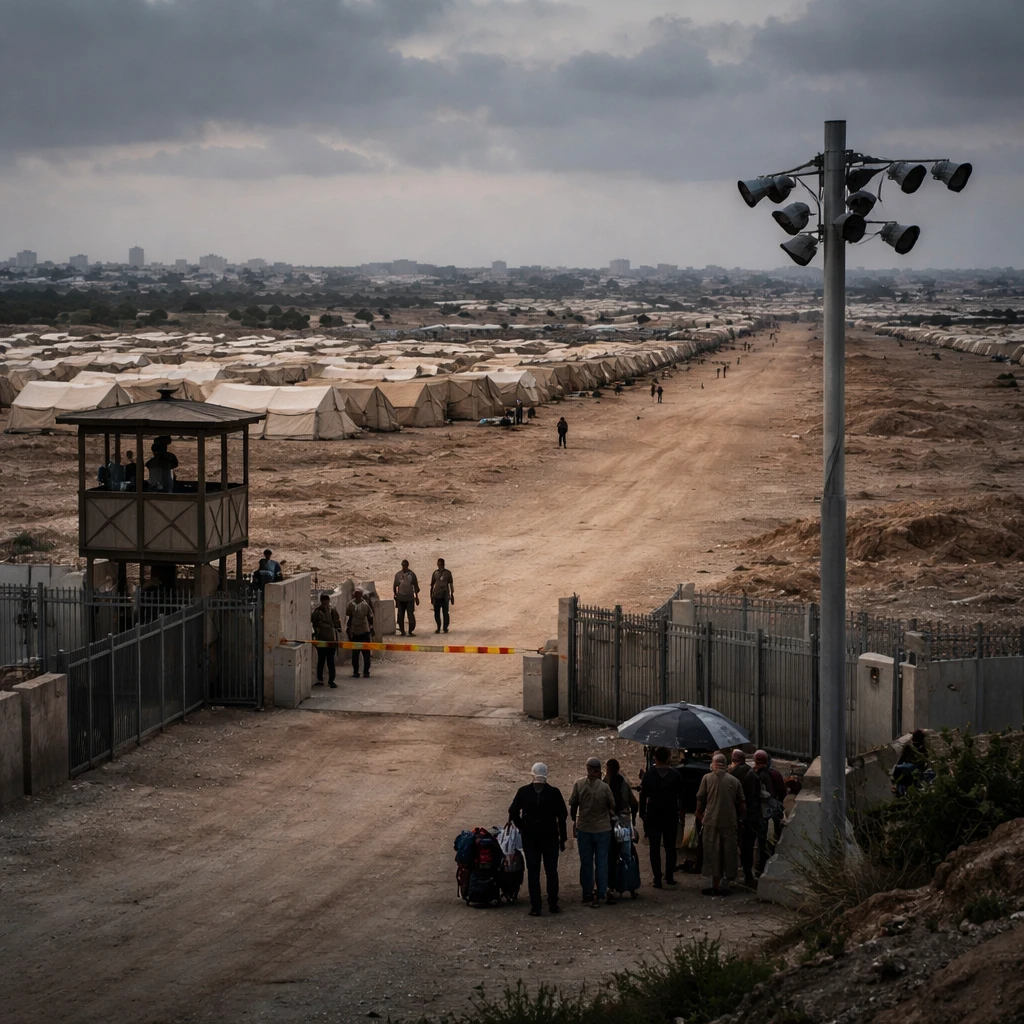
Israel has prepared a parcel of land in southern Gaza for construction of a large camp that, according to a retired Israeli brigadier-general who advises the military, could include surveillance at its entry and facial recognition capabilities. Retired reservist Brigadier-General Amir Avivi gave the account, saying the site lies in Rafah in an area that Israeli forces have cleared of tunnels attributed to Hamas and that movement into and out of the camp would be monitored by Israeli personnel.
Avivi, who founded the Israel Defense and Security Forum, a grouping of thousands of Israeli reservists, framed the camp as a facility to host Palestinians who either want to leave Gaza to cross into Egypt or prefer to remain inside Gaza. He emphasized that the site would offer infrastructure for people to make that choice, saying that the area needs to be able to receive them and that such infrastructure must be in place.
Official responses and context
The retired general does not speak on behalf of Israel’s military, which declined to comment. The Israeli prime minister’s office had not provided an immediate response regarding any Rafah camp plan. Avivi’s remarks were made as Israel prepares for what has been described as a limited reopening of the Rafah border crossing with Egypt - an element noted by U.S. President Donald Trump’s plan for ending the Gaza war.
Avivi stated that the area he referenced is now under complete Israeli military control following the October ceasefire, and that most Palestinians had fled that zone for areas held by Hamas. He said, "There are no Gazans, almost at all, in Rafah." He added that, to accommodate people who may come to Rafah, authorities needed to build organized facilities that can host them and provide options whether to stay or cross into Egypt.
Design and capabilities described
In Avivi’s description, the site would be "a big, organized camp" with the capacity to host hundreds of thousands of people. He said the camp could enforce identity checks and include facial recognition among the tools used to monitor entry and exit. The idea of an organized, monitored facility in Rafah has appeared in public remarks before; in July, Israel’s Defence Minister Israel Katz told local media he had ordered troops to prepare a camp in Rafah to house Gaza’s population, though officials have not since publicly detailed such plans.
Ismail Al-Thawabta, head of the Hamas-run Gaza government media office, rejected the plan in a statement to Reuters, characterizing it as a cover for what he called "forced displacement." The proposal remains politically sensitive and has drawn sharp denunciations from Palestinian authorities.
Security dynamics and the prospect of renewed fighting
Avivi also said Israel’s military is preparing for a new offensive against Hamas if the group does not relinquish its weapons. He indicated such an operation could involve renewed attacks on Gaza City, the enclave’s largest urban center. Avivi added that the Rafah camp could serve as shelter for Palestinians fleeing any such renewed assault, saying: "Plans are set. The army is ready to get the command from the government, from the cabinet to renew its maneuvers in Gaza."
Israel’s military has stated it has continued operations since the ceasefire, aimed at preventing what it describes as planned militant attacks and at destroying Hamas’ tunnel network under Gaza. Health authorities in Gaza report that Israeli attacks since the ceasefire have killed more than 480 Palestinians, while the Israeli military said four soldiers have been killed in militant attacks.
Avi Dichter, a minister in Prime Minister Benjamin Netanyahu’s cabinet and a former head of Israel’s domestic intelligence service, warned that disputes over disarmament could return Israel to war in Gaza. Dichter said, "We have to get prepared for the war in Gaza," and indicated that the disarmament question "will have to be solved by Israeli troops, the hard way."
Disarmament talks and reconstruction framework
Hamas has publicly refused to lay down its weapons. Two Hamas officials told Reuters this week that neither Washington nor mediators had presented the group with a detailed or concrete disarmament proposal. A White House document shared last week framed the Trump administration’s approach as seeking immediate decommissioning of heavy weapons, with "personal arms registered and decommissioned by sector" as a new police force under an interim technocratic administration in Gaza becomes capable of guaranteeing personal security.
U.S. President Donald Trump has warned Hamas it would have "hell to pay" if it does not disarm. A U.S. official said disarmament could be paired with some form of amnesty for Hamas members. In the Israeli parliament on Monday night, Prime Minister Benjamin Netanyahu said the next phase of the ceasefire would not include reconstruction of Gaza, arguing instead that the coming phase must focus on demilitarization and disarming Hamas.
Humanitarian and movement restrictions
Palestinians in Gaza have experienced long-standing restrictions on movement and monitoring of communications, according to the reporting. Nearly all of Gaza’s roughly 2 million residents have been displaced into a narrow coastal strip following Israeli operations and subsequent withdrawals under the ceasefire, an area where Hamas remains in control. The proposed camp and the debate around it are unfolding against that backdrop of constrained movement and intensive security monitoring.
The plan described by Avivi intersects with diplomatic efforts tied to the Rafah crossing and with domestic Israeli debates about how to secure the Strip and whether reconstruction can proceed without Hamas disarming. Officials and political figures quoted in the reporting underline how central the disarmament issue has become to both security planning and to potential next steps for the enclave.
What remains unclear
While the retired brigadier-general described cleared land and plans for a monitored camp, Israel’s military and the prime minister’s office did not confirm the specifics. Officials had previously discussed preparing such a facility but had not provided further public detail in recent months. The extent to which surveillance measures would be implemented, the timeline for establishing the camp, and how decisions about who moves and who stays would be operationalized remain unspecified in the reporting.