
World January 28, 2026

Greenland Will Not Bow to Outside Pressure, Prime Minister Says

Leaders stress Arctic security and call for Western unity while declining external demands

By Sofia Navarro
Greenland Will Not Bow to Outside Pressure, Prime Minister Says

Greenland's prime minister told an audience in Paris that the territory will resist foreign pressure, emphasizing the need to address local fears while boosting Arctic surveillance. Denmark's prime minister joined him in calling for closer U.S.-European cooperation on security as both leaders pursue support from European allies following talks in Berlin. The remarks came after U.S. President Donald Trump said he had secured a framework for a future deal on Greenland, without providing details.

Key Points

  • Greenland's prime minister said the territory will resist external pressure and is balancing pushback with addressing citizens' fears.
  • Both Greenland's prime minister and Denmark's prime minister emphasized increased Arctic surveillance and called for closer U.S.-European cooperation on security.
  • The leaders are seeking support from European allies after meeting with German Chancellor Friedrich Merz, while President Trump has claimed a framework for a future deal on Greenland without providing details.

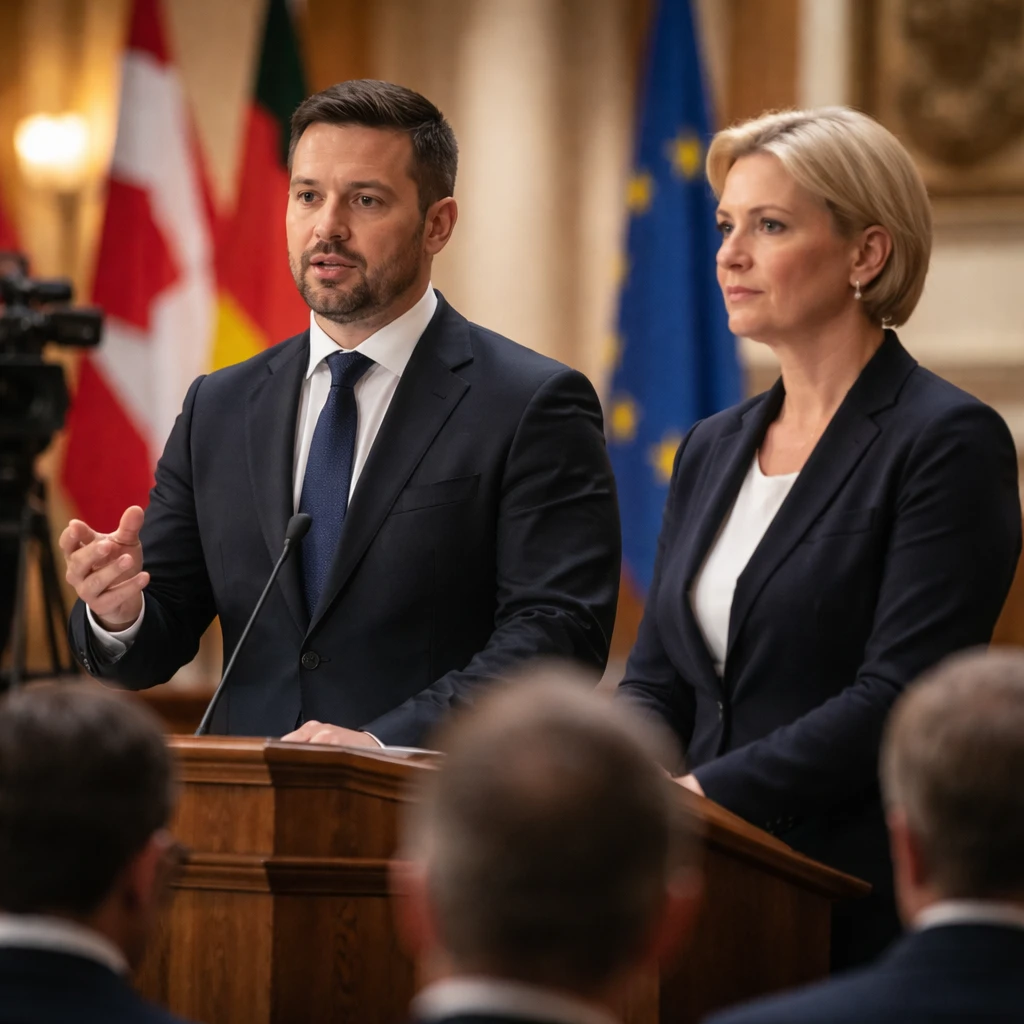
Greenland's prime minister, Jens-Frederik Nielsen, said the territory will not capitulate to external pressure, addressing concerns about foreign influence and domestic unease during a public appearance in Paris.

Speaking at Science Po University, Nielsen described the government's current task as pushing back against outside pressure while tending to the population's anxieties. "What we are dealing with as a government is trying to push back from outside and handle our people who are afraid and scared," he said.

At the same event, Nielsen also said Greenland needs to expand surveillance and security in the Arctic "because of the way Russia acts now," while reiterating that Greenland will not submit to external demands.

Danish Prime Minister Mette Frederiksen, who appeared alongside Nielsen, framed the current moment as a departure from the post-World War II order. "The world order as we know it that we have been fighting for 80 years is over and I don't think it will return," she said.

Frederiksen urged cohesion among Western partners as a response. "The best way forward for the U.S, Europe is to stick together," she said, adding: "We will try to find a way forward with U.S. We share concerns on Arctic security. Russia does not want peace with Europe."

The joint Paris appearance followed a meeting in Berlin on Tuesday with German Chancellor Friedrich Merz. The two leaders have been engaging European counterparts as they seek allied support for their positions.

These statements were made in the wake of comments by U.S. President Donald Trump, who recently said he had secured a framework for a future deal regarding Greenland. Trump, who has a history of expressing interest in the territory, did not provide specifics of the proposed framework but indicated that discussions would continue.


Context and next steps

The leaders' public remarks underline a focus on Arctic security measures and diplomatic coordination with Western partners. They have been actively consulting European allies, including a recent meeting with Germany's chancellor, as they navigate the interplay of local concerns and international pressure.

At the same time, references to an unspecified U.S. framework for a potential deal keep aspects of the situation uncertain, as no detailed arrangement has been presented publicly.

Risks

  • Heightened Arctic security concerns due to comments about Russian behavior could increase geopolitical tensions - affecting national security and defense considerations.
  • Diplomatic uncertainty persists because the U.S. claim of a framework for a future Greenland deal lacks public specifics, leaving the outcome of ongoing discussions unclear - relevant to international relations and policy markets.
  • Local unease in Greenland, described by officials as people who are "afraid and scared," presents a domestic political risk that the government is attempting to manage.

More from World

Kremlin says Russia has long offered to process or store Iran’s enriched uranium Feb 2, 2026 Long-Awaited Rafah Reopening Prompts Hope and Anxiety Among Palestinians Stranded Across Border Feb 2, 2026 Rafah Reopens but Core Questions Persist Over Implementation of Trump’s Gaza Blueprint Feb 2, 2026 Rafah Crossing Reopens on Foot with Strict Limits as Gaza Remains Under Strain Feb 2, 2026 Medvedev Warns World Is Growing More Dangerous but Says Russia Does Not Seek Global War Feb 2, 2026