
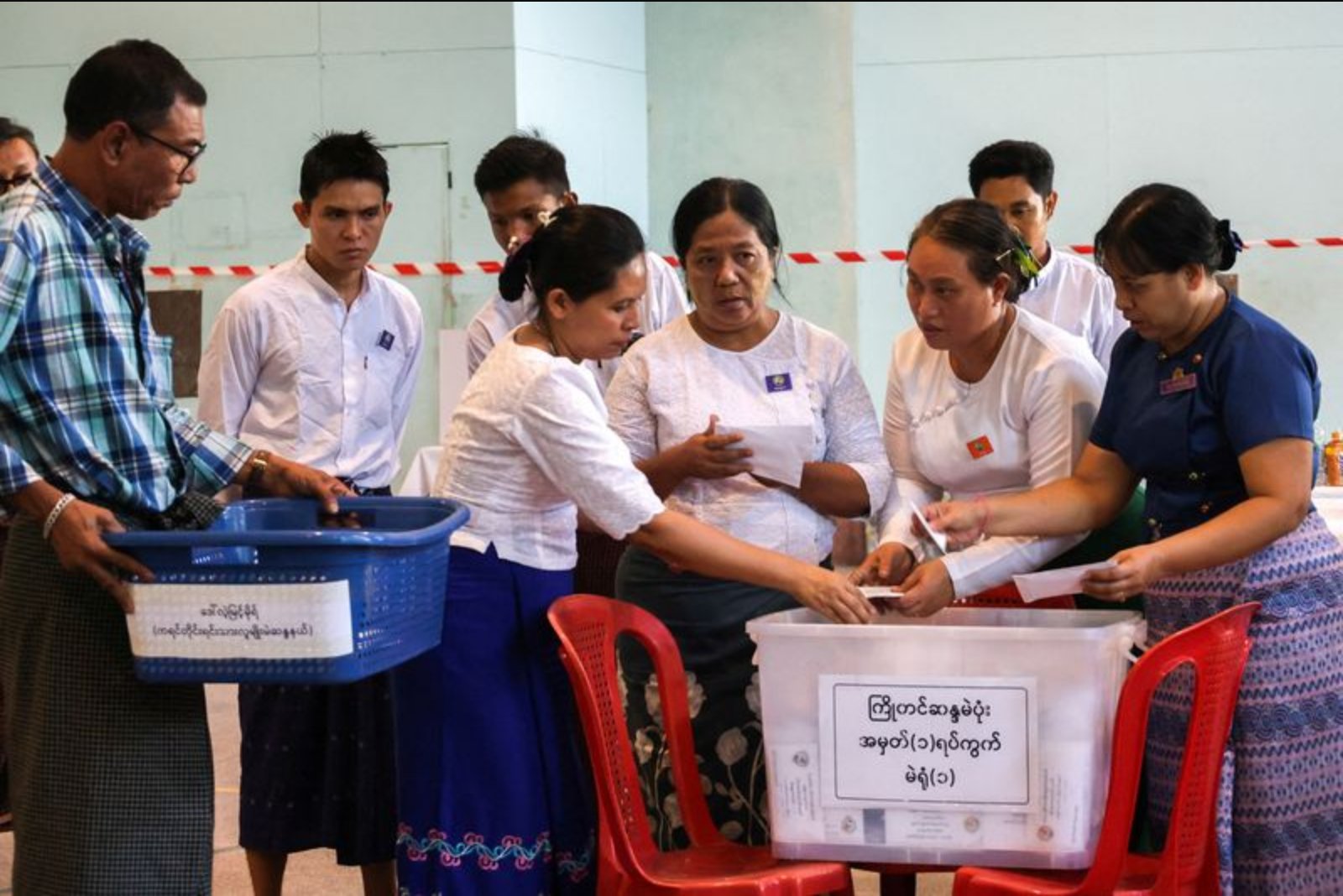
Polling stations opened on Sunday for the final phase of Myanmar's multi-stage general election, completing a three-part voting process held amid civil war and international condemnation. Voters in 60 townships, including the country’s largest cities Yangon and Mandalay, were due to cast ballots as the military-backed party that leads the race prepares to consolidate its advantage.
The first two rounds of voting, conducted on December 28 and January 11, were characterised by markedly reduced participation compared with pre-coup elections. Turnout in those phases was around 55 percent, substantially lower than the roughly 70 percent participation recorded in Myanmar’s 2020 and 2015 general elections. Authorities and the junta have acknowledged the lower engagement while arguing the process reflects public support.
Myanmar has been in turmoil since a dawn coup on February 1, 2021, when the military seized power and removed an elected civilian government led by Aung San Suu Kyi. The 80-year-old politician remains detained, and her political party, the National League for Democracy, has been dissolved by the junta, along with several opposition organisations. Those actions have reshaped the electoral field in a manner that favours the military-backed Union Solidarity and Development Party.
International responses have been critical. Malaysia, which previously chaired the Association of Southeast Asian Nations, said the bloc rejected Myanmar’s invitation to send poll observers and would not endorse the election. Rights groups and some Western governments have described the ballot as a sham intended to prolong the military’s tenure. In public commentary, analysts have warned the vote is unlikely to resolve the crisis that has now entered its fifth year.
"Rather than resolving a crisis now in its fifth year, the vote is more likely to reinforce the military’s hold on power, with little prospect of restoring domestic legitimacy or improving the country’s standing with Western partners," said Kaho Yu, Principal Asia Analyst at Verisk Maplecroft.
Fighting has continued across parts of Myanmar through the campaign and previous voting phases. Air strikes and clashes have been reported around civilian areas in the border states of Rakhine, Shan and Kayin, underlining the security challenges that have accompanied the electoral timetable.
At present, the election commission’s tallies show the Union Solidarity and Development Party in a commanding position. The party has won 193 of 209 seats in the lower house and 52 of 78 seats in the upper house, figures that leave it dominant in the legislature if those results hold through the final phase.
The USDP, established in 2010 and the governing party following an earlier transition from direct military rule, is led by a retired brigadier general and includes numerous former senior officers. Myanmar’s armed forces, which have governed for much of the nation’s modern history, have signalled no intention of permanently relinquishing political influence.
"Regardless of how successive governments may change over time, Tatmadaw remains a steadfast institution that will continue to shoulder the responsibilities of national defence and security," junta leader Min Aung Hlaing said last week, referring to the Burmese term for the military. The 69-year-old general has indicated he is weighing a change of leadership in the armed forces and is likely to move into a fully political role, potentially after appointing a successor as armed forces chief.
The junta has maintained that the election process is legitimate and free from coercion. At the same time, residents in major cities have described an atmosphere of fear during the campaign, saying many felt compelled to vote to avoid potential arrest or retribution. State media have reported that, under an election protection law, authorities have charged more than 400 people for criticising or obstructing the electoral process.
Despite the junta’s pledge to transfer power to a new government, likely in April, significant doubts remain about the vote’s capacity to restore domestic legitimacy or to improve Myanmar’s diplomatic standing with Western partners. With conflict persisting in multiple regions and large swathes of the political opposition dismantled, the election appears set to consolidate the military-backed party’s dominance rather than produce a broad-based settlement.
Summary
The final round of Myanmar’s general election took place with voting in 60 townships, including Yangon and Mandalay, amid ongoing conflict and low voter turnout. The military-backed Union Solidarity and Development Party leads the results and is poised to cement control. International actors and rights groups have criticised the election as designed to maintain military influence, while the junta has vowed a transition to a new government, likely in April.
Key points
- The election’s earlier phases saw turnout near 55 percent, well below the roughly 70 percent recorded in 2020 and 2015, indicating diminished voter engagement.
- The Union Solidarity and Development Party currently holds 193 of 209 lower house seats and 52 of 78 upper house seats based on the commission’s counts, placing it in a dominant legislative position.
- Continued fighting and international non-recognition of observer arrangements suggest persistent political and security risks that are likely to affect investment sentiment and financial market perceptions of Myanmar.
Risks and uncertainties
- Security risk - Ongoing conflict, including air strikes in Rakhine, Shan and Kayin states, creates an unstable environment that threatens civilian safety and economic activity.
- Legitimacy risk - Low voter turnout and the dissolution of prominent opposition parties raise questions about domestic legitimacy and international recognition of the electoral outcome.
- Legal and political repression - The prosecution of over 400 people under election-related legislation indicates heightened enforcement that could suppress dissent and complicate any political reconciliation.
Tags: Myanmar, election, military, junta, Yangon