
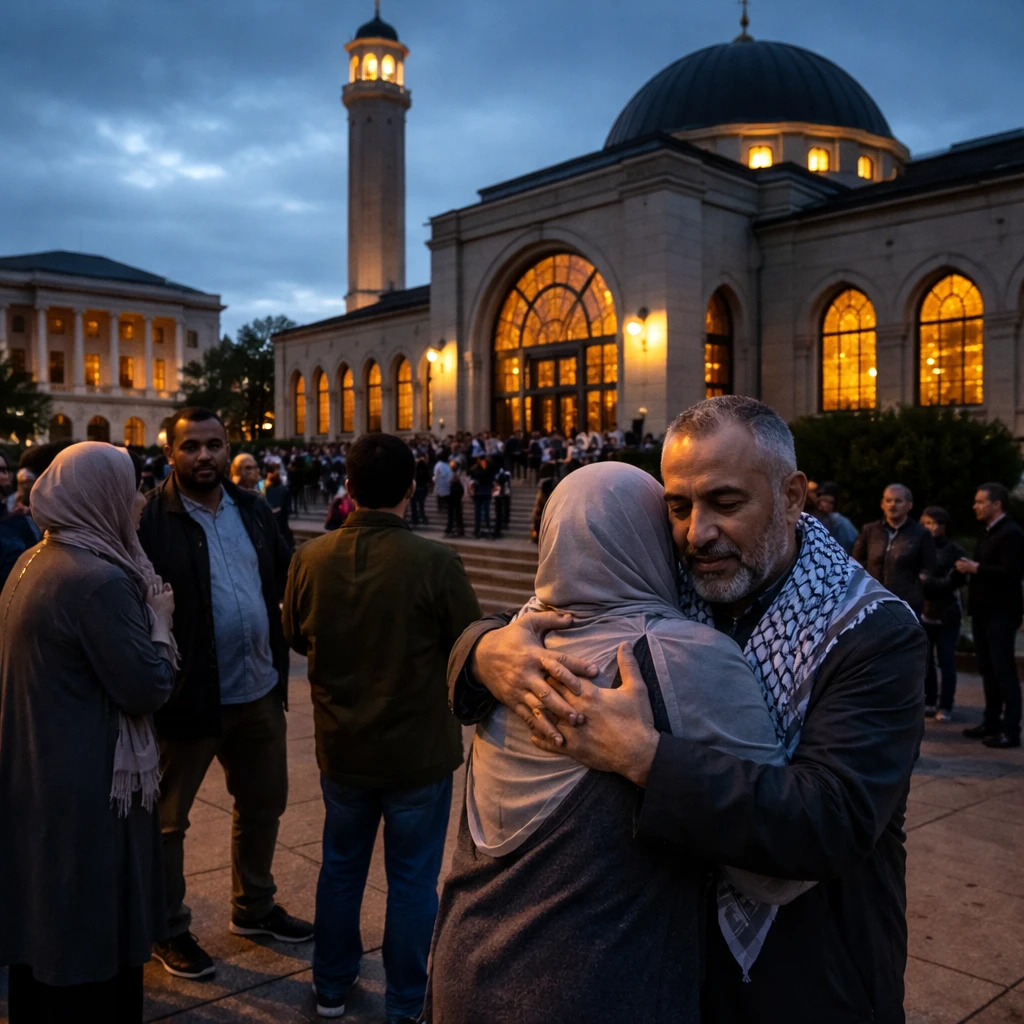
WASHINGTON, June 18 - A federal judge on Thursday directed the release of Salah Sarsour, the 53-year-old president of Wisconsin’s largest mosque, from U.S. Immigration and Customs Enforcement custody after concluding that Sarsour had presented a potentially substantial First Amendment retaliation claim.
U.S. District Court Judge James Patrick Hanlon, who was appointed during President Donald Trump’s first term, wrote in the ruling that "Mr. Sarsour has raised a ’substantial’ First Amendment (free speech) retaliation claim, which could render his detention unlawful." The court ordered Sarsour freed from detention, while the broader legal proceedings against him continue.
The Islamic Society of Milwaukee (ISM) says Sarsour is a legal permanent resident who has lived in the United States for over 30 years and that he grew up in the Israeli-occupied West Bank. The mosque and advocates had argued that Sarsour was being targeted because of his Palestinian and Muslim background and his public advocacy for Palestinian rights.
After his release, Sarsour said: "I will never stop speaking for Palestine and humanity, wherever I am." He added, "I am so relieved to be with my family." His legal team reported that Sarsour, who has type 2 diabetes, lost more than 30 pounds while detained.
Sarsour has no criminal record in the United States. The publicly available record shows a conviction from his youth in an Israeli military court prior to his arrival in the U.S. The Israeli rights group B’Tselem states that military courts in the West Bank, where Palestinians are tried for alleged crimes, have a 96% conviction rate and a history of extracting confessions through torture.
The Department of Homeland Security, which oversees ICE, noted Sarsour’s past conviction and said he was convicted of throwing Molotov cocktails at the homes of Israeli armed forces. In a statement on Thursday, DHS said: "There is no First Amendment right to fund terror organizations and lie on immigration forms." Sarsour has denied supporting extremists.
Judge Hanlon ordered that Sarsour remain in Wisconsin pending further proceedings. The case is ongoing.
The Council on American-Islamic Relations (CAIR), among groups that advocated for Sarsour’s release, welcomed the judge’s decision. The legal action and advocacy around Sarsour’s detention formed part of broader debates over government actions related to pro-Palestinian activism.
In recent months, the Trump administration has taken several measures aimed at curbing pro-Palestinian voices, including attempts to deport foreign protesters, threats to freeze funding for universities where protests occurred, and directives to screen immigrants’ online comments. Those measures have encountered judicial challenges and obstacles.
Public statements from the former president assert that pro-Palestinian voices are antisemitic and support extremists. Advocates, including some Jewish groups, counter that the government is improperly conflating criticism of Israel’s actions in Gaza with antisemitism and treating advocacy for Palestinian rights as equivalent to support for extremism.
Context and next steps
The judge’s ruling grants Sarsour immediate freedom from ICE detention but does not resolve the underlying immigration case. The legal process will determine whether the First Amendment claim ultimately alters the outcome of the proceedings. For now, the court has limited Sarsour’s mandated residence to Wisconsin.