
On Sunday night near the town of Adamuz in southern Spain, one of Europe's most severe high-speed train derailments occurred, resulting in at least 42 fatalities. The site lies in a remote and hilly region, complicating investigation efforts. Among the components sought by investigators was a missing bogie, the wheeled undercarriage essential for guiding the train along the rails. This part's loss is particularly significant as it plays a vital role in the train-track interface, and its condition could provide direct insight into the derailment's causes.
On Tuesday, a substantial metal fragment was discovered partly submerged in a small stream beneath a railway bridge approximately 15 meters below the tracks and about 300 meters from the primary crash location. Photographs obtained by Reuters revealed the component’s position outside the immediate cordoned-off area. The Civil Guard reportedly first located this piece on Monday but left it in place due to its heavy weight. Transport Minister Oscar Puente described this item as "one of hundreds of pieces of evidence" being collected as part of the ongoing investigation but did not clarify to which of the two involved trains it belonged.
A source familiar with the probe, requesting anonymity due to the investigation's sensitive nature, indicated the part is likely the bogie of the first derailed train, which was operated by the private consortium Iryo. Despite the bogie’s substantial mass, the force of the collision and the high speeds involved caused it to be ejected with great velocity, described by the source as flying "like a bullet." In the days following the accident, investigators have meticulously searched the surrounding terrain, documenting and preserving evidence to reconstruct the event accurately.
Official statements from key stakeholders reflect their measured approach. Spain’s railway accident body CIAF is actively examining this component but refrains from public commentary outside the scope of the formal investigation. Similarly, the state rail company Renfe highlighted their limited disclosures, and neither the Spanish Transport Ministry, Iryo, nor infrastructure manager Adif has confirmed details about the part’s identification. Italy’s Ferrovie dello Stato, which holds a majority stake in Iryo, declined to comment pending investigation developments.
Industry experts acknowledge the significance of such a find. Scottish railway engineer Gareth Dennis explained that bogies—components bearing wheels and suspension—commonly detach during high-energy derailments. Their locations provide investigators critical data on the trajectories and forces involved in the accident sequence. By pinpointing the bogie’s original position on the train, investigators can refine their understanding of the derailment dynamics, aiding future safety measures.
The discovery of this piece marks a vital step toward piecing together the accident's circumstances, though many questions remain. Authorities continue to gather evidence and analyze all fragments to establish a comprehensive account of the events leading up to the collision.
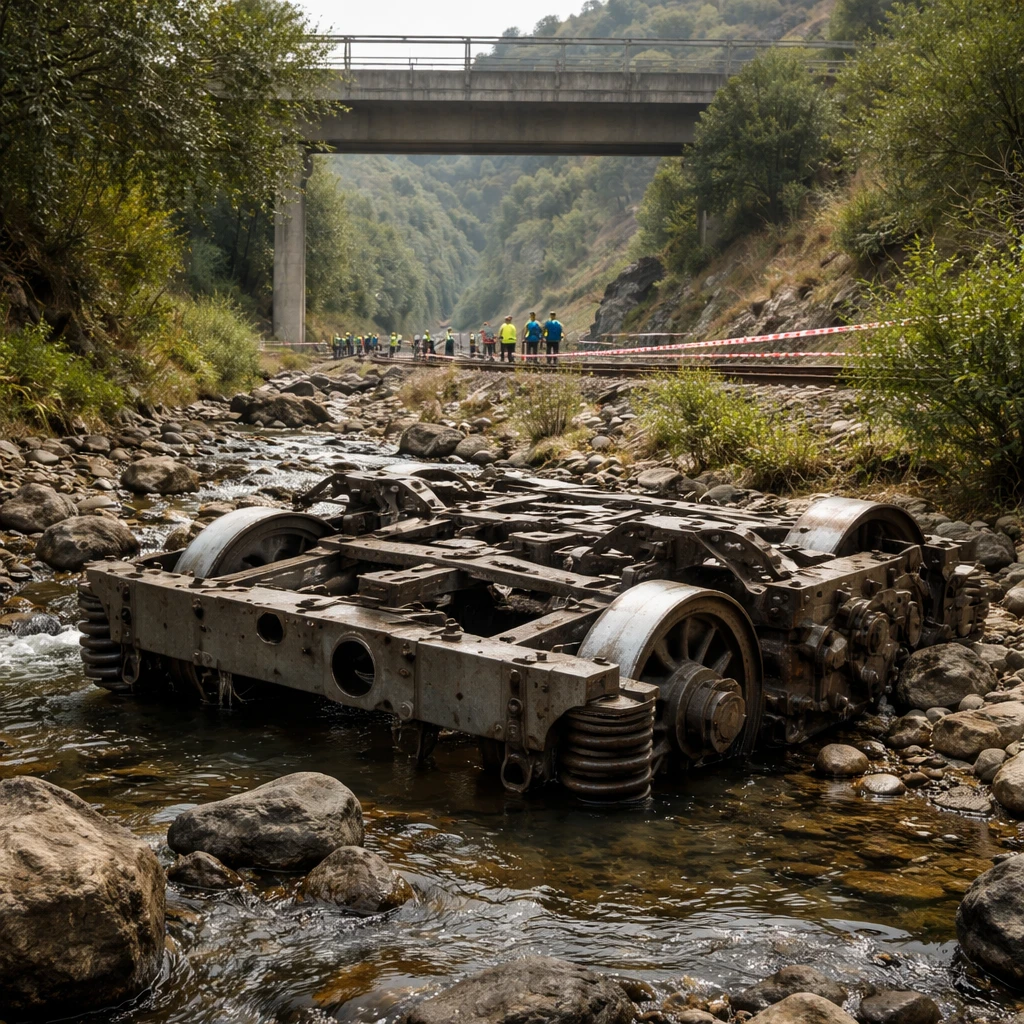
Authorities investigating a recent high-speed train derailment near Adamuz, Spain, have located a significant metal piece thought to be the missing bogie of the first derailed train. This find may be key to understanding the causes of the accident that resulted in at least 42 deaths. The bogie, a critical structural element connecting the train to the tracks, was found outside the primary crash area and is under close examination by investigators.
Key Points
- A significant metal part, likely a bogie, was found near the crash site outside the main investigation zone, potentially explaining the derailment cause.
- The bogie belongs to the first derailed train, operated by private consortium Iryo, and was ejected with high force due to the collision and speed involved.
- Investigators, including Spain’s CIAF and the Civil Guard, are meticulously collecting evidence to analyze the accident dynamics, but official details are limited due to ongoing investigations.
Risks
- The extent of damage and loss of life underscores considerable safety and operational risks in high-speed rail services, particularly in relation to critical train components like bogies, impacting operator reputations and regulatory scrutiny.
- Uncertainties surrounding the precise cause of the derailment may prolong investigations and delay remedial actions, imposing financial and regulatory risks on involved companies such as Iryo and infrastructure managers.
- The removal and identification of heavy, dispersed train parts complicate reconstruction accuracy, posing risks to comprehensive accident analysis and appropriate safety reforms post-investigation.