
World July 24, 2026 10:13 AM

China and U.S. Law Enforcement Officials Pledge Expanded Cooperation in Beijing Meeting

Top Chinese police official and FBI director agree to deepen practical cooperation after recent cross-border fugitive repatriations

By Avery Klein
Share
Twitter Reddit Facebook LinkedIn

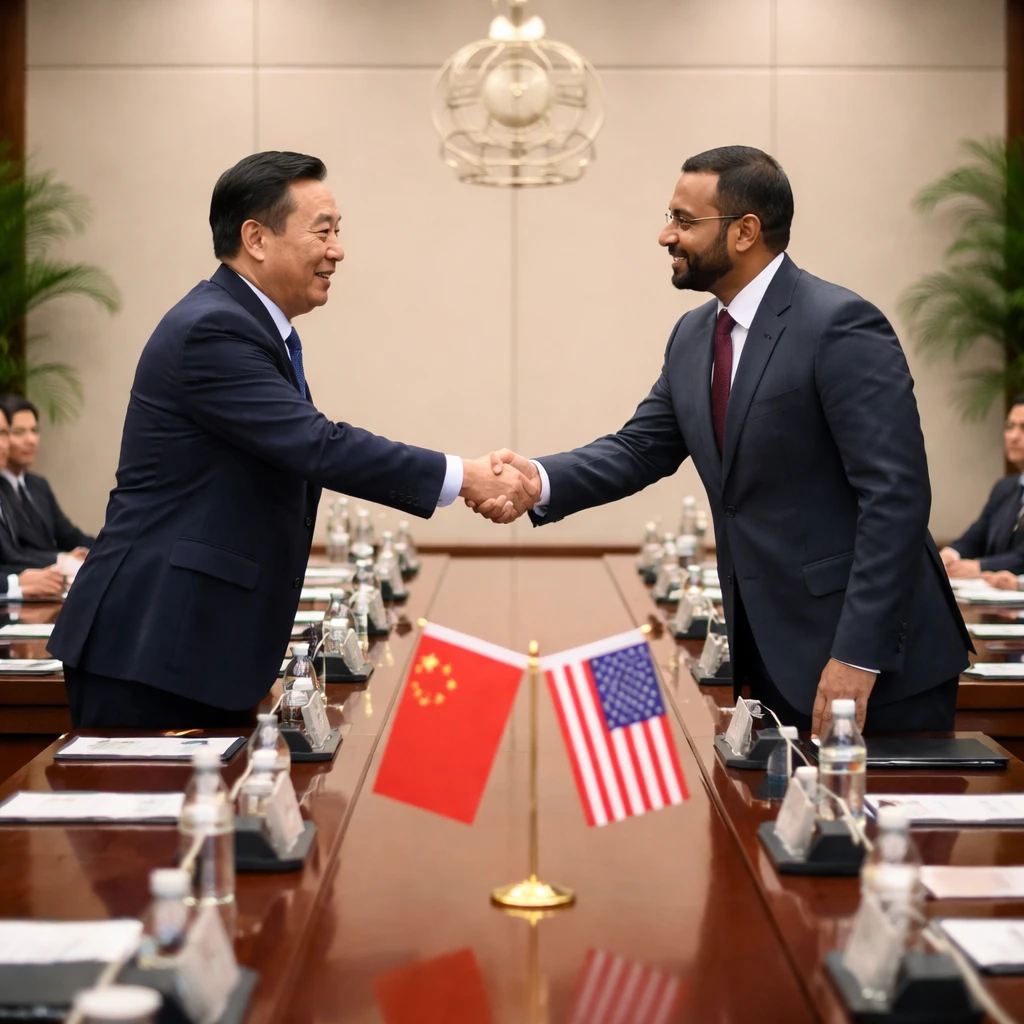
China’s minister of public security, Wang Xiaohong, and U.S. FBI Director Kash Patel met in Beijing and pledged to strengthen law enforcement cooperation. The talks followed two recent repatriations of fugitives between the two countries — which do not have an extradition treaty — and covered a range of operational areas from counter-narcotics to cyber fraud and anti-money laundering.

China and U.S. Law Enforcement Officials Pledge Expanded Cooperation in Beijing Meeting
Summarize with
ChatGPT Perplexity Claude Grok Gemini

Key Points

  • China’s minister of public security Wang Xiaohong and FBI Director Kash Patel agreed to deepen law enforcement cooperation during a meeting in Beijing; sectors affected include law enforcement, cybersecurity, and financial compliance.
  • The talks followed two recent repatriations of fugitives between the United States and China, despite the absence of a formal extradition treaty; this practical cooperation has covered counter-narcotics, fugitive recovery and anti-money laundering.
  • Previous and recent engagements have targeted fentanyl trafficking and telecom/cyber fraud, reflecting operational priorities that may influence enforcement activity across criminal justice and compliance-related markets.

BEIJING, July 24 - China’s senior public security official and the head of the U.S. Federal Bureau of Investigation held talks in Beijing on Friday and agreed to intensify cooperation on law enforcement matters, Chinese authorities said.

The meeting between China’s Minister of Public Security Wang Xiaohong and FBI Director Kash Patel came after two recent transfers of fugitives between the two countries, which do not maintain an extradition treaty. China’s official summary of the talks said both sides should "engage in more constructive dialogue on the basis of mutual respect and deepen practical cooperation" to address a spectrum of criminal activity.

On Thursday, China’s Public Security Ministry announced it had handed over to U.S. law enforcement a U.S. national wanted on serious violent crime charges, including the suspected murder of a spouse and the sexual assault of a young girl. The ministry said this action was part of a pattern of operational collaboration between Chinese and U.S. agencies.

The ministry listed recent cooperative work as encompassing "a series of practical cooperation in areas such as counter-narcotics, repatriation of illegal immigrants, fugitive recovery, combating telecom and cyber fraud, and anti-money laundering." It added that such collaboration reflected a consensus reached between U.S. President Donald Trump and Chinese President Xi Jinping.

Chinese state media said that, days earlier, the United States had repatriated to Beijing a fugitive accused of kidnapping and killing Chinese citizens overseas. That repatriation was described by Beijing as "the latest achievement" in carrying out the presidents’ agreed approach.

The Chinese summary also noted prior engagements between U.S. and Chinese law enforcement officials. FBI Director Patel visited Beijing in November 2025 to discuss fentanyl and related law enforcement issues, following an October summit that year in which the two presidents agreed on cooperation to combat fentanyl trafficking. The two presidents are scheduled to meet again in Washington in September, President Trump has said.


Context and implications

The exchanges in Beijing underline a recent uptick in on-the-ground coordination between Chinese and U.S. agencies across a range of operational priorities, while also occurring against the backdrop of high-level presidential engagement on shared law enforcement concerns.

What remains limited in the public record

  • The public summaries do not specify the mechanisms that will govern expanded cooperation going forward.
  • Details on timelines, legal frameworks or case-by-case arrangements for future repatriations were not disclosed.

Risks

  • No bilateral extradition treaty exists between the United States and China, leaving repatriations dependent on ad hoc arrangements and potentially limiting predictability for law enforcement and legal sectors.
  • Public statements do not disclose the specific mechanisms or timelines for implementing expanded cooperation, creating uncertainty for agencies and private-sector firms that rely on cross-border legal and compliance clarity.
  • The durability of cooperation could be affected by the evolving high-level political relationship; upcoming presidential meetings are referenced but outcomes remain uncertain, which could influence future enforcement coordination.

More from World

UNEP Warns 1.5C Threshold Will Be Crossed 'Within a Few Years', Recovery Uncertain Sep 2, 2026 Search Efforts Fade as Nepal Counts the Cost of Glacier Collapse Floods Sep 2, 2026 Search Continues in Grand Canyon After Flash Flood Leaves One Hiker Missing Sep 1, 2026 Tucson Authorities Treat Fatal Shootings Outside Gay Bar as Possible Hate Crime Sep 1, 2026 USS Abraham Lincoln Pulls Into Laem Chabang After Record-Length Deployment Sep 1, 2026