
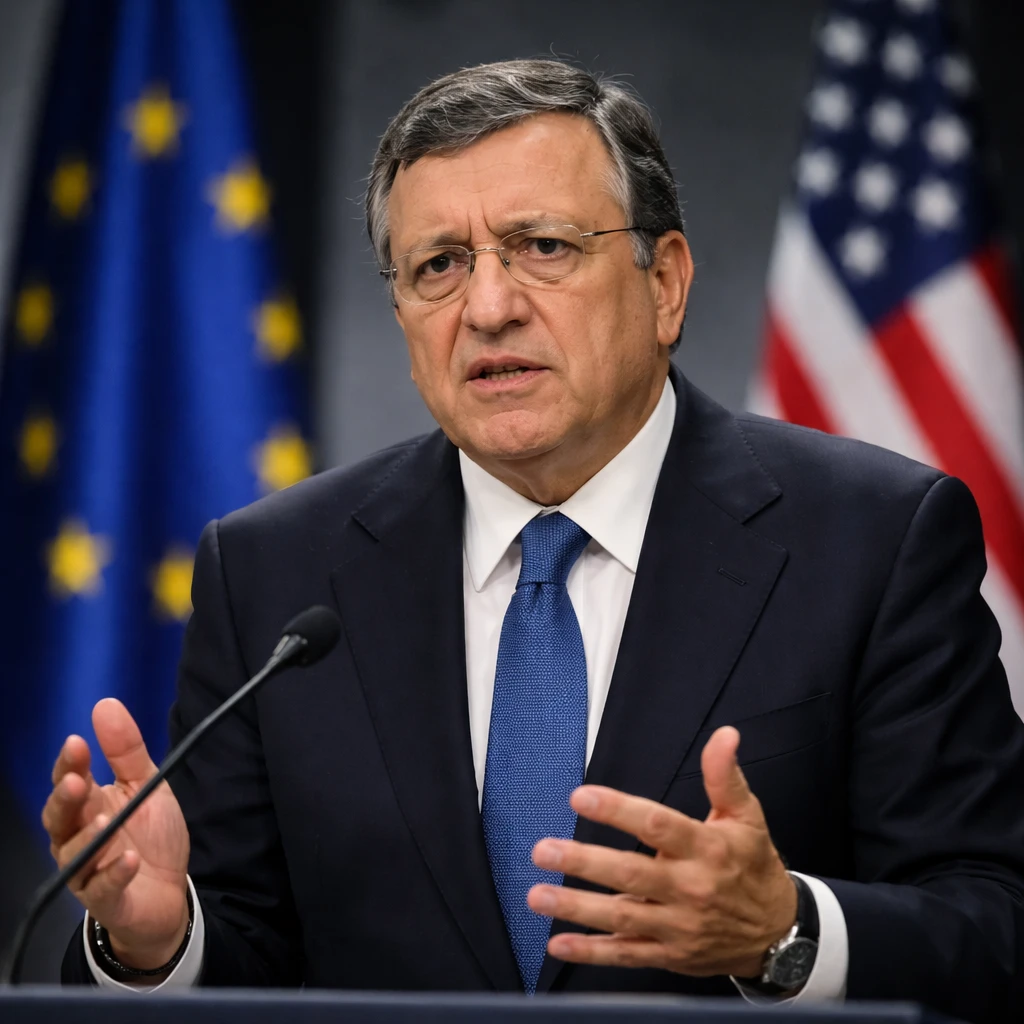
Former European Commission President Jose Manuel Barroso said in a CNBC interview on Monday that relations between Europe and the United States are experiencing their "lowest moment" since NATO was established.
Barroso pointed to a growing sense of distrust that extends beyond the European Union to include the United Kingdom. He singled out several recent U.S. policy moves as contributing factors to strained ties, including U.S. President Donald Trump’s reported aim of seizing Greenland - a semi-autonomous territory of Denmark - along with threats of military action and the possibility of higher tariffs on European nations.
These measures, Barroso said, have undermined European confidence in American leadership and helped push the relationship into what he described as a "rupture phase." In that phase, he argued, the transatlantic partnership has become increasingly driven by narrow interests rather than shared "democratic values."
He labeled President Trump as "the great disruptor" and said the president is sometimes "more tough with allies and friends, than with opponents."
On defense, Barroso noted that European leaders have accelerated moves toward what they describe as "European sovereignty" in response to increased pressure from the Trump administration over the bloc’s defense spending. "If you want to keep NATO, it will be a more Europeanized NATO," he said, urging that Europe should put priority on strengthening its own defense rather than relying solely on American support.
Despite his warnings about the current state of transatlantic relations, Barroso stressed that the broader alliance has not disappeared. He pointed out that NATO has, in some respects, become stronger since Russia’s invasion of Ukraine, highlighting the accession of Sweden and Finland to the alliance and NATO's expanded military presence along its eastern flank.
While expressing a pessimistic view of the present relationship between Europe and the United States, Barroso cautioned against declaring the end of the alliance, emphasizing that the U.S. remains essential to Europe’s security.
Context and implications
Barroso’s comments frame recent diplomatic tensions as a structural shift in how Europe views its security partnership with the United States - from a relationship grounded in common democratic values to one increasingly negotiated around discrete national interests. He tied this shift to specific policy gestures and pressures from the U.S. administration that have prompted European leaders to consider bolstering their own defense capabilities and recalibrating reliance on the United States.