
World February 5, 2026

Azerbaijan Court Hands Long Sentences to Former Nagorno-Karabakh Officials

Five receive life terms, eight given 15-20 years as trial draws criticism from human rights groups

By Avery Klein
Azerbaijan Court Hands Long Sentences to Former Nagorno-Karabakh Officials

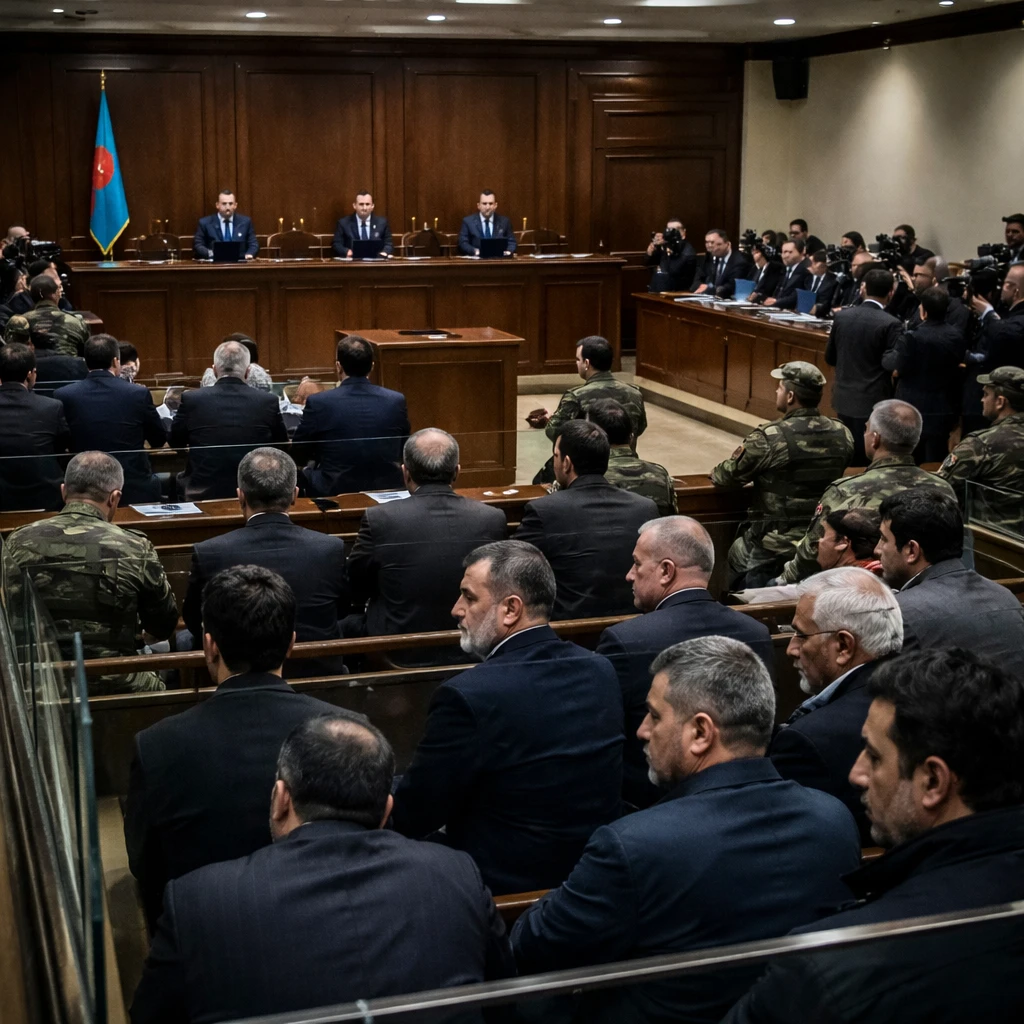
On Feb 5 in Baku, an Azerbaijani military court sentenced 13 former officials from the unrecognised Nagorno-Karabakh administration. Five defendants, including former Karabakh leader Arayik Harutyunyan, received life imprisonment; eight others were handed prison terms of 15 to 20 years. Convictions covered a range of grave charges. Human rights organisations have raised questions about the fairness of proceedings that began in January 2025.

Key Points

  • An Azerbaijani military court on Feb 5 sentenced 13 former Nagorno-Karabakh officials; five received life imprisonment while eight were handed 15-20 year terms.
  • Convictions encompassed charges including crimes against peace and humanity, war crimes, preparation and conduct of an aggressive war, genocide, violations of the laws and customs of war, terrorism and violent seizure of power. Sectors potentially affected - the article does not specify particular economic sectors; implications could be felt in regional political risk assessments and investor sentiment.
  • Human rights groups raised concerns about the fairness of the trial, which began in January 2025; the article also notes that a verdict is still pending for Ruben Vardanyan, for whom prosecutors have demanded a life sentence.

BAKU, Feb 5 - An Azerbaijani military court on Thursday delivered lengthy prison sentences to 13 former officials who had served in the administration of Nagorno-Karabakh, the Armenian-majority breakaway region that existed outside Baku's authority for roughly three decades before Azerbaijani forces regained control in 2023.

Five defendants were given life terms, among them Arayik Harutyunyan, who led the Karabakh administration. The court imposed prison sentences of between 15 and 20 years on eight other former officials.

The court found the defendants guilty on an array of charges. The convictions included crimes against peace and humanity, war crimes, the preparation and conduct of an aggressive war, genocide, violations of the laws and customs of war, terrorism and the violent seizure of power.

Human rights groups have publicly questioned whether the trial met standards of fairness. The proceedings opened in January 2025, and rights monitors have expressed concerns about elements of the process.

Nagorno-Karabakh, an internationally recognised part of Azerbaijan, had been governed by ethnic Armenian authorities after seceding from Baku as the Soviet Union dissolved in 1991. Azerbaijan and Armenia fought two wars over the mountainous territory before Azerbaijan re-established full control in 2023. Following that return to Azerbaijani authority, the region's entire Armenian population, estimated at about 100,000 people, departed for Armenia.

Speaking to reporters, Arayik Harutyunyan's lawyer, Javid Rzazade, said his client had anticipated the court's decision. "Arayik Harutyunyan was prepared for this court decision. We knew the court could issue a life sentence. Naturally, we do not agree with either the indictment or the verdict," Rzazade said, adding that it was too early to determine whether they would file an appeal.

A verdict has not yet been delivered in the case of Ruben Vardanyan, a former banker who served as the number two official in the Karabakh administration. Prosecutors have sought a life sentence for Vardanyan.


The court rulings mark a significant legal outcome for Azerbaijani authorities following their 2023 restoration of control over Nagorno-Karabakh and follow months of legal proceedings that began earlier this year. Questions from human rights organisations about trial fairness remain part of the public record, and the status of at least one high-profile defendant remains unresolved pending a separate verdict.

Risks

  • Concerns expressed by human rights organisations about the fairness of the proceedings - this uncertainty may affect perceptions of legal and political stability in the region.
  • An outstanding verdict for Ruben Vardanyan and the possibility of appeals create judicial uncertainty; the article indicates it is too early to determine whether Harutyunyan's defence will appeal his sentence.
  • The displacement noted in the article - the exodus of the region's roughly 100,000 ethnic Armenian residents to Armenia after 2023 - underscores ongoing humanitarian and demographic uncertainties tied to the conflict's aftermath.

More from World

Czech National Bank Keeps Policy Rate at 3.5% as Inflation Signals Diverge Feb 5, 2026 Machado Says Venezuela Could Hold Elections This Year, Citing Possibility of Manual Voting Feb 5, 2026 U.S.-Iran Talks in Oman Focus on Nuclear Standoff as Wider Regional Disputes Loom Feb 5, 2026 Famine-level Acute Malnutrition Confirmed in Two Additional North Darfur Localities, Monitor Says Feb 5, 2026 Russia Regrets End of New START but Says It Will Act Responsibly as Limits Fall Away Feb 5, 2026