
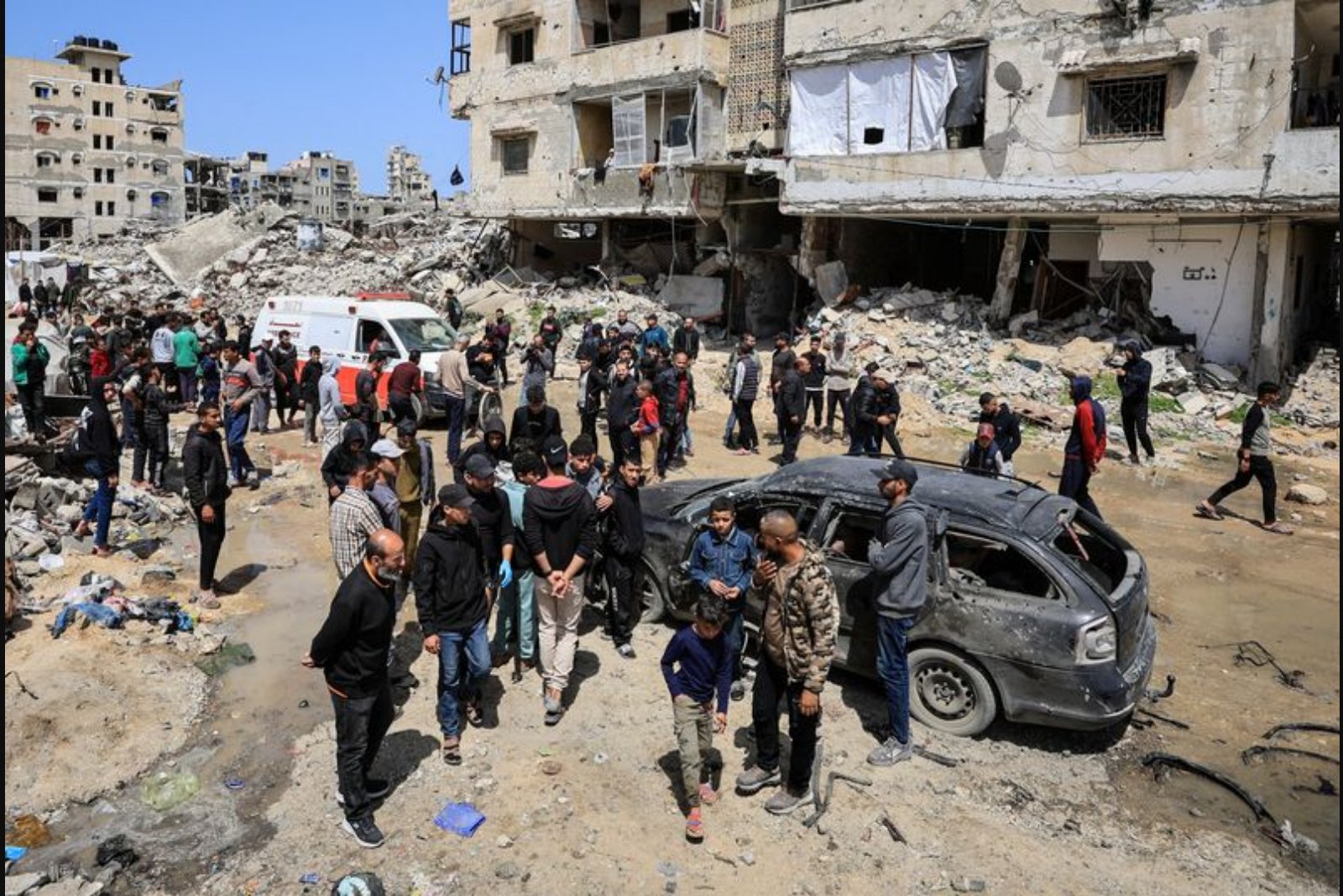
An Israeli airstrike struck a crowded neighborhood outside a school housing displaced Palestinians on Monday, killing at least 10 people and injuring several others, health officials and local medics said. The blast occurred after clashes erupted between some Palestinians and members of an Israeli-backed militia, who, residents and medics said, had attacked the school in what they described as an attempted abduction.
Witnesses and medical personnel reported that the fighting took place east of the Maghazi refugee camp in the central Gaza Strip. During those confrontations, Israeli drones fired two missiles into the area, according to the same accounts, producing the casualties. The strikes hit a compact neighborhood populated largely by people displaced from other parts of the territory.
It was not immediately possible to determine how many of the dead were civilians among the at least 10 fatalities linked to the drone strikes. Local medics and residents described chaotic scenes as the missiles impacted a tightly packed residential area where many families had sought shelter.
"The residents tried to defend their homes, but the occupation forces targeted them directly," said Ahmed al-Maghazi, an eyewitness, describing how members of the Israeli-backed militia first attacked their area and then opened fire.
Later on Monday, footage circulated showing a leader of one of the Israeli-backed militias claiming they had killed some five Hamas members. The video could not be immediately authenticated, according to those who reviewed it.
Separately, medics reported that an Israeli airstrike earlier on Monday killed one Palestinian and wounded a child who were traveling on a motorbike in Gaza City. In another incident, medics said Israeli forces shot and killed a Palestinian after opening fire on a vehicle in central Gaza. Taken together, the three incidents raised Monday’s death toll in Gaza to at least 12, health officials said.
The Israeli military did not issue an immediate comment on any of the incidents reported on Monday.
The flare-up of violence has further strained a fragile U.S.-backed ceasefire that came into effect in October. Since the ceasefire began, the Gaza health ministry reports that Israeli fire has killed at least 700 people. Israel, for its part, reports that militants in Gaza have killed four soldiers over the same period.
Talks to implement the next phases of U.S. President Donald Trump’s proposed Gaza plan have been complicated by the continued presence of weapons in the hands of Hamas, which has controlled Gaza since 2007. Hamas has resisted disarmament, and the group’s armed wing said on Sunday that broaching the subject of its surrender before Israel completes the first phase of the proposed plan amounted to an attempt to perpetuate what it described as genocide against the Palestinian people.
The long shadow of the October 7, 2023 attacks by Hamas, which Israel says killed 1,200 people, remains central to the conflict. Israel’s subsequent campaign has, according to Gazan health authorities, resulted in more than 72,000 Palestinian deaths, most of them civilians; the offensive has also produced widespread destruction, deepened famine, and displaced the majority of Gaza’s population, the health authorities say.
These latest incidents - a deadly drone strike near a sheltering school, a claimed militia operation, and separate killings in Gaza City and central Gaza - have renewed scrutiny of the ceasefire’s durability and the prospects for progress on disarmament and reconstruction. Officials on all sides have presented competing accounts, and key details remain contested and difficult to verify on the ground.