
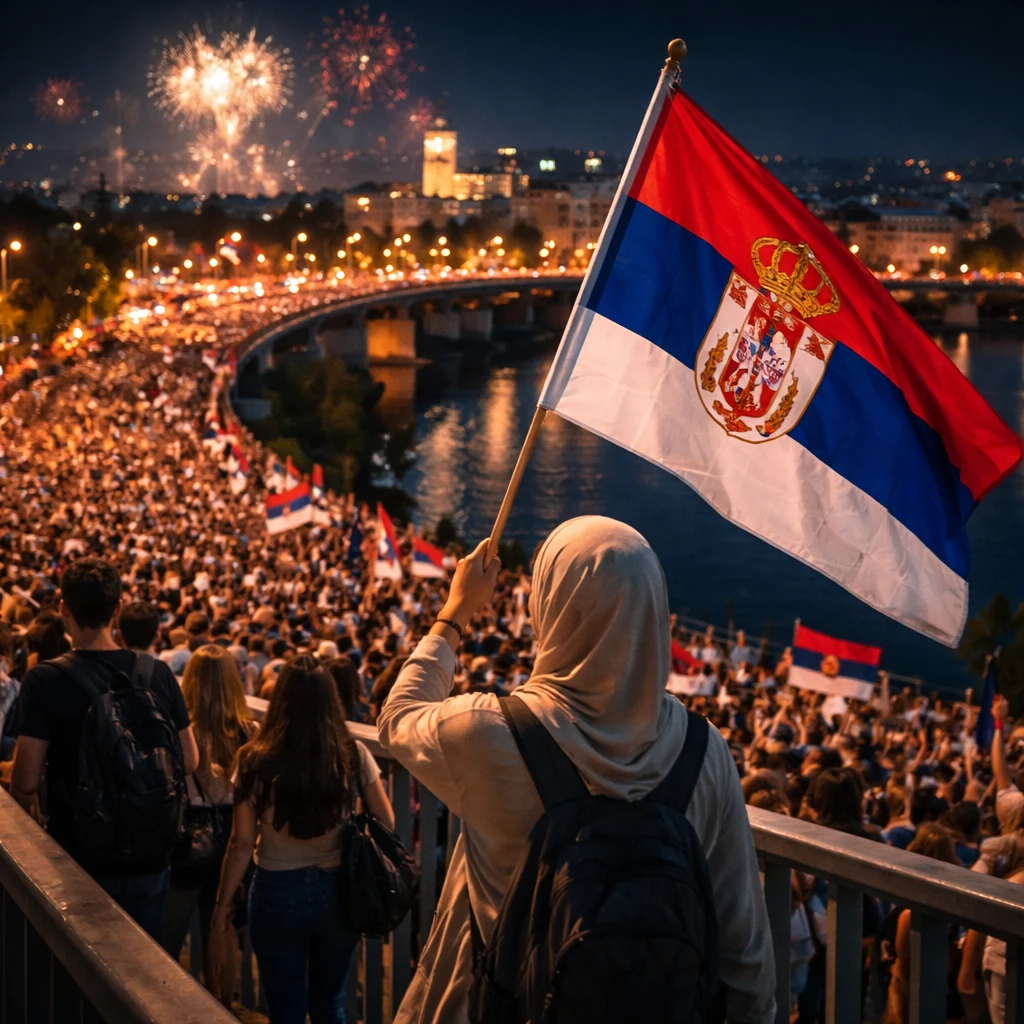
NOVI PAZAR, Serbia - When Merima Avdic stepped off a bridge over the Danube and into the city of Novi Sad in November, she was met by fireworks, cheering crowds and the sight of tens of thousands of protesting students. Avdic had carried a Serbian flag in her hand after completing a walk of more than 400 km (249 miles) from the State University of Novi Pazar in the Sandzak region of southwest Serbia to join one of the largest sustained protest movements the country has seen in decades.
The demonstrations began in the wake of a railway station roof collapse a year earlier that killed 16 people. The disaster has fuelled demands for the government to resign amid widespread allegations that corruption and a lack of accountability contributed to poor construction standards. Government officials have denied that state graft was to blame for the tragedy.
For Avdic, a student from Serbia’s Bosniak Muslim minority who wears a hijab, arriving in Novi Sad and joining the flood of protesters was a formative experience. "During the walk, I was stunned to see so many people who supported us and who came out to tell us that we are not alone," she said. She described a moment when a man from Kosjeric offered the group his Serbian flag because they had none, and how they marched into Novi Sad carrying it.
The protests have drawn students and citizens of all ages and ethnic backgrounds, uniting disparate groups around shared calls for reform and an end to corruption. Muslims make up roughly 4% of Serbia’s population, and more than half of that community lives in Sandzak, the region where Avdic was born and where the State University of Novi Pazar is located.
The Sandzak population has lived through decades marked by war, rising Serb nationalism and ethnic conflict as the former Yugoslavia disintegrated. Within that context, the protests sweeping Serbia - led in large part by students - have been notable for their cross-ethnic cohesion. At the State University of Novi Pazar, the change in perception has been particularly visible. Where once the community felt sidelined and subject to prejudice and state pressure, students now say they feel part of a broader national movement for change.
Established in 2007, the State University of Novi Pazar was the first higher education institution in the region and provided the Bosniak community with access to state-funded local university education for the first time. Yet national acceptance of the community, students say, has been slower to arrive.
Avdic described practical and symbolic signs of that shift during the march. She and other students spent a night at Studenica, a medieval Orthodox monastery, where they were provided a halal breakfast - an accommodation she said would have been unimaginable a quarter-century ago. These moments underscored to participants that outreach across religious and cultural lines was possible amid the larger protest movement.
Visuals from the demonstrations reinforced the emerging narrative of unity. One image taken at a protest in Kraljevo, central Serbia, showed Nadija Delimedjac, a student from Novi Pazar wearing a hijab, walking beside Sava Nikolic from Cuprija wearing a traditional Serbian hat. The photograph circulated widely on social media and became emblematic of the changes students say the protests represent.
Protests involving students from Novi Pazar persisted longer than at most other universities in Serbia. For more than a year students maintained a blockade of Novi Pazar University that halted lectures until little over a week ago, when the university replaced its rector and revoked expulsions for 200 students who had been banned for anti-government activism. During the occupation students continued their demonstration even after authorities cut the heating in university buildings.
"I am proud of myself and my colleagues and how we destroyed prejudice and showed that we want to live in this country," Avdic said, reflecting on what the protests have meant for her and fellow students. Her words underline how the movement has not only pushed for institutional accountability but has also begun to reshape how marginalized communities see themselves within Serbia.
Not all impacts of the protests are settled. The long-running blockade and expulsions, the questions raised about construction standards after the fatal roof collapse, and the political debate over responsibility for the disaster leave unresolved issues for local institutions and national authorities. Families of activists and local residents have expressed admiration for the students' commitment. "I am stunned by the sacrifice they have made," said Muamer, the father of Delimedjac, speaking of the march to Novi Sad. "Diversity is our fortune."
As the protests continue to influence public discourse, students from Novi Pazar and other regions say the movement has provided a concrete sense of belonging and visibility for communities that have long felt marginalized. Whether that translated solidarity will produce lasting institutional change remains tied to broader political developments and decisions by university and state authorities.