
Hook & thesis
Rayonier (RYN) is trading at $20.41 with a market cap near $6.2 billion, yet the company is actively monetizing non-core assets and shrinking leverage. Management's $710 million sale of a 77% New Zealand JV stake and the October merger with PotlatchDeltic (creating an $8.2 billion combined business) create a near-term path for cash returns and a multi-quarter re-rating.
My trade thesis is straightforward: the stock is pricing in flat-to-worse timber demand and ignores the immediate balance-sheet optionality. Timberland is selling in pockets for roughly $1,800 an acre right now, which implies meaningful hidden asset value in Rayonier's portfolio - and that should support a mid-term re-rating as cash hits the balance sheet and investor focus pivots from short-term harvest cycles to asset value, recurring FCF and a healthy dividend.
What Rayonier does and why the market should care
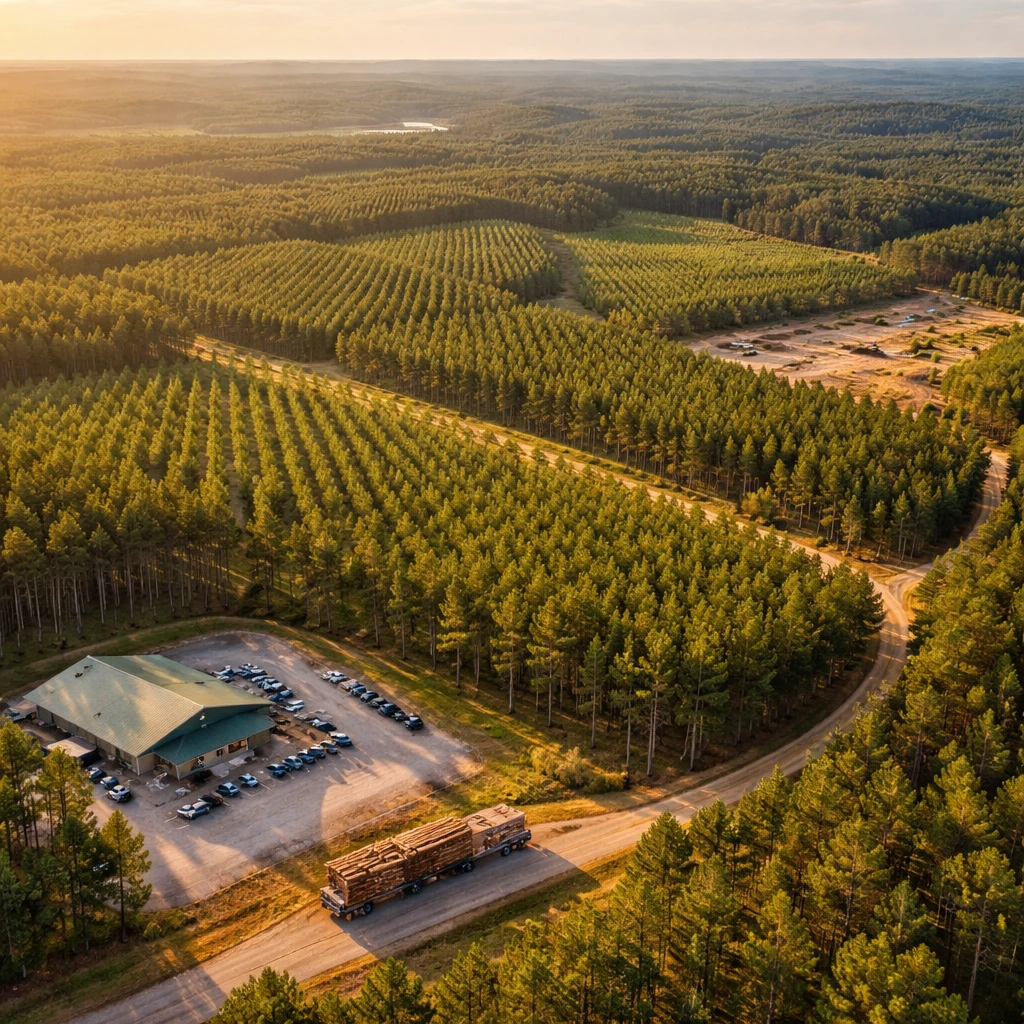
Rayonier is a REIT focused on timberlands with operating segments across the U.S. South, the Pacific Northwest and New Zealand plus a Real Estate segment that records U.S. land sales in categories like Improved Development, Unimproved Development, Rural and Timberlands. Management has been explicitly recycling capital - selling the bulk of the New Zealand JV for $710 million on 03/11/2025 - to reduce leverage, fund strategic acquisitions and support shareholder returns.
Why this matters: timberland REITs are hybrid businesses - they generate recurring cash flows from timber harvests and log trading, but their intrinsic floor is acreage value. When active land markets show per-acre transactions around $1,800, that floor supports a higher multiple on the operating business and makes a 5% dividend sustainable even with cyclical harvests.
Defensible numbers
- Market cap: about $6.2 billion and enterprise value roughly $6.34 billion.
- Free cash flow: $177.1 million in the most recent reported period, implying a FCF yield near 2.9% on current market cap.
- Dividend yield: roughly 5.0% - a meaningful income kicker while the re-rate plays out.
- Valuation metrics: price-to-book around 1.48, EV/EBITDA roughly 31x and smoothed technicals show the name modestly oversold (RSI ~35) beneath its 10/20/50-day averages.
Why the timing looks attractive
Rayonier's $710 million New Zealand JV sale (03/11/2025) has already been executed, meaning proceeds are available to reduce debt, fund buybacks or seed a special dividend. Management flagged potential use of proceeds for shareholder returns and strategic buys. On top of that, the PotlatchDeltic merger announced 10/14/2025 establishes $40 million of expected annual synergies - that's incremental operating leverage that should flow to the bottom line over the coming quarters.
Valuation framing
At a market cap near $6.2 billion and an enterprise value of about $6.34 billion, the stock's multiple looks like a mixed bag. EV/EBITDA in the low 30s reflects a market that is valuing the timber operations conservatively relative to the balance-sheet asset base. If parts of the portfolio can trade at roughly $1,800 an acre in active markets, acreage replacement cost argues for a higher multiple on recurring earnings. The company produces meaningful free cash flow ($177.1 million) and earnings support a mid-single-digit dividend yield while optionality around land sales increases.
Technical backdrop
Price is below the 10-, 20- and 50-day averages (SMA10 ~$20.93, SMA20 ~$21.46, SMA50 ~$22.41) and RSI sits near 35. MACD shows bearish momentum, indicating more upside from mean reversion rather than a breakout. Short interest and recent elevated short-volume days suggest the name can move quickly on positive headlines (special dividend or accelerated buybacks).
Catalysts (2-5)
- Liquidity event follow-through - clear announcement of how the $710M proceeds are allocated (buybacks, special dividend or debt paydown).
- First-quarter earnings or a merger update that quantifies realized synergies and revised guidance.
- Accelerating land sales in the U.S. South or development parcels that confirm the ~$1,800/acre signal to the market.
- Housing or construction demand tick that lifts lumber and log prices, improving harvest margins.
Trade plan - precise and actionable
Position: Long RYN
Entry price: $20.25
Stop loss: $19.20
Target: $24.00
Horizon: mid term (45 trading days) - I expect the combination of liquidity deployment from the New Zealand sale and early synergy realization from the PotlatchDeltic merger will create a window for stock re-rating within ~two months. The trade aims to capture mean reversion, dividend carry and any incremental multiple expansion as asset sales or special distributions are announced.
Position sizing & exits: Treat this as a medium-risk swing: size so that a stop at $19.20 limits portfolio loss to your pre-set risk tolerance (e.g., 1-2% of portfolio). If the stock gaps below the stop on heightened weakness, respect the stop and re-evaluate on the next rebound. If RYN breaches $24.00 with volume, consider trimming to lock gains and moving a trailing stop to preserve upside.
Risks and counterarguments
Every trade has downsides. Below are the primary risks I see and at least one counterargument to the bullish view.
- Timber cyclicality - Timber and lumber prices are cyclical and tied to housing and construction activity. A macro slowdown would reduce harvest volumes and FCF.
- Execution on merger synergies - The $40 million of expected annual synergies requires integration execution; any delay or lower realization would undercut the re-rate thesis.
- Asset-sale timing and pricing risk - While $1,800/acre transactions are reported in parts of the market, those prices may not be achievable across Rayonier's entire portfolio or during a period of lower buyer demand.
- Interest-rate and REIT sensitivity - REITs can de-rate in a rising-rate environment; higher rates increase cap rates used to value land and reduce investor appetite for dividend yields.
- Event risk - Shareholder litigation or investigations (some firms have publicly raised issues) could be a distraction and weigh on the stock if they escalate.
Counterargument: The market may be correctly pessimistic about near-term timber demand or the company's ability to monetize lower-quality parcels at premium per-acre prices. If timber prices fall or the company must sell into a weaker market, the implied acreage valuation supporting the thesis disappears and the stock could trade materially lower.
What would change my mind
I will reassess the bullish stance if any of the following occur: 1) management explicitly rules out shareholder returns for the $710 million proceeds and uses it only for non-value-accretive projects; 2) realized synergies from the merger fall meaningfully below the $40 million target; 3) timber/log prices deteriorate sharply and sustainably; or 4) free cash flow falls well below the current ~$177 million run-rate and dividend coverage weakens materially.
Conclusion - clear stance
Rayonier is a buy here for a mid-term swing trade. The combination of a near-5% yield, a freshly monetized $710 million asset sale, and a merger with quantified synergies creates asymmetric upside into a market that is still digesting the new capital structure. Enter at $20.25, protect at $19.20 and target $24.00 over approximately 45 trading days. Monitor land-sale headlines, dividend guidance and synergy updates - any of those can accelerate the re-rate, while clear misses on any would force a rapid reassessment.
Trade clearly: the thesis is simple - asset-backed optionality plus recurring cash flow. If the market pays attention, you get a tidy re-rate; if not, the stop protects downside.