
Hook & thesis
Quanta Services (PWR) is not a speculative play on technology or commodities; it is a pure-play on the heavy lifting required to rewire, expand, and decarbonize U.S. infrastructure. With a reported backlog near $44 billion and visible demand from utilities, renewable developers, and hyperscalers building data centers, Quanta’s multi-year addressable market is both deep and sticky. I am upgrading PWR to a constructive stance and recommending a long trade to capture continued revenue conversion and multiple expansion as execution reduces perceived risk.
The company trades near $565.51 today, well above its 52-week low of $227.08 and not far from its 52-week high of $583.73. That price reflects both the quality of the franchise and the market’s willingness to value future earnings highly: P/E sits near 80 and EV/EBITDA near 35. Still, free cash flow and backlog growth argue for patience. This trade plan balances valuation with the tangible catalysts that can deliver earnings growth and justify higher absolute levels.
What Quanta does and why the market should care
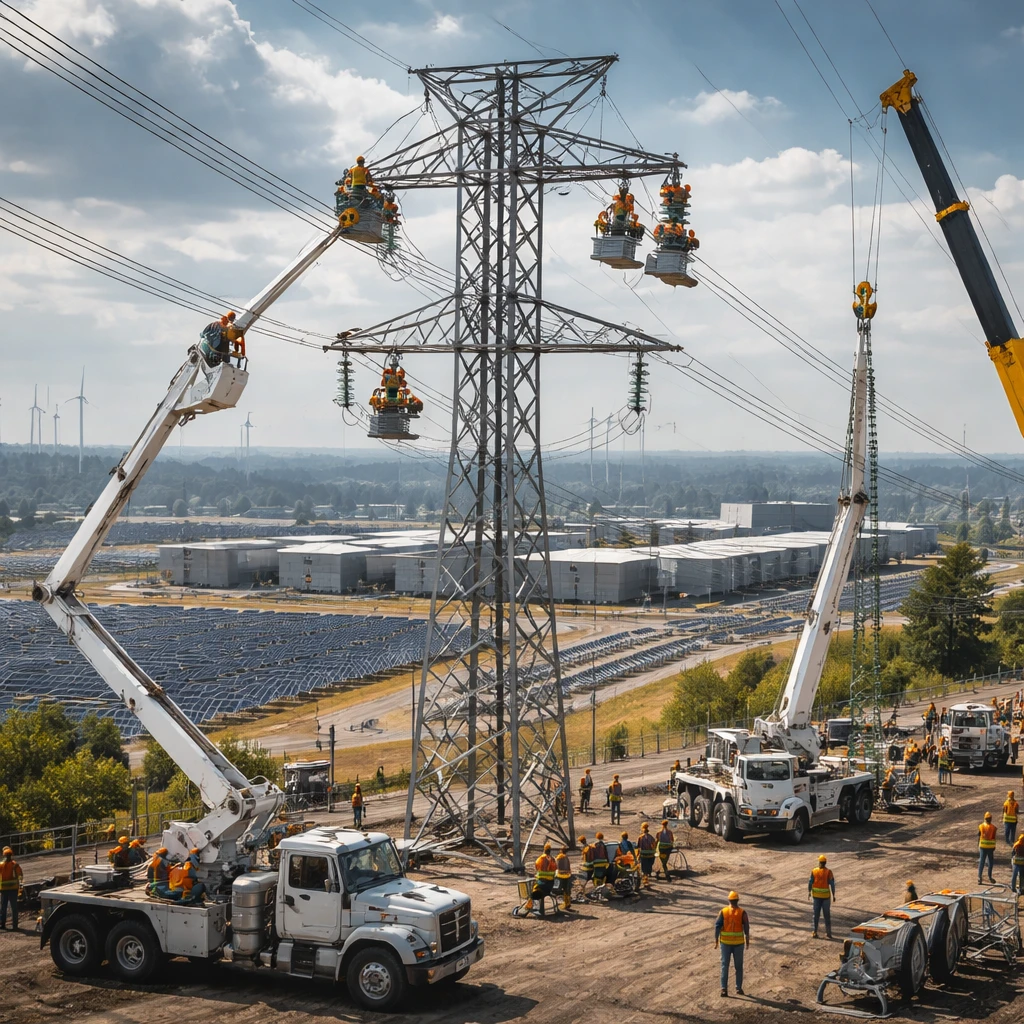
Quanta Services provides specialized infrastructure solutions across Electric Power, Renewable Energy, and Underground & Infrastructure segments. The company builds and maintains high-voltage transmission, distribution networks, renewable interconnections, pipeline and midstream systems, and communications infrastructure. In short, Quanta is the contractor the energy transition and reindustrialization rely on.
Why that matters now: hyperscalers and chip/AI investments are driving a massive build-out of data centers that require reliable, often bespoke, electrical infrastructure. Utilities are replacing aging systems and adding capacity to integrate renewables. Quanta’s backlog (reported in coverage as roughly $44 billion) gives revenue visibility; the company converts a significant portion of that backlog into cash flow over time, and it sits with the operational scale to capture outsized share in large programs.
Key fundamentals and valuation framing
Useable numbers:
- Market cap: approximately $84.48 billion.
- Enterprise value: about $87.70 billion.
- Trailing EPS around $6.87; P/E roughly 80 (snapshot P/E ~80.8).
- Price-to-sales ~2.88; price-to-book ~9.19.
- Free cash flow: $1.517 billion; implied FCF yield ~1.8% (FCF / market cap).
- Return on equity: ~11.5%; debt-to-equity ~0.67.
- Dividend: quarterly cash dividend $0.11 per share ($0.44 annualized) payable 04/10/2026; ex-dividend date 04/02/2026; yield ~0.08%.
The valuation is rich on headline multiples. P/E near 80 and EV/EBITDA around 35 imply the market prices elevated growth and a premium business mix. That premium is defensible if Quanta continues to convert backlog at steady margins and if the data center/utility capex cycle sustains. Two practical valuation frames to keep in mind:
- Absolute: at a market cap of $84.48B and FCF of $1.517B, FCF yield is low (~1.8%). That argues for either multiple expansion via visible margin improvement and higher EPS or for a higher cash conversion rate to justify the stock.
- Relative/strategic: infrastructure providers with dominant scale and differentiated execution often trade at premium multiples because contracts are large, sticky, and create long-duration revenue streams. If Quanta keeps winning large interconnection and data center power projects, the premium is largely structural rather than speculative.
Execution and technical backdrop
Operationally, Quanta has the scale (about 69,500 employees) and execution footprint to handle large, complex programs. Short interest and short-volume metrics show pockets of active trading but not an outsized short base: recent short interest was ~4.44 million shares with days-to-cover under four days. Technical indicators are neutral-to-constructive; 10-day and 20-day SMAs sit around $559-561, while the 50-day SMA is roughly $534, supporting momentum from the pull-up off 52-week lows.
Catalysts (what can move the stock higher)
- Data center and hyperscaler spend - Continued large-scale capital expenditure by hyperscalers creates multi-year demand for high-voltage interconnection and on-site power delivery work.
- Backlog conversion - Regular quarterly execution that converts the reported $44B backlog into revenue and cash at stable or expanding margins will materially de-risk the elevated forward multiple.
- Renewables and transmission programs - Federal and state-level transmission buildouts and renewable interconnection programs provide a steady pipeline of projects that favor scaled vendors.
- Analyst-day clarity - Upcoming investor days and quarterly reports that give longer-term margin targets, book-to-bill detail, or multi-year guidance can catalyze multiple re-rating if guidance beats expectations.
Trade plan - entry, stops, targets, and horizon
Trade stance: constructive long.
| Action | Price | Rationale |
|---|---|---|
| Entry | $560.00 | Near short-term consolidation and just below current trading price to reduce slippage. |
| Stop | $525.00 | Invalidates the constructive setup if price collapses below recent support and 50-day EMA. |
| Target | $650.00 | Reflects roughly 15%+ upside driven by multiple expansion and modest EPS growth over the next 6-9 months. |
Horizon: long term (180 trading days). I expect the trade to play out over several quarters as backlog converts, quarterly results show margin stabilization or improvement, and visible contract wins accumulate. The 180-trading-day horizon gives time for both fundamental execution and market multiple repricing.
Risks and counterarguments
Balanced risk framing is critical. Below are primary downside scenarios and one counterargument to the bullish thesis.
- Execution risk: Large infrastructure projects carry schedule and cost overrun risk. If Quanta misses margins materially while executing big projects, the premium multiple could compress quickly.
- Demand normalization: Hyperscaler capex and data center build-outs could slow or reallocate if macro conditions change. A slowdown in the AI/data center cycle would reduce a key tailwind.
- Valuation sensitivity: With P/E near 80 and EV/EBITDA very high, the stock is vulnerable to multiple contraction if growth or margins disappoint even slightly. This makes near-term downside risk asymmetric relative to upside.
- Capital intensity & working capital: The business model can be capital intensive and cyclical in working-capital needs. Any deterioration in working capital or credit markets would pressure free cash flow conversion and liquidity.
- Counterargument: One can reasonably argue that the current price already prices in most of the good news. P/E in the 80s implies the market expects significant growth and margin improvement; if Quanta merely delivers steady-state performance without meaningful improvement, upside could be limited and the stock could trade sideways or fall.
What would change my mind
I will reassess the bullish stance if any of the following occur:
- Materially missed backlog conversion or guidance that implies persistent margin erosion.
- A significant reduction in hyperscaler or renewable interconnection demand, evidenced by cancellations or sharp reductions in book-to-bill.
- Balance-sheet stress: any meaningful deterioration in liquidity or a rise in leverage beyond current debt-to-equity of ~0.67.
Why this trade, and why now?
Quanta is a structural beneficiary of capital-intensive trends: grid hardening, renewable interconnection, pipeline and midstream work, and the power needs of AI data centers. The company’s backlog, scale, and operating footprint make it a logical consolidator and prime beneficiary of multi-year infrastructure spend. While the multiple is elevated, that premium is not unjustified if execution continues and backlog converts into predictable cash flow.
Practically, the trade buys exposure with a controlled risk point and a time horizon that allows macro and project-level catalysts to unfold. The stop at $525 limits downside if the market decides short-term sentiment matters more than fundamentals; the $650 target reflects a reasonable multiple expansion and EPS improvement over a 180-trading-day window.
Final view
I am upgrading PWR to a buy/constructive recommendation for traders and investors willing to accept a medium level of valuation risk in exchange for participation in a multi-year reindustrialization. The trade is directional long with a 180-trading-day horizon, defined entry at $560.00, stop at $525.00, and target at $650.00. Continued strong backlog conversion, visible wins in data center and renewables work, and solid quarterly execution will validate the upgrade; any sign of rolling demand or execution slippage will prompt a reassessment.
Note: Ex-dividend date for the latest quarterly cash dividend is 04/02/2026 and the payable date is 04/10/2026.