
Hook & thesis
OPAL Fuels is an attractive business on paper: it converts organic waste to renewable natural gas (RNG), sells fuel and power, and operates a vertically integrated model. But the stock is acting like a company struggling to turn a capital-intensive growth story into durable profits. Revenue growth is real, but margins are compressing and free cash flow remains deeply negative. That combination is a tough look for a small-cap energy name in a thin market.
For traders, the path to a win is tactical: the market has already priced a lot of uncertainty into OPAL's shares, leaving limited upside versus defined downside if margins continue to erode or liquidity is tested. My actionable stance is a controlled short position: entry $2.10, target $1.40, stop $2.50, mid-term (45 trading days). The trade leans on weak cash conversion, margin pressure, and a technically fragile chart while keeping risk tightly defined.
What OPAL does and why the market should care
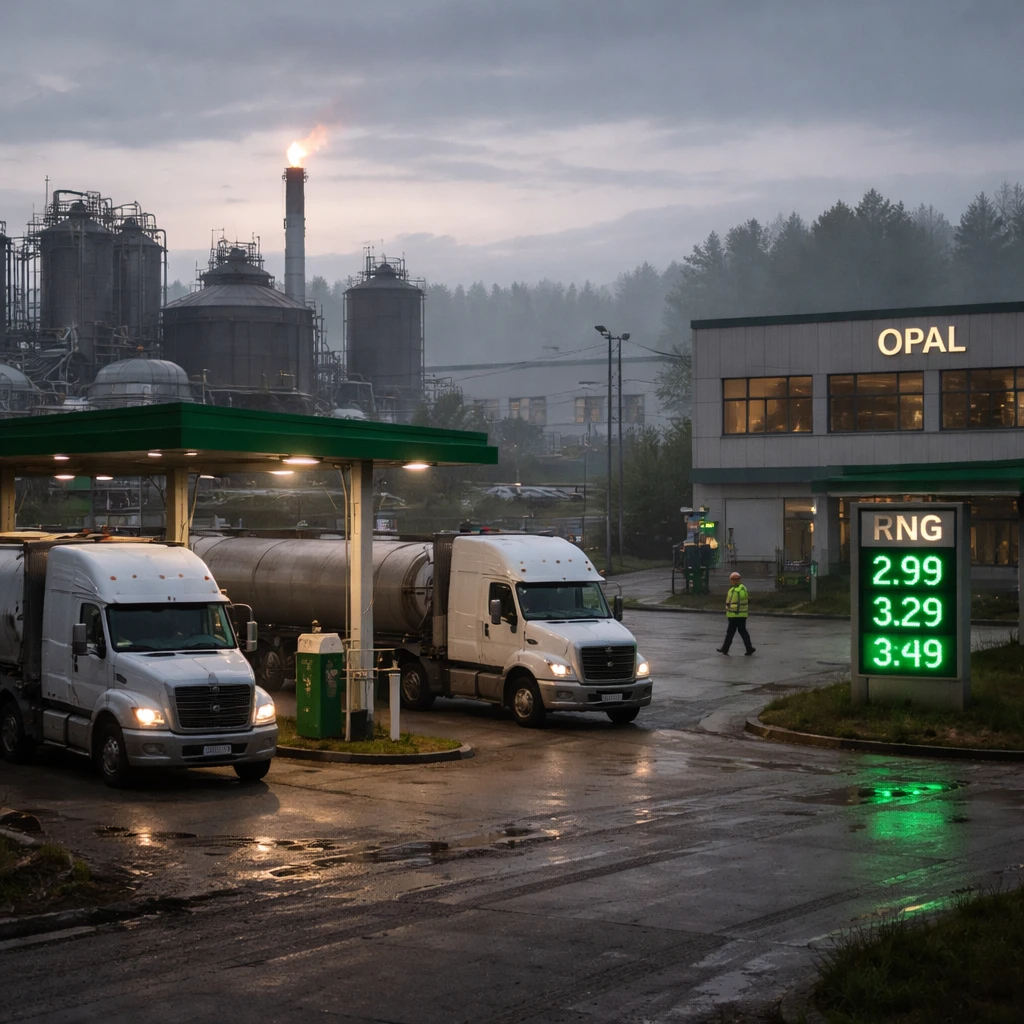
OPAL Fuels produces and distributes low-carbon intensity renewable natural gas under a vertical waste-to-energy model. Its business lines include RNG Fuel (supply and dispensing), Fuel Station Services (construction and maintenance for third-party fueling stations), and Renewable Power sold to utilities. The substrate is attractive: decarbonization policy, fleet fuel switches, and renewable fuels mandates create demand for RNG.
That said, demand alone doesn't guarantee a healthy business. RNG projects require upfront capital, steady feedstock, and favorable pricing of credits/renewable identification numbers. OPAL's recent results and balance sheet metrics show the company is still wrestling with turning scale into consistent free cash flow and improving returns.
Key fundamentals and why they matter
- Revenue and trend: OPAL reported Q2 2025 revenue of $80.5 million (08/08/2025). The company has shown revenue growth year-over-year but that growth has not translated into healthy free cash flow.
- Profitability: Trailing numbers imply an earnings per share around $0.15 and a P/E near 14.1. That P/E masks operating issues: return on equity is deeply negative at roughly -33.1% and return on assets is near 0.45%.
- Cash generation and liquidity: Free cash flow was approximately -$34.24 million, and cash per share is only about $0.23. Current and quick ratios are modest at 1.17 and 1.06 respectively — enough to operate, but not a buffer against large project cost overruns or revenue shocks.
- Valuation snapshot: Market capitalization sits near $366.7 million with enterprise value around $388.0 million. Price-to-sales is low around 0.17, which looks cheap, but that discount is deserved given negative FCF and weak returns.
- Share structure & liquidity: Shares outstanding are about 173.4 million with a reported float of roughly 17.7 million shares. Average volumes are uneven — two-week average volume is listed around 359,865 shares, but there are spikes and thin sessions that can amplify moves.
Technical context (why the timing matters)
The stock is trading around $2.11 (current price $2.115), below the 10-, 20-, and 50-day SMAs (SMA10 $2.241, SMA20 $2.1765, SMA50 $2.2883) and has an RSI near 46.4 — not wildly oversold but below neutral. MACD shows slightly bearish momentum. Those indicators imply limited technical support for a clean breakout right now. The 52-week range is wide: high $4.08, low $1.26, so there is precedent for large swings, but the market has punished the shares previously when fundamentals disappointed.
Valuation framing
At a market cap of $366.7M and EV $388M, OPAL trades at a low EV/sales multiple (~1.11 EV/sales in some metrics) and price-to-sales around 0.17. Those headline multiples can look compelling for growth investors, but they hide a reality: OPAL's free cash flow was negative roughly -$34.24M and ROE is negative. Cheap multiples tied to structural cash burn are not a bargain unless there is a clear path to sustainably positive FCF or margin recovery.
Operationally, OPAL's EV/EBITDA sits near 14.24, which is not a screaming discount. For a small-cap operator in an evolving commodity and regulatory space, the company needs steady project execution and margin stability to justify a re-rating. Absent that, the low price-to-sales is more a reflection of risk than buried value.
Catalysts that could move the stock (2-5)
- Quarterly earnings and guidance (next report): any upward revision to guidance or margin expansion would be an immediate positive catalyst.
- RNG project ramp announcements or commercial contracts that materially improve near-term cash flow.
- Policy changes or credit improvements that raise RNG pricing or increase subsidy flows to project economics.
- Secondary financing or strategic capital that meaningfully strengthens cash on hand and reduces refinancing risk.
Trade plan (actionable)
Thesis: The combination of margin compression reported in mid-2025, ongoing negative free cash flow, and modest liquidity creates downside risk if operational hiccups continue. Technicals are not supportive of a breakout, and the float is small enough to exacerbate moves on any negative news.
Trade: enter a short position at $2.10. Set a hard stop-loss at $2.50 to limit the downside if the name reverts to risk-on. Target $1.40, which leaves room above the 52-week low ($1.26) but captures meaningful downside if margins and cash flow remain pressured.
Horizon: mid term (45 trading days). This horizon gives time for one quarterly report to print or for a material operational update to emerge while avoiding the longer-term policy-driven rerating scenarios. The 45-trading-day window balances the speed of news flow in small-cap energy names with the time it takes for cash-flow signals to appear in the marketplace.
Position sizing & risk management
- Keep any individual position size limited given the stock's volatility and small float; consider sizing so that the $0.40 stop equals no more than 1-2% of portfolio capital.
- Revisit the position ahead of earnings or any corporate financing announcements; tighten stops if the company posts another quarter of deep negative free cash flow or raises capital on dilutive terms.
Risks and counterarguments (at least 4 risks + at least 1 counterargument)
- Policy tailwinds could flip the script. RNG economics are sensitive to subsidies, credits, and renewable fuel policy. A favorable policy move or improved credit pricing could rapidly improve project margins and cash flow.
- Project execution surprises to the upside. OPAL could announce successful ramping of new projects or commercial contracts that materially increase RNG production and improve margins, invalidating the short thesis.
- Short squeeze / low float volatility. Float is ~17.7M shares and short interest is meaningful (roughly 1.58M short as of late February, days to cover near 9). A rapid squeeze or a liquidity-driven rally could force outsized short-covering losses.
- Refinancing or capital injections. Management could secure non-dilutive financing or a strategic investor that shores up the balance sheet and gives the market confidence on liquidity—this would hurt the short trade.
- Broader commodity/market moves. A sudden rally in energy or a risk-on environment for small-cap renewable names could lift OPAL irrespective of near-term fundamentals.
Counterargument to my thesis: OPAL's revenue growth, reported at $80.5M in Q2 2025, and remaining guidance imply the company is scaling RNG volumes. If management can convert top-line growth into steady positive free cash flow through operational leverage or better pricing for RNG credits, the current valuation would look cheap. In that scenario, the right play would be to accumulate on weakness, not short it.
What would change my mind
I would abandon the short if OPAL reports a quarter showing clear margin recovery and positive free cash flow, materially higher cash on hand (enough to fund operations for multiple quarters without dilutive issuance), or announces a strategic capital partner that reduces refinancing risk. Specifically, a swing to positive quarterly free cash flow, or a cash balance that meaningfully exceeds short-term maturities, would force a reassessment.
Conclusion and final framing
OPAL Fuels sits at the intersection of a compelling long-term decarbonization theme and the messy near-term reality of small-cap project execution and capital intensity. The market currently prices the company in between — some optimism on growth but little faith in margins or cash conversion. For disciplined traders, that creates an opportunity: a defined-risk short with clear stop and target levels across a mid-term 45-trading-day horizon.
Enter at $2.10, stop at $2.50, target $1.40. Keep size small, monitor the next earnings release and any financing announcements closely, and be ready to cover quickly if the company demonstrates sustainable margin improvement or secures a material capital infusion.
Key numbers at a glance
| Metric | Value |
|---|---|
| Current price | $2.115 |
| Market cap | $366,730,865 |
| Enterprise value | $388,039,330 |
| Q2 2025 revenue | $80.5M (08/08/2025) |
| Free cash flow | -$34.24M |
| EPS (trailing) | $0.15 |
| P/E | ~14.1 |
| 52-week range | $1.26 - $4.08 |
Trade specifics (repeat)
- Trade direction: Short
- Entry price: $2.10
- Stop loss: $2.50
- Target price: $1.40
- Horizon: mid term (45 trading days)
If you take this trade, size conservatively and be disciplined: OPAL can gap on news or policy, and the float and short interest dynamics can amplify moves. This is a tactical trade against execution and cash-flow risk, not a long-term call on the RNG sector.