
Hook & thesis
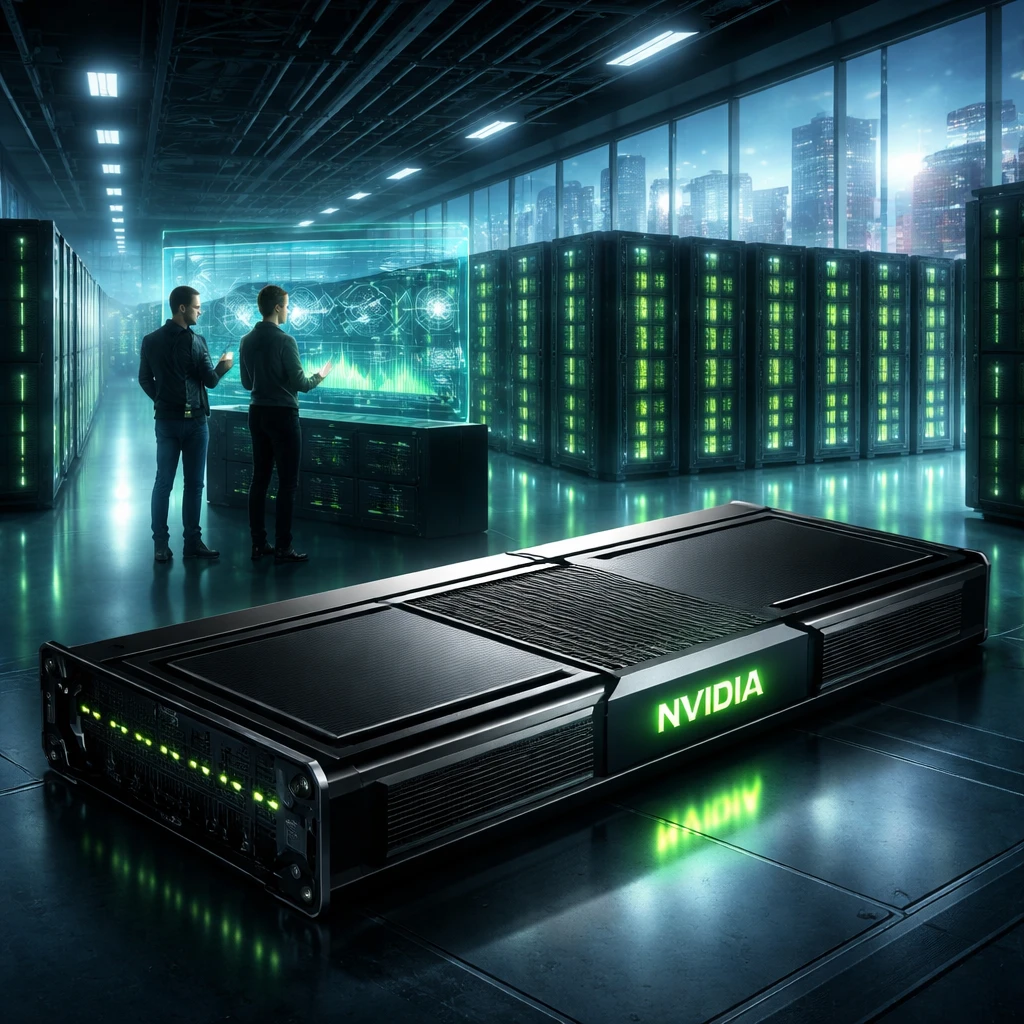
Nvidia is no longer just a semiconductor company - it's become the core supplier for the modern AI stack. Recent data points show the market is rewarding that position: Nvidia trades at $176.42 and the company's market capitalization sits around $4.29 trillion, yet its cash generation and industry dynamics leave room for a much larger valuation if AI infrastructure spending continues to accelerate. The path toward a multi-fold increase in market value is clearer now than it was a year ago, driven by the Blackwell/Rubin generation product cycle, hyperscaler commitments, and expanding software and services revenue.
That doesn't mean investors should buy with open eyes. Valuation is rich - price-to-earnings is roughly 35.6x and price-to-sales is near 19.6x - so the trade here is about disciplined exposure with a defined stop and an actionable target that captures significant upside if the AI investment cycle sustains. The trade plan below is my way to capture Nvidia's upside over a clearly defined long-term window while limiting downside from headline risk or a broad-market drawdown.
What the company does and why the market should care
Nvidia designs GPUs, networking and AI infrastructure that power gaming, graphics, data centers, and nascent software-driven revenue streams such as Omniverse and DGX Cloud. The business runs through two main segments: Graphics and Compute & Networking. The latter is the obvious engine of today's re-rating as accelerated computing becomes a non-negotiable part of AI model training and inference at scale.
Why the market cares: businesses building large language models and foundation models need extreme compute density and specialized hardware. Nvidia's general-purpose GPUs remain the most widely adopted solution in data centers, and the company is layering software, networking (Quantum InfiniBand and Spectrum Ethernet), and cloud services that increase per-customer revenue and stickiness. That combination turns Nvidia from a chip vendor into a platform provider with recurring software-like economics.
Hard numbers backing the thesis
| Metric | Value |
|---|---|
| Current price | $176.42 |
| Market cap | $4,288,467,622,000 |
| PE (trailing) | ~35.6x |
| Price / Sales | ~19.63x |
| Free cash flow (trailing) | $96,676,000,000 |
| Return on equity | ~76.33% |
| Debt to equity | 0.05 |
| 52-week range | $86.62 - $212.19 |
Those figures sketch a company that is massively profitable and cash generative - free cash flow is nearly $97 billion - while carrying very little leverage. High returns on equity and assets show capital is being used efficiently. The valuation multipliers are elevated but not detached when you consider the growth runway for AI infrastructure: industry estimates point to AI infrastructure spending nearly tripling by 2029, which would massively expand the revenue base for a dominant GPU supplier.
Technical & market context
On the technical side, Nvidia is trading around its short-term moving average (SMA 10 ~$173.95), with an RSI of ~45.8 indicating neutral momentum and a MACD that shows slightly bearish momentum. Average daily volume sits around ~185 million shares, and today's volume at ~226 million shares signals above-average participation. Short interest is relatively light versus float with days-to-cover near 1.3—this reduces the risk of a large squeeze but also shows limited naked bearish conviction.
Valuation framing
The market currently values Nvidia at roughly $4.29 trillion. With a PE near 35.6x and price-to-sales near 19.6x, the stock is priced for continued exponential growth in datacenter and AI revenue. That premium can be rationalized in two ways:
- Nvidia captures a disproportionately large share of a dramatically expanding TAM for AI infrastructure. If AI infrastructure spends approach near-$1 trillion levels over the next 3-5 years, absolute revenue multiples could justify a markedly larger market cap even if valuation multiples compress moderately from today.
- Nvidia is expanding beyond chips into software, networking, and cloud services which can carry higher gross margins and recurring revenue characteristics, supporting a higher multiple than legacy hardware peers.
Put differently, the current multiple presumes significant adoption and monetization of AI compute - if that adoption persists, the market cap could expand substantially. If it does not, the multiple becomes the primary risk vector.
Catalysts to watch (2-5)
- Hyperscaler procurement announcements and multi-year commitments to Blackwell/Rubin GPUs - these lock in large, predictable revenue streams and justify a higher multiple.
- Product cycles and supply ramp - sustained production and delivery of next-gen GPUs remove execution risk and allow revenue to scale with demand.
- Software & services monetization progress - growing revenue from DGX Cloud, Omniverse Enterprise and enterprise software improves gross margins and creates recurring revenue.
- Partnerships and investments that shore up the AI stack - recent moves like a $2 billion strategic partnership with Marvell position Nvidia within broader infrastructure roadmaps.
- Macro tailwinds - easing geopolitical tensions, lower Treasury yields and reduced market volatility that favor growth re-rating.
Trade plan - actionable idea
Trade direction: Long
Entry price: $176.42
Target price: $400.00
Stop loss: $150.00
Horizon: long term (180 trading days) - I expect this trade to play out over several product cycles and quarterly results as AI infrastructure spending manifests in hyperscaler bookings and software monetization. The 180-trading-day horizon gives time for supply ramps, contract announcements, and multiple quarterly results to re-rate the stock toward the target.
Rationale: Entry near $176 captures a point where the company still trades well under its 52-week high and in line with shorter-term averages, giving a favorable risk/reward. The $150 stop respects technical support and limits exposure if sentiment reverses or a broader market correction occurs. The $400 target represents an ambitious but reachable re-rating if Nvidia's growth remains intact and software plus services improve margin quality - this would be a multiple expansion plus material revenue upside.
Risk management and position sizing
This is a medium-high risk trade given valuation and macro sensitivity. Use position sizing that limits downside to a predetermined percentage of portfolio capital if the stop is hit; treat this as a core satellite position rather than an all-in conviction. Re-evaluate after each quarterly report, product ramp, or material macro event.
Risks and counterarguments
- Execution risk: supply chain or manufacturing bottlenecks could prevent timely delivery of Blackwell/Rubin GPUs, slowing revenue realization despite demand.
- Valuation compression: the stock is priced for near-perfect outcomes. If growth slows, multiples could compress rapidly, causing large drawdowns.
- Competitive risk: ASIC players and hyperscaler custom chips (Broadcom, Marvell partnerships, or in-house solutions) could take share in custom or lower-margin segments.
- Macro/geopolitical risk: higher rates, recession, or trade restrictions could impair datacenter spending cycles and prolong sales cycles.
- Counterargument - concentration risk in AI narrative: A legitimate counter to my bullish view is that Nvidia's current valuation already embodies most of the AI upside. If competitors close the performance gap or if hyperscalers proliferate custom ASICs at scale, Nvidia's share and pricing power could be materially lower than the market expects. In that case, the stock would likely underperform despite a growing AI market.
What would change my mind
I would reduce the target or flip bias if one or more of the following occurs: missed revenue guidance tied to obvious supply shortfalls; a meaningful, sustained decline in software monetization; or a shift in hyperscaler procurement toward custom ASICs that meaningfully reduces Nvidia's share of datacenter GPU spend. Conversely, a string of multi-quarter beats driven by material software ARR growth or multi-year hyperscaler contracts would strengthen the bull case and justify higher targets.
Conclusion
Nvidia is the prime beneficiary of the AI infrastructure wave. Its financial strength - nearly $97 billion in free cash flow and returns on equity above 75% - gives it the optionality to expand its platform and defend share. That makes a higher market cap more plausible than it was a few years ago. But that upside comes with elevated valuation risk; this trade is about capturing asymmetric gains while locking in protection on the downside.
Recommendation: take a long position at $176.42, use a $150 stop to limit downside, and set a $400 target for the 180-trading-day horizon. Reassess on quarterly results and hyperscaler contract announcements. If the AI spend trajectory remains intact, Nvidia has the balance sheet, product roadmap and customer positioning to materially increase its market cap. If those elements falter, respect the stop and wait for clearer evidence of recovery.
Key near-dated items to watch: hyperscaler procurement headlines, supply/ramp commentary in quarterly earnings, and software monetization metrics in the next two to three quarters (watch for DGX Cloud and Omniverse progress). News items on 04/01/2026 highlighting AI infrastructure spending projections and strategic partnerships reinforce the bullish backdrop but do not remove execution or valuation risk.