
Hook & thesis
Power is AI's most constrained ingredient. Chips and software get headlines, but large-scale AI training runs on racks of GPUs that burn megawatts. IREN has staked its strategy on owning cheap, renewable, grid-connected power and land at scale - and the market is starting to pay for it. With a landmark Microsoft contract, a sizable capital raise to fund GPU deployment, and measurable revenue acceleration, IREN is moving from optionality toward execution.
That said, the stock is not a free call on AI compute. Valuation is rich relative to current cash flows, free cash flow is deeply negative, and execution risk around filling gigawatts of capacity is real. This trade idea buys into the capacity narrative at current prices while giving the company room to prove out deployments. Entry is $38.15, stop loss $32.00, target $50.00 - a swing trade horizon that also leaves room for larger position re-evaluation over a 180 trading-day runway.
What IREN does and why the market should care
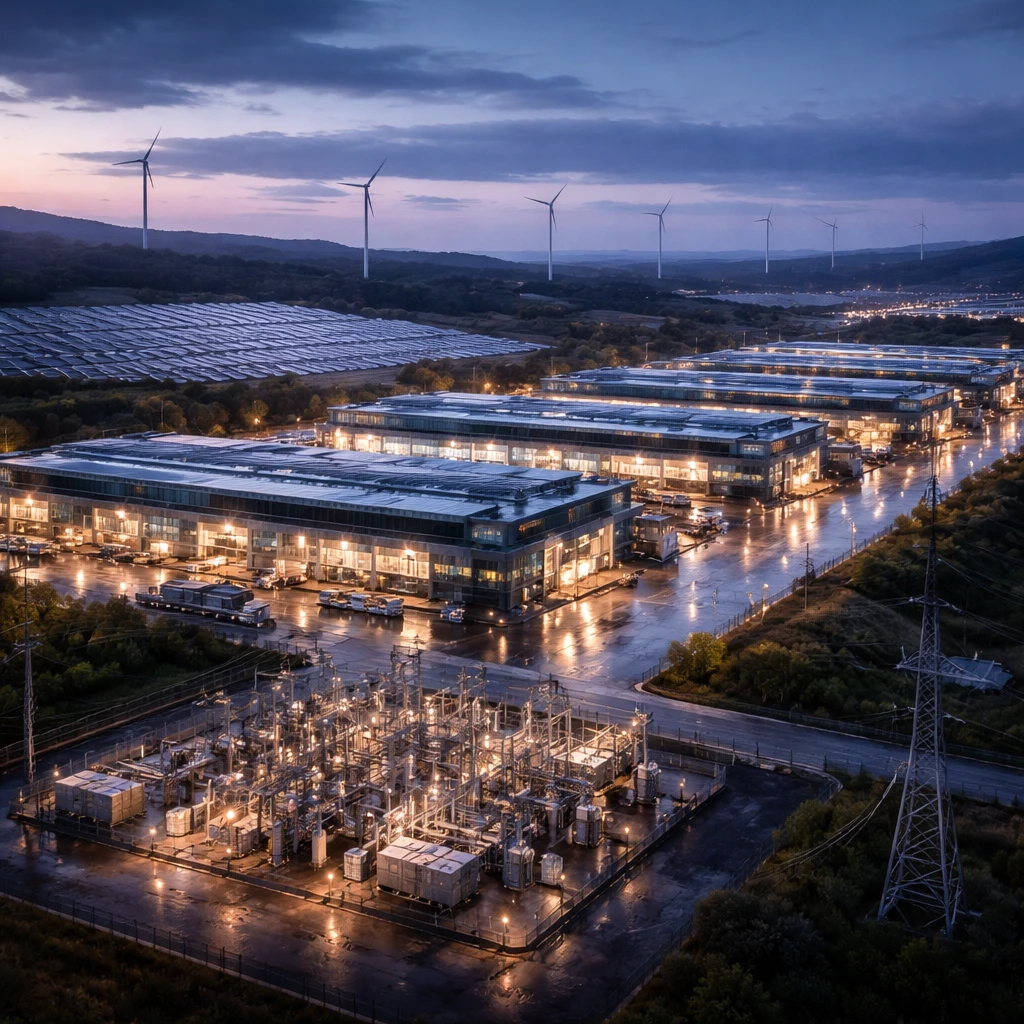
IREN is a vertically integrated data center operator focused on high-power computing - Bitcoin, AI and other power-dense workloads - built in renewable-rich, fiber-connected locations across the US and Canada. It sells GPU compute capacity and custom infrastructure designed for the next generation of power-dense AI clusters. The strategic advantage is physical: large land parcels, grid connections that can be expanded to multi-gigawatt scales, and favorable power economics.
The market cares because AI training demand is ballooning and utility-scale power access is a bottleneck. Hyperscalers and major cloud partners are contracting capacity where they can get both scale and stable power. IREN has already translated that advantage into a headline contract with Microsoft and ongoing purchase interest from other enterprise-level users. When compute demand outstrips local grid headroom, companies with shovel-ready capacity win pricing and market share.
Numbers that matter
- Market cap: about $12.45 billion.
- Current price (trade reference): $38.15.
- 52-week range: low $5.13 - high $76.87.
- Recent Q4 performance (company commentary): revenue grew 59% year-over-year to $184.7 million and adjusted EBITDA was $75.3 million.
- EPS (most recent reported): $0.62 per share. Using reported price anchors, the company trades at roughly a P/E near 60 at prices in the high $30s ($37.45 price implied P/E ~59.9; at $38.15 P/E is ~61.6).
- Enterprise value ~ $13.0 billion, EV/EBITDA ~ 139x (reflecting early-stage EBITDA and aggressive growth capital), EV/Sales ~ 24x.
- Free cash flow is negative and meaningful: about -$1.197 billion (most recent reported), while balance-sheet cash sits at roughly $4.78 per share (per reported metrics).
- Leverage and capital structure: reported debt-to-equity ~ 1.53, indicating meaningful leverage as the company scales capacity.
How to read those numbers
Two things jump out. First, revenue growth is healthy and accelerating from a small base: 59% YoY to $184.7 million in Q4 signals demand for the product. Second, valuation metrics are aggressive. EV/EBITDA near 139x and EV/Sales ~24x reflect a market pricing in materially higher future cash flows tied to fill rates for large-capacity assets. That makes IREN more of an execution story than a value play: the thesis pays off if the company converts pipeline into contracted GPU deployments at attractive margins and keeps financing costs manageable.
Recent catalysts - why the runway is real
- Large cloud contracts: IREN secured a major Microsoft contract to deliver GPU compute capacity, a strategic win that validates its capacity-led model and establishes a base of large-scale demand.
- Capital raise for GPU/data center expansion: Management announced a substantial capital raise to accelerate deployment. The market’s initial reaction was negative on dilution concerns, but the funding reduces the short-term capital squeeze risk and accelerates revenue runway if deployments land.
- MSCI USA inclusion: Being added to the MSCI USA Index on 02/27/2026 increases institutional visibility and can create steady passive flows over subsequent rebalancings.
- Investor conviction trades: Cantor Fitzgerald bought 3.33 million shares (~$172 million), signaling some institutional conviction relative to peers in neo-cloud infrastructure.
Trade plan - precise and actionable
Direction: Long (buy).
Entry price: 38.15
Stop loss: 32.00
Target: 50.00
Horizon: Primary: swing (45 trading days). Secondary: reassess as a position trade out to long term (180 trading days) if deployments and contract backlog materially improve.
Rationale: entry at $38.15 captures the post-dip sentiment after a capital raise and earnings that showed accelerating revenue. The stop at $32 gives roughly -16% downside protection, a level that would likely signal either market rejection of the capacity story or a materially worse financing outcome. The $50 target is achievable if the company books incremental large contracts or shows sequential quarters of rising utilization and positive FCF direction; it also represents a meaningful discount to prior highs ($76.87) while implying ~31% upside from entry.
How to manage: Start with a core-sized allocation appropriate to your risk tolerance (this is a high-risk, high-reward trade). If IREN prints another quarter showing revenue growth and meaningful increases in utilization and GPU bookings, consider adding toward $50 target. If management signals further large dilution beyond the announced raise or if financing costs spike, tighten stops or exit.
Valuation framing - expensive but growth-priced
At roughly $12.45 billion market cap and an enterprise value near $13.0 billion, IREN is priced for outsized future growth. Trailing EV/EBITDA is extremely high (about 139x) because EBITDA is still relatively small versus the asset base and near-term capital spending. EV/Sales around 24x and P/E near 60 reflect a market that expects revenues and margins to expand rapidly as gigawatts of capacity are filled and GPU financing costs remain favorable (management cited sub-6% GPU financing in commentary).
In plain terms: you're paying a premium today for the optionality of multi-gigawatt scale, low-cost renewable power and the ability to convert that into contracted AI compute. If the company converts the Microsoft win into a longer list of hyperscaler and enterprise contracts and demonstrates margin expansion, the multiples could compress from today's levels. If it doesn't, valuation is vulnerable to a large reset.
Catalysts to watch (next 3-9 months)
- Quarterly results that show sequential revenue growth and rising utilization across new campuses.
- Announcements of additional multi-hundred-megawatt or gigawatt-scale customer contracts beyond the Microsoft deal.
- Progress updates on GPU deployments and financing terms - particularly if management secures low-cost GPU financing and shows early positive cash conversion.
- Institutional buying flows following MSCI inclusion or further notable insider/firm purchases.
- Any regulatory or permitting milestones that unlock additional grid capacity at key sites.
Risks and counterarguments
Every high-growth infrastructure story has execution and capital risks. Below are the key ones I’m watching:
- Execution risk - filling capacity: IREN has meaningful gigawatt-scale buildouts. If utilization remains at 10-20% of capacity while the company issues equity or takes on debt to fund growth, dilution and financing costs could erode shareholder value.
- Cash burn and negative free cash flow: FCF was roughly -$1.197 billion recently. Sustained negative FCF increases dependency on capital markets and the terms of financing; a credit market shock or rising rates would hurt.
- Concentration risk: The Microsoft contract is strategic but also concentrates revenue risk. Heavy dependence on a few large customers can leave the company vulnerable if one relationship changes.
- Valuation sensitivity: The shares trade rich—P/E near 60, EV/EBITDA ~139x—so upside requires strong, visible execution. Any miss can compress multiples quickly.
- Market competition and margin pressure: Competitors focused exclusively on GPU cloud and colo can undercut pricing or move faster on product integrations, pressuring margins.
- Grid and permitting risk: Access to utility capacity, transmission upgrades, and local permitting can delay projects and increase capex.
Counterargument
Critics will say you’re paying for future growth that may never arrive. They point to negative free cash flow, high leverage, and the capital raise as evidence the company is still dependent on external finance. That’s fair: if IREN cannot convert pipeline into multi-year contracts that cover capital and operating costs, the valuation is too optimistic. The counter to that view is that IREN already has one very large anchor customer (Microsoft), favorable GPU financing rates under 6% that management has cited, and rapid recent revenue growth (59% YoY to $184.7M), which suggests real demand and unit economics that can scale if deployments proceed as planned.
Conclusion - clear stance and what would change my mind
I rate this a tactical long for disciplined traders. Entry at $38.15 with a $32 stop and $50 target balances the high upside of owning a differentiated power-and-scale play in AI versus the real execution and financing risks. My view would turn negative if any of the following happen: management signals materially worse-than-expected financing terms or additional dilution beyond the announced raise; sequential revenue or booked deployment updates disappoint; a major customer delays or cancels capacity commitments; or free cash flow stays deeply negative with no credible path to improvement.
Conversely, my conviction would ratchet higher if IREN posts consecutive quarters of strong sequential utilization increases, signs more multi-hundred-megawatt contracts, and demonstrates a clear path to positive free cash flow. For traders, this is a binary, news-driven setup: either the company proves the capacity model at scale and the multiples get justified, or valuation compresses hard. The trade plan above lets you buy that binary with a defined risk and a clear catalyst checklist.
Key points
- IREN owns large, renewable-rich, grid-connected sites that are strategically valuable for AI GPU farms.
- Q4 revenue accelerated 59% YoY to $184.7M with $75.3M adjusted EBITDA, validating early traction.
- Valuation is aggressive - EV/EBITDA ~139x, P/E near 60 - so success hinges on deployment execution and financing.
- Trade plan: long at $38.15, stop $32.00, target $50.00, primary horizon swing (45 trading days), reassess for long-term hold to 180 trading days as execution proves out.