
Hook & thesis
HP Inc. is offering a compelling priced entry right now: shares are near cycle lows at $19.80, yield a healthy 5.9%, and trade at a cheap P/E of about 7.2. Management has been an active capital allocator — dividend + buybacks — and cash generation remains robust with $2.8 billion in free cash flow. That combination qualifies HP as a classic 'share-cannibal' value play: the business is mature, cash-generative and shrinking its float, which can support per-share upside even absent dramatic top-line acceleration.
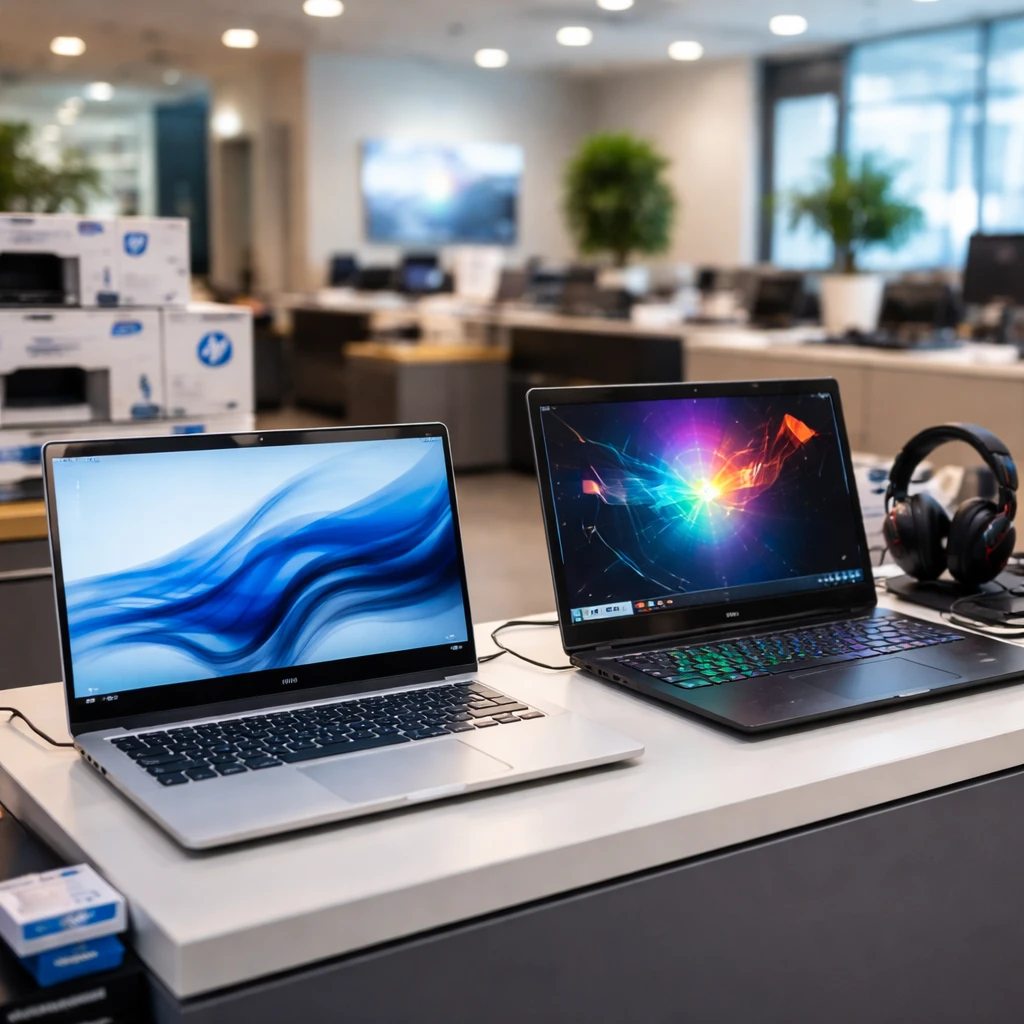
My trade thesis is simple: buy HP for a mid-term rebound as investors re-rate a low-multiple, high-yielding name and as product refreshes (including AI-capable EliteBooks and refreshed gaming/HyperX lines) provide incremental demand. Entry at $19.80, target $24.00, stop loss $18.50 — horizon mid term (45 trading days).
Why the market should care - the business in one paragraph
HP is a hardware-first information technology company that sells personal systems (commercial and consumer PCs, workstations, thin clients) and a printing business (printers, supplies, services). It remains a major OEM in PCs and printers globally with roughly 55,000 employees. The business is mature but steady: solid free cash flow, recurring consumables revenue from printing, and an installed base that makes recurring revenue less volatile than pure-cycle hardware peers.
The fundamental driver for this trade
The trade hinges on three concrete, observable dynamics: valuation, cash return to shareholders, and product refresh cadence. Valuation is straightforward: market capitalization sits around $18.2 billion with an enterprise value of roughly $24.1 billion, yet earnings-per-share are comfortably positive at $2.75 (last twelve months), implying a P/E near 7.2. Free cash flow last reported at $2.8 billion supports an elevated dividend and aggressive buybacks; HP recently declared a $0.30/share dividend payable 04/01/2026 with record date 03/11/2026 (declared 01/27/2026). Meanwhile, new EliteBook X G2 series and refreshed HyperX/OMEN products unveiled at CES 01/05/2026 are timely product catalysts for notebook and gaming demand into spring.
Concrete numbers that support the setup
| Metric | Value |
|---|---|
| Current price | $19.80 |
| Market cap | $18.18B |
| Enterprise value | $24.15B |
| P/E | ~7.2 |
| Free cash flow | $2.8B |
| Dividend (recent) | $0.30 per share (payable 04/01/2026; ex-dividend 03/11/2026) |
| 52-week range | $18.94 - $35.28 |
| Average daily volume (30d) | ~18.3M |
Valuation framing
At about a $18.2B market cap and $24.1B EV, HP's multiples are compressed: price-to-sales sits near 0.33 and price-to-free-cash-flow around 6.5. Those are value-like metrics for a company that still generates recurring consumables revenue in printing and has sustained product refresh cycles in PCs. The P/E of ~7.2 implies little optimism priced in — the market is assigning modest growth and/or margin stability. Historically large buybacks and the current dividend mean even a stable operating profile can translate into outsized per-share returns as the float contracts.
If you view HP as a capital-return story more than a high-growth platform, the current mix of yield, FCF and buyback activity justifies a higher multiple than today's depressed reading. A modest re-rating to the mid-teens on P/E or a rebound to the 50-day moving average (~$22.57) would put shares well above current levels; my $24 target assumes partial multiple expansion plus modest EPS stability through the spring buying season.
Technical & sentiment context
Technically, HP sits near its 52-week low ($18.94) and the 10-day SMA is $19.51 while the 50-day SMA is $22.57 — meaning the stock has room to snap back toward mean levels. RSI is ~36, indicating near-oversold conditions without extreme readings. Short interest has trended up, with about 85 million shares short as of 01/15/2026 and short-volume data showing significant daily shorting in late January and early February; that creates asymmetric upside if a tangible fundamental or technical catalyst forces covering.
Catalysts (2-5)
- Dividend and buyback cadence - continued shareholder returns and a declared $0.30 dividend payable 04/01/2026 keep the yield attractive and encourage buy-side interest.
- Product refresh adoption - availability and early reviews for the EliteBook X G2 series and HyperX/OMEN refreshes (announced 01/05/2026) may lift notebook and gaming revenue in upcoming quarters.
- Consumables resilience - printing supplies and services revenue often acts as ballast in down PC cycles; any stabilization here reduces earnings risk.
- Short-covering squeeze - rising short interest combined with heavy retail volume could accelerate a technical bounce if price moves above the near-term resistance around $20.50-$21.50.
Trade plan (actionable)
Entry: Buy at $19.80.
Stop loss: $18.50 (below the late-January low to avoid noise; protects capital if the downtrend extends).
Target: $24.00.
Size & risk: Position size should align so the $1.30 per-share downside to the stop represents a defined portion of portfolio risk (e.g., 1-2% of capital).
Horizon: mid term (45 trading days) - that window allows enough time for post-CES product availability buzz and the March ex-dividend record date to work through investor flows, while keeping the trade focused on a tactical rebound rather than a multi-quarter macro recovery.
Why these levels? $24 is a pragmatic target: it's above the 50-day SMA (~$22.57), allows for some multiple re-rating from single-digit P/E toward a low-teens multiple, and captures upside from yield-seeking flows and potential short-covering. The $18.50 stop is intentionally below the 01/29/2026 low ($18.94) to reduce whipsaw and respect the near-term downside structure.
Risks (balanced) and a counterargument
- Macro-driven PC demand collapse - the core Personal Systems business remains cyclical. A deeper-than-expected enterprise or consumer PC downturn would pressure revenue and margins and could drive the stock below the recent low.
- Print segment deterioration - while consumables are a strength, continued secular declines in printing volumes or pricing pressure could reduce FCF and make buybacks unsustainable.
- Capital allocation mis-steps - aggressive buybacks can accelerate EPS in the near term but leave less flexibility for R&D or market share defense. If management prioritizes buybacks over necessary investments, longer-term competitiveness may erode.
- Execution on product refresh - the EliteBook X G2 and HyperX consolidations are potential catalysts, but poor market reception or delays would remove that upside and keep the multiple depressed.
- Counterargument: This is a value trap - the market may be pricing in structural weakness (declining print volumes, commodity-driven PC margins, or shifting compute consumption). In that scenario, buybacks and dividends only paper over a deteriorating business and EPS could fall, leaving a low P/E justified and shares lower.
What would change my mind
I will reduce the conviction or flip to neutral/short if any of the following occur: the company signals a material downward revision to revenue or margins for the upcoming quarter; free cash flow falls materially from the reported $2.8 billion figure without a clear temporary cause; management pauses buybacks or cuts the dividend; or the stock decisively breaks below $18.00 on heavy volume, indicating broader market rejection rather than a tactical oversold bounce.
Bottom line: HP is a pragmatic, cash-rich hardware name trading at depressed multiples with an attractive yield and shrinking float. That combination supports a defined-risk long trade into the spring, with an upside target that is reachable if products and cash returns perform as expected.
Execution checklist before entry
- Confirm trade-sized fills near $19.80 and that average daily liquidity supports intended position sizing (30-day avg vol ~18.3M shares).
- Set automatic stop at $18.50 and pre-declare position size relative to portfolio risk tolerance.
- Monitor short-volume prints and next two earnings / quarterly commentary for any signs of demand deterioration.
Final words
This is a mid-term, defined-risk trade rooted in cheap earnings, strong free cash flow ($2.8B), and active capital returns. It favors investors who want a value-yield exposure with clear downside protection and a roughly 45-trading-day horizon to allow time for catalysts to unfold. The thesis is straightforward: the market has over-penalized a cash-generative, dividend-paying company — if that view shifts even modestly, HP has room to recover into the mid-$20s.